The Trap of Cross-Cultural Marriage
 Dr. Abdulqawi Al-Qadasi · 3 min read
Translated from the Arabic. Read the original (العربية)
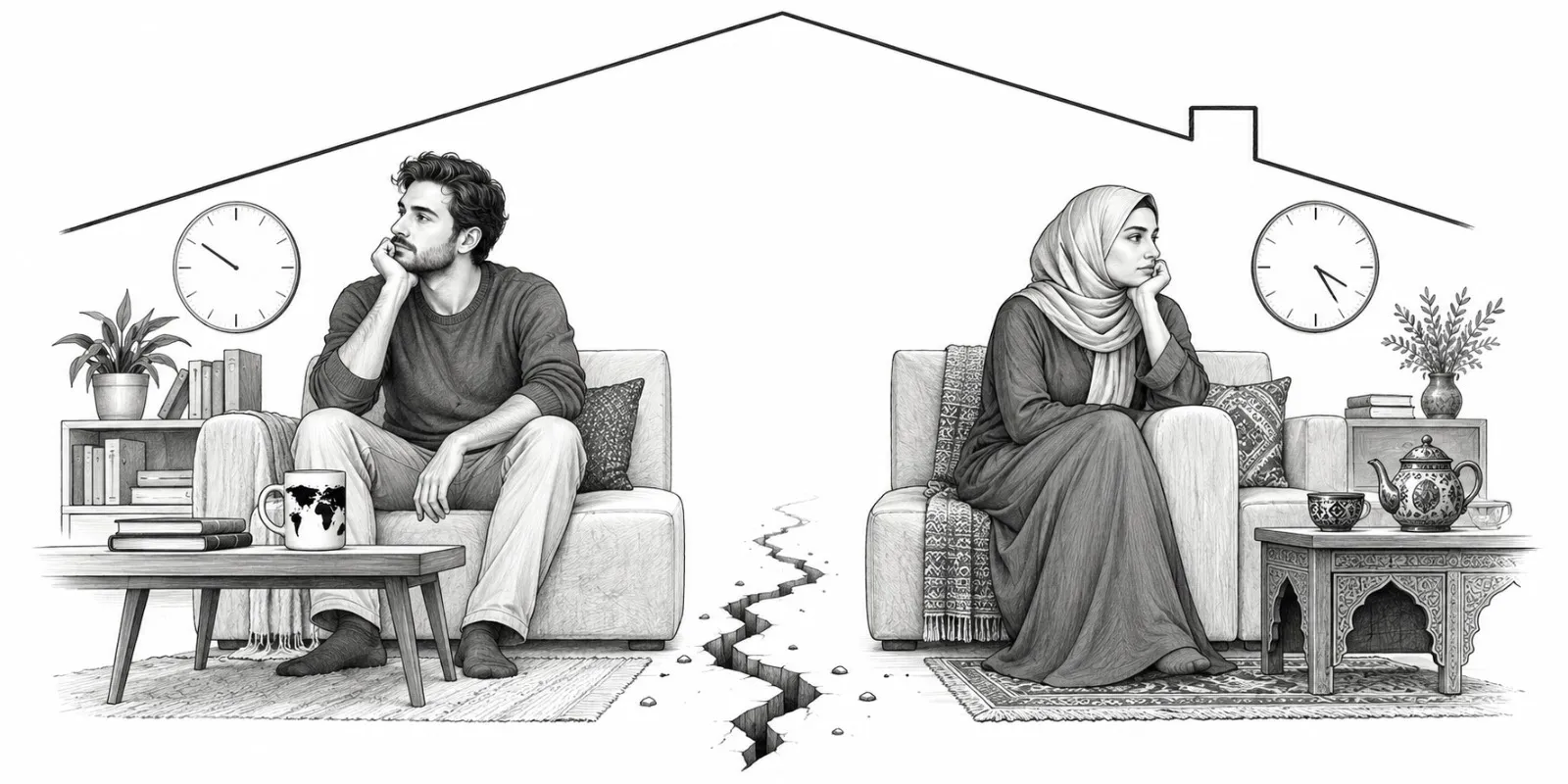
Affection may bring together two people from different cultures, and they may suppose that the sincerity of their feelings is enough to dissolve the differences and overcome every obstacle. But marriage does not take place in the realm of emotion alone. It is a daily life in which values, customs, expectations, ways of thinking, the management of money, the upbringing of children and the relationship with two families all meet.
Abdulqader told me of a marriage whose effects still pain him. He had married a woman from a different culture, believing that the love that joined them would prove stronger than everything that set them apart. But the picture changed after the wedding; he discovered that emotional closeness does not necessarily mean agreement on the details of life.
He did not feel that he was living the married life he had imagined. It seemed to him that they merely shared a dwelling, while each lived in a world of their own. His wife's priorities, her way of life and her way of running the household differed from what he had grown up with, and she, for her part, looked at life through another environment and other conceptions.
Their disagreements were not always over great matters. They began with small details that repeated every day: how money was spent, how the house was kept, the limits of privacy, the relationship with relatives, how to show care, and what each expected of the other. In time these details accumulated and became a constant source of exhaustion and estrangement, until affection weakened and the journey ended in a painful separation, a departure he was forced to make, and the loss of custody of his daughter.
This experience shows that a cross-cultural marriage is not doomed to fail. Many such marriages succeed and are rich in diversity and complementarity. But their success demands greater awareness and deeper preparation, because here marriage joins not just two people but brings two worlds close together, worlds that may differ in things that do not show clearly during the period of courtship.
Each side may suppose that their own way of life is natural and needs no explanation, because it is familiar in their family and society. Then, after the marriage, they discover that the other holds exactly the same view of their own customs. From there the disagreement is no longer about the act alone, but about the meaning each side gives to that act. What one takes to be care, the other may take to be interference; what one counts as independence, the other may read as coldness; what one sees as respect for the family, the other may see as an intrusion on the couple's privacy.
For this reason, those preparing for marriage should not content themselves with asking how much they love one another. They should also ask whether they are able to build a shared life. How will disagreements be managed? Where will they live? What are the limits of the two families' involvement? How will they handle money? On what values will the children be brought up? Which language will prevail in the home? And what will they do when customs conflict with the convictions of one of them, or with the interest of the family?
Wisdom does not mean that a person should look for someone who resembles him in everything; that is unrealistic even among people of the same culture. It means looking for someone with whom he can build common ground, learning the differences before marriage, and telling apart what can be settled by understanding from what is hard to give up.
Cultural difference can be a source of richness when it is accompanied by awareness, respect and flexibility, but it can become a burden when emotion is left to conceal it, or when talk of it is postponed until after the wedding. Frank questions before commitment are no insult to love; they protect it from shocks that could have been foreseen.
When Abdulqader looked back on his experience, he said quietly:
“Had I understood this before my marriage, I would have asked myself more questions before answering with a single word.”
─── ◆ ───
Emotion may open the door to marriage, but by itself it does not build a home. Stability grows when affection meets agreement in values, when expectations draw closer, and when each partner learns to understand the other's world before asking the other to understand theirs.
From the book Khalf Sitar al-Ta'addud [Behind the Veil of Polygyny]
Dr. Abdulqawi Al-Qadasi
Related service: Pre-marriage counselling
Questions people hesitate to ask
Is marrying someone from a different culture doomed to fail?
No. Many such marriages succeed and are rich in diversity and complementarity. But success needs greater awareness and deeper preparation, because the marriage brings together two worlds that may differ in ways not clearly visible during the getting-to-know-you stage. Difference becomes a richness when it comes with awareness, respect and flexibility.
What questions should you ask before marrying someone from another culture?
Asking how much you love each other is not enough. Ask how disagreements will be handled, where you will live, how far each family may intervene, how money will be managed, what values the children will be raised on, which language the home will use, and what you will do when customs clash with one partner's convictions or the family's interest.
Share your thoughts
Have you been through something like this, or has a question come to mind? Write it here. Your words may help another reader.
No comments yet. Be the first to start the conversation.