The Family… The Law of Fitrah
 Dr. Abdulqawi Al-Qadasi · 9 min read
Translated from the Arabic. Read the original (العربية)
Insights from nature and the earliest human societies
However much the forms of life differ, one scene keeps repeating around us: a shelter is prepared, offspring are born, and the young need care and protection until they are strong enough to face life. We see this scene in many guises in the world of living creatures, and then in a nobler and deeper form in human life, where the shelter becomes a home, attachment becomes a covenant, care becomes responsibility, and belonging to a family becomes part of a person’s identity, memory and future.
Here a question arises that deserves reflection: is the family merely a social arrangement that human beings devised at some stage of their history, or is it a response to a deeper need, rooted in their fitrah (innate human nature)?
Before civilisation… there was a home
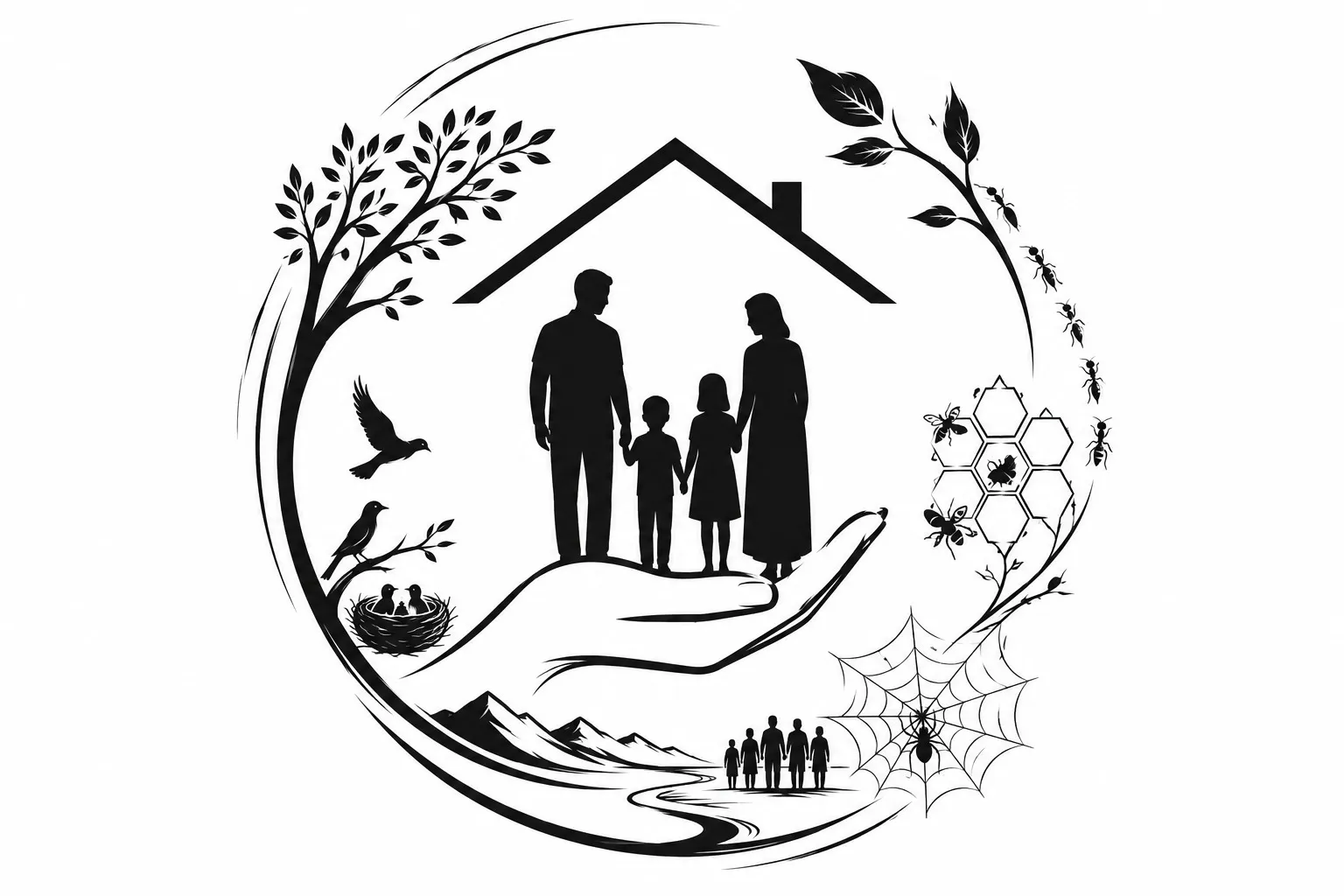
When a person looks closely at nature, he finds that the care of offspring did not begin with cities, and did not wait for law, school and state to appear. Birds build their nests, and many creatures prepare an environment that protects their young, feeds them, and stays beside them until they are better able to stand on their own.
This does not mean that the human family is a copy of the lives of other creatures. The human being is honoured with reason and charged with the divine law, and his family rests on meanings of affection, mercy, loyalty and responsibility that cannot be reduced to biological behaviour. These scenes simply reveal an elementary and important meaning: that the inclination to preserve offspring, to care for them and to build the environment that holds them is older than the institutions human beings created to organise their lives.
When Islam came, it did not present the family as a mere economic or social arrangement. It tied the marital relationship to tranquillity (sakan), affection and mercy, as God Almighty says: “And of His signs is that He created for you from yourselves mates that you may find tranquility in them; and He placed between you affection and mercy” [Ar-Rum: 21].
What does nature tell us?
Nature does not offer a single model of social life. Some creatures live alone, some in small groups, while other species have developed highly complex social systems.
The societies of bees and ants offer a striking example. Their colonies rest on a division of labour, an exchange of information, an organisation of tasks, and forms of behaviour and decision-making at the level of the group. These phenomena have become a wide field of study in the sciences of animal behaviour and collective organisation.[1]
The point is not that human beings should take bees or ants as a model for their families; the difference between human society and those societies is fundamental. But nature sets before us a meaning worth pondering: that gathering together does not by itself create a strong entity; it needs orderly relationships, complementary functions, and individuals cooperating to preserve the entity that unites them.
This meaning comes close to the reality of the family. A home is not a set of people living under one roof; it is a network of relationships, rights, responsibilities and feelings that turns that gathering into a “family”.
When the thread is strong… and the house is frail
The Noble Qur'an draws our attention to another, highly expressive image, saying:
“The example of those who take allies other than Allah is like that of the spider who takes [i.e., constructs] a home. And indeed, the weakest of homes is the home of the spider…” [Al-Ankabut: 41].
The Qur'anic context is clear: it coins a parable for the frailty of relying on anything other than God. Yet the choice of a “home” in this image opens a beautiful space for reflection, especially in light of what modern science has uncovered about spider silk.
Scientific studies describe spider silk as one of the biological materials with exceptional mechanical properties: some species combine tensile strength, elasticity and toughness to a remarkable degree, which is why it has become a subject of interest in materials science and biological engineering.[2]
And here a wonderful paradox appears: the thread may be strong, and yet the house is described as frail.
We should not load the verse with more than it bears, or turn it into a statement of materials science or zoology; the Qur'an here offers a parable of belief whose meaning is plain. But the image gives us a profoundly human lesson: the strength of a home does not lie in the material it is built from alone.
A house may be magnificent, its furniture luxurious, its comforts complete, and still be brittle within. Conversely, a dwelling may be modest, yet the affection that gathers its people, the trust that governs their relationships, and the responsibility each member carries make it a home of greater strength and stability.
Houses are not made strong by cement alone, but by the relationships that dwell inside the cement.
The family before the state
If we move from nature to human history, the picture becomes clearer. Human beings knew the family before they knew the modern state, ministries, schools and social security systems. Across different societies the family was the first frame that received the child, gave him his belonging, taught him language, values and relationships, and joined the generation that came before him to the one that would come after.
One of the best-known comparative anthropological attempts in this field is the study by the American anthropologist George Peter Murdock, who examined some 250 societies and concluded that the family performs a set of recurring basic functions, relating to the regulation of sexual relations, reproduction, socialisation and education, and economic cooperation.[3] Contemporary sociological references, when presenting Murdock’s work, note that the variety of family forms across cultures did not prevent the family from standing out as one of the most widespread social phenomena.[4]
This does not mean that the family appeared in a single fixed form in every society. Extended and nuclear families, systems of kinship and residence, and the roles of family members have differed greatly across cultures and eras. Indeed, contemporary sociology itself affirms this diversity in how the family is defined, in its forms and in its functions.[5]
Yet behind this diversity lies a fact that is hard to ignore: a human being does not begin life as an independent individual in a vacuum.
He is born helpless, in need of someone to look after him, protect him, feed him and teach him. In human society this biological fact becomes a social and moral bond: there is one who cares, one who belongs, one who bears responsibility, and one who carries the memory of one generation to the next.
For this reason the family was never merely a form of shared housing. Throughout history it has been one of the most important environments in which social upbringing takes place, where the child learns his first notions of language, values, identity and belonging.[4]
Has the need for the family come to an end?
With the rise of the modern state, many of the family’s functions changed. The school took over a large part of teaching, the hospital took over part of healthcare, the state set up systems of protection and social security, and the market supplied services and goods that the family once largely produced for itself.
Here a modern question arises: if society’s institutions can now do much of what the family once did, does the family remain a necessity?
The question seems convincing if we reduce the family to its functions alone.
But what if the family is deeper than its functions?
The way people obtain water has changed thousands of times, yet they have not done without water. The means of communication have changed, yet they have not done without the need to communicate. Medicine has advanced, yet it has not abolished the need for health.
Means change; but the original needs need not disappear because the means have changed.
So it is with the family.
A school can teach a child mathematics and science, but it cannot be his father and mother. The state can grant him a financial allowance, but it cannot, by administrative decree, give him a family history, childhood memories and an enduring emotional bond across the generations. Care institutions can provide great and necessary services, but they do not make the institution an exact substitute for the home.
For this reason sociology regards the family as an institution whose roles go beyond material support to physical, emotional and social care, to upbringing, and to the continuity of ties between generations.[5]
The family does not offer a person “services” alone; it gives him something that is hard to put into an economic table: belonging.
The fitrah that modernity does not cancel
And here we reach the heart of the matter.
To say that the family is rooted in fitrah does not mean that every form families have taken through history was sound, nor that every family custom should be defended, nor that the shape of family life is immune to the influence of economics, culture and law. Nor does it mean that ancient societies should become a rigid model for modern ones.
The fitrah is one thing; the historical forms that take shape around it are another.
That is why the family can develop without losing its essence, just as a house can change its architecture without losing the meaning of shelter.
The Qur'an places the concept of fitrah in a wider frame when it says: “So direct your face [i.e., self] toward the religion, inclining to truth. [Adhere to] the fitrah of Allah upon which He has created [all] people. No change should there be in the creation of Allah” [Ar-Rum: 30].
From this perspective, the task of civilisation is not to free the human being from the family, but to help the family carry out its mission in new circumstances. Progress does not lie in replacing the home with the state, but in building a state that protects the home, remedies its imbalances and supports it when it falters, without imagining that law alone can accomplish what affection, mercy and belonging accomplish.
The world around the family has changed thousands of times, yet the child is still born in need of someone to care for him, the human being still searches for someone to find tranquillity in, and the elder still needs someone beside whom he feels he belongs to a story larger than his individual life.
Empires have changed, economic systems have shifted, cities have developed, and the means of livelihood have altered, and the family has remained present.
The family is not merely an institution we inherited from the past; it is one of the stories that begin anew with the human being in every generation.
But the family’s survival does not mean that its form has remained one and the same through history. The size of families, the roles of their members, patterns of marriage and ties of kinship have all changed, shaped by agriculture, the city, industry, and economic and social transformation.
From here our discussion leads to the question of the next article: how did the family take shape through history? What changed in its form, and what remained constant in its essence?
References
[1] Feinerman, Ofer, and Amos Korman. “Individual versus Collective Cognition in Social Insects: From the Behaviour of Individuals to the Adaptive Behaviour of the Colony.” Frontiers in Robotics and AI, 2017. The paper discusses the mechanisms of organisation, collective behaviour and decision-making in societies of social insects.
[2] Yarger, Jeffery L., Brian R. Cherry, and Arjan van der Vaart. “Uncovering the Structure–Function Relationship in Spider Silk.” Nature Reviews Materials, vol. 3, 2018, article 18008. A review study of the properties of spider silk, its molecular structure, and their relationship to its mechanical properties.
[3] Murdock, George Peter. Social Structure. New York: Macmillan, 1949.
[4] OpenStax. Introduction to Sociology, 3rd ed., Chapter 14: “Marriage and Family,” especially the section “Variations in Family Life.” The book presents Murdock’s study of some 250 societies and the four functions he identified for the family: sexual, reproductive, educational/socialising, and economic.
[5] OpenStax. Introduction to Sociology, 3rd ed., section “What Are Marriage and Family?” It presents the sociological definitions of the family, the diversity of its forms, and its roles in physical, emotional and social care, socialisation, and relations between generations.
Questions people hesitate to ask
Is the family innate or just a social arrangement?
The article holds that the family answers a deeper need rooted in human nature: caring for offspring is older than cities and law, and a person is born helpless. The variety of family forms across cultures does not negate its essence; innate nature is one thing, the historical forms around it another.
Can the state and the school replace the family?
A school can teach a child, the state can give financial aid, and care institutions can provide vital services, but none can be the child's father and mother or give a family history and belonging. Means change while core needs remain; the state's task is to protect and support the home, not replace it.
Share your thoughts
Have you been through something like this, or has a question come to mind? Write it here. Your words may help another reader.
No comments yet. Be the first to start the conversation.