The Classroom as a Space for Upbringing
 Dr. Abdulqawi Al-Qadasi · 6 min read
Translated from the Arabic. Read the original (العربية)
What happens during a lesson is no less important than what is taught in it
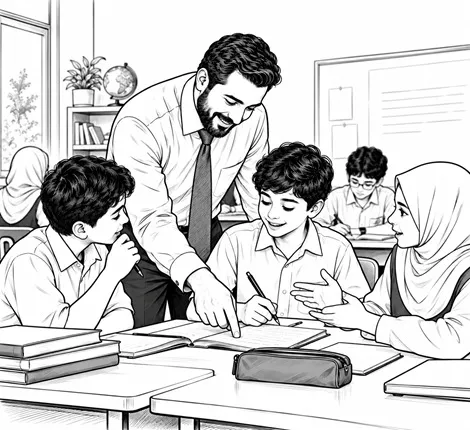
The teacher enters the classroom with a lesson in mind that must be completed within a set time. He explains, asks questions, listens to the answers, asks the students to carry out an activity, and then moves on to assessment. Meanwhile, apparently small incidents occur: one student interrupts a classmate; another makes a mistake and some of the students laugh; a third monopolises the work in his group; and another hesitates to give his opinion for fear of mockery. These incidents are not outside the lesson; they are part of the life the students live while they learn, and they hold opportunities for upbringing that need no separate class period.
The classroom is not only a place for receiving knowledge, but a space in which the student practises, every day, listening, waiting his turn, cooperating, disagreeing, taking responsibility, and respecting time and the rights of others. For this reason, the way a lesson is run can contribute to upbringing in a measure that merely talking about these values never achieves.
In a group activity, for example, a teacher may seat four students around a table to solve a task, only to find that one student does all the work while the rest simply watch. The team may in the end arrive at a correct answer, but something important has not happened: they have not learned to work together. When the teacher distributes responsibilities, gives each student a real role, and then holds the group accountable for the product and each individual for his contribution, the learning task itself becomes training in cooperation and responsibility.
In another situation, two students differ over an answer, and one says to the other dismissively: “You don’t understand.” The teacher can announce the correct answer and end the discussion, but he can also stop the insult and ask each of them to explain his argument, and to listen to the other before replying. The lesson has not turned into a lesson in ethics, and we have not paused long over the subject matter; yet the student has practised, in a real situation, how to disagree without demeaning.
A mistake itself carries an opportunity for upbringing. In some classrooms students learn quickly that a wrong answer may bring laughter or a hurtful remark, and many of them choose silence. But when the teacher treats a mistake as a natural part of learning, and says to the student, for example, “Show me how you arrived at this answer,” he is not only correcting the information, he is nurturing the courage to try, the acceptance of correction, and the refusal to let stumbling turn into a fear of taking part.
Our educational heritage took care over how the learner is treated in the scholar’s gathering. Ibn Jama‘ah spoke of the scholar’s gentleness with his students, patience with the limits of their understanding, kindness in addressing them, and consideration of their circumstances. How these meanings are applied differs with the time and organisation of the school, but their root is still present: the way knowledge is presented is part of the educational impact the teacher leaves on the learner.[1]
Upbringing also appears inside the classroom in fairness of opportunity. In every class there are students quick to answer who raise their hands before the teacher has finished his question, and others who need longer to think. If participation always belongs to the fastest and boldest, the lesson may, unintentionally, become a space in which some students take the lead and others disappear. Varying the chances to answer, allowing time to think, and involving those who do not normally volunteer teaches the student that every individual has a place and a voice, without implying an artificial equality between levels of performance.
The subject itself can carry opportunities for upbringing, without loading it with what is not in it. In science, the student records the result of an experiment as it appeared even if it contradicts his expectation; here he practises scientific honesty. In language, he listens to a different interpretation of a text and discusses it, training himself in dialogue. In mathematics, he faces a problem he cannot solve on the first attempt, and learns perseverance. In art, he respects the work of his classmates, and in an oral presentation he learns to listen to the one who is speaking. We are not adding a lesson in values to the subject here; we are drawing on the very nature of learning.
Even homework and projects can go beyond the grade. A student is assigned part of a group project and does not complete it, so his classmates’ work is delayed. The result could be a two-mark deduction and that is the end of it; or we could add his responsibility to repair what he has caused: he completes the missing part, or helps the team make up the time. Then the grade alone is not the consequence of the shortcoming, and the student learns that his decisions may affect others and that he must deal with their impact.
Cooperative learning methods offer a clear example of education and upbringing coming together. Its literature has shown that merely putting students into groups does not create cooperation; the work needs mutual interdependence among them, with clear individual responsibility for each.[2] This is an observation we easily see in school: we may call an activity “group work” while the strongest student does it alone and puts everyone’s names on it at the end. Upbringing here does not come from the arrangement of the seats, but from the kind of relationship and responsibility the task has been designed to create.
This view should not lead us to turn the teacher into a preacher who comments morally on every movement. That may in fact be among the things that most weaken the idea. When every incident becomes a sermon, teaching time is lost and words lose their effect. Sometimes it is enough for the student to give back what he took from a classmate, or wait his turn, or correct his hurtful phrase, or redo work he did not do well. It is repeated practice that gives upbringing its natural presence within the lesson.
Nor should upbringing become a pretext for lowering the level of academic education. The value of the classroom is that it combines the two: we expect the student to understand the scientific or linguistic problem thoroughly, and in the course of pursuing that he learns how to work, to ask, to disagree and to bear his responsibility. And if our book is built in the first place on restoring the balance between upbringing and education, it makes no sense to remedy the dominance of one by weakening the other.
What gives the classroom its educational importance is repetition. The student enters it almost every day and lives hundreds of situations in it across his years of study. He waits his turn again and again, deals with mistakes, takes part in a task, disagrees with a classmate, keeps an appointment, and bears his share of the work. Each situation may seem small taken alone, but the accumulation of these practices is what helps shape habits and character.
For this reason we do not need to choose between a class period for education and a class period for upbringing. It is more useful to ask what kind of life the student lives while he learns, and what values he practises within the learning process itself. In the classroom the student does not only acquire knowledge; he also learns how to work with others, how to act when he errs or disagrees, and how to bear his responsibility.
So the question is not only: what did we teach the student today? But also: what did he learn from the way we taught him?
[1] Badr al-Din Ibn Jama‘ah, Tadhkirat al-Sami‘ wa al-Mutakallim fi Adab al-‘Alim wa al-Muta‘allim [The Reminder for the Listener and the Speaker on the Etiquette of the Scholar and the Learner], edited by Muhammad ibn Mahdi al-‘Ajami (Beirut: Dar al-Bashair al-Islamiyya).
[2] David W. Johnson, Roger T. Johnson and Edythe Johnson Holubec, Learning Together and Alone: Cooperative, Competitive, and Individualistic Learning, on the principles of positive interdependence and individual accountability in cooperative learning.
Related service: Parenting and education counselling
Questions people hesitate to ask
How can a teacher build values in class without a separate lesson on values?
By using the situations that arise within learning itself: giving every student a real role in group work, stopping insults during disagreements and asking each side to explain their reasoning, treating mistakes as a natural part of learning, and varying who gets to answer so that every student has a voice.
How should a teacher respond to a student's mistake in an educational way?
When a teacher treats a mistake as a natural part of learning and says, for example, Show me how you reached this answer, they do more than correct the information. They build the courage to try and to accept correction, and stop stumbling from turning into fear of participating or silence for fear of mockery.
Share your thoughts
Have you been through something like this, or has a question come to mind? Write it here. Your words may help another reader.
No comments yet. Be the first to start the conversation.