A Reading of Contemporary Paths to Commitment
 Dr. Abdulqawi Al-Qadasi · 10 min read
Translated from the Arabic. Read the original (العربية)
From the Centrality of the Family to Individualism
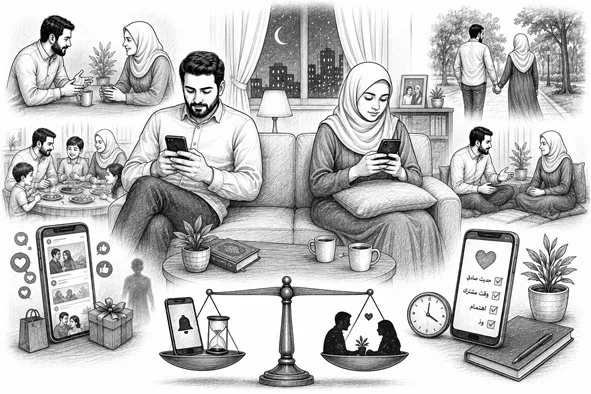
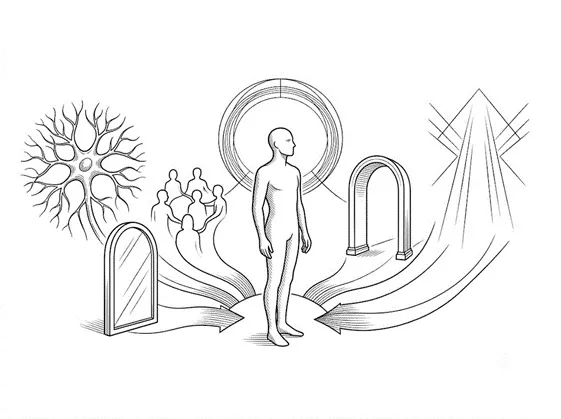
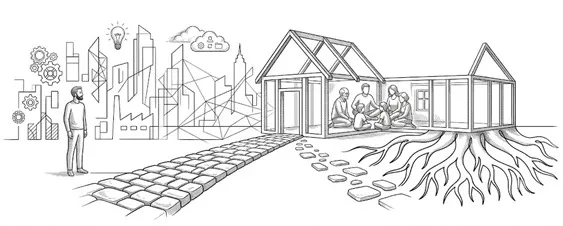
In the modern human being's race to tame nature, multiply production, and build cities and skyscrapers, human bonds have not always received the same care. As the pace of life quickened, the logic of speed seeped out of the world of industry and consumption into the most private spaces of a person's life, until it reached the way he understands love, commitment and the family.
For some people the question is no longer: how do we build a relationship that lasts and gives life its meaning? It has become: how do we obtain the greatest measure of closeness and pleasure with the least commitment and consequence?
Here the relationship began to move, in some of its forms, from being a covenant that founds a family to being an individual experience that may continue or end according to the personal satisfaction it yields. The sociologist Zygmunt Bauman described one aspect of these shifts with the concept of “liquid love,” in which bonds are quickly formed, weak in endurance and easy to dissolve; a reflection of a wider culture inclined to flexibility, consumption and the avoidance of long-term commitments.[١]
When the Logic of Speed Entered Relationships
Young men and women in modern society find themselves facing mounting challenges: long years of study, difficulty finding work, rising housing costs, the pressure to prove oneself, and delayed economic stability. At the same time, their psychological, emotional and physical needs do not stop and wait for these conditions to be met.
In this context a “fast food” culture has seeped into human relationships. Instead of a gradual path ending in a clear covenant and shared responsibility, paths have appeared that offer a measure of emotional or physical closeness without imposing, from the outset, any long-term legal or social commitment.
When a person is placed between a road that demands patience, financial and parental responsibility, and mutual concession, and a relationship that gives him some of the benefits of commitment with the possibility of leaving it more easily, the second choice becomes more in harmony with the prevailing individualism.
This does not mean that everyone who takes this road does so out of selfishness or frivolity; complex economic and social circumstances may drive them to it. But understanding the circumstances that explain a behaviour does not prevent us from discussing the consequences that may follow from it.
Dating and Cohabitation: A Relationship That Seeks Closeness and Hesitates Before the Covenant
Among the most prominent contemporary paths to commitment are extended dating relationships and cohabitation without marriage.
In a dating relationship an emotional attachment forms, and perhaps a physical one, without a marriage covenant or clear legal and family responsibilities. Such a relationship may turn into marriage, may last for years, and may end without leaving the injured party adequate protection or recognition for the time and feeling invested.
In cohabitation, the two parties share a home and some details of daily life without marriage, and sometimes present it as a way of testing compatibility before deciding on permanent commitment.
Cohabitation is no longer a marginal phenomenon in a number of Western societies. In the United Kingdom, the number of cohabiting-couple families without marriage reached about 3.5 million in 2025, representing 17.6% of all families, while the proportion of married-couple families fell to 65.3%.[٢] Data from the Organisation for Economic Co-operation and Development also show that marriage rates have fallen in most OECD countries since 1990, alongside a rise in the average age at marriage and a wider presence of cohabitation as an alternative to marriage or a stage before it.[٣]
But the existence and spread of a relationship do not necessarily settle its ability to provide the same functions that marriage performs. A marital relationship does not rest only on two people being in one house, but on a declaration of commitment, the setting of rights, the bearing of responsibility, and the linking of the present to a shared future.
Longitudinal studies indicate that the relationship between cohabitation and stability is not simple, and that it is affected by the quality of communication, income, the intention before commitment, and other factors. In a study that followed a group of German families for ten years, initial differences appeared in the separation rates of cohabiting and married couples, but the effect of the type of relationship on separation did not remain significant once other variables were controlled for. On the other hand, the study found a greater decline in the level of relationship adjustment among some cohabiting mothers, and an association between cohabitation and some externalising behavioural problems in children; this led the researchers to call for further study rather than offer firm causal judgements.[٤]
This overlap confirms that the matter should not be reduced to condemning individuals, nor to claiming that every marriage is successful and every cohabitation a failure. There are troubled marriages and long non-marital relationships. But the essential difference remains between a relationship that enters from its start within a declared covenant, and one that leaves the level of commitment, its limits and its end date to the changing judgement of the two parties.
From Complementarity to Competition
Individualism has extended to the way the relationship between man and woman is conceived. There is no doubt that the movements demanding justice for women played an important role in exposing forms of injustice and discrimination, and contributed to women's acquiring educational, legal and social rights that cannot rightly be denied.
But the problem appears when the demand for justice turns into interpreting the relationship between man and woman as a perpetual struggle for power; when their difference becomes evidence of hierarchy, complementarity a form of subordination, and the division of roles a curtailment of freedom.
In some radical feminist currents the family was no longer a space that could be reformed and in which justice could be achieved, but a structure accused at its root, because, on this view, it rests on a division of roles that may give the man authority and place the burdens of care on the woman.
The trouble with this perspective is that it may shift the relationship from the question, how do the two parties cooperate and prevent injustice? to the question, who overcomes the other? And when married life becomes a meticulous ledger of what each side has contributed, the home loses something of the meanings of affection, generosity and sacrifice, even if it outwardly keeps an equal distribution of tasks.
Justice is a necessity without which the family cannot stand, but it does not mean arithmetical identity in every detail. The distribution of responsibilities may differ from one family to another, according to the spouses' abilities and circumstances, without difference alone being evidence of injustice. The more important criteria are mutual consent, fairness, complementarity, the preservation of dignity, and neither party exploiting the other.
Redefining the Family
The shift reached a further stage when the debate was no longer confined to the form of the relationship between man and woman but extended to the definition of the family itself. The legislation of a number of countries has recognised the marriage of two persons of the same sex, granting them some of the rights that spouses enjoy, including, in certain legal systems, the possibility of adopting children. According to the OECD, twenty-five OECD countries recognised same-sex marriage, wholly or in some of their territories, by 2022.[٥]
It is important here to distinguish between two levels: the level of human and legal treatment of individuals in a way that preserves their dignity and protects them from assault, and the level of defining the family and the functions on which it rests.
From the standpoint of the Islamic frame of reference and the philosophy of the family from which this essay proceeds, the family in its original formation rests on the union of a man and a woman in a declared covenant, which brings about tranquillity, joins difference with complementarity, and opens the natural way to procreation and the continuation of generations. Consequently, not every emotional bond becomes a family in the same sense merely because it has obtained legal recognition.
This is a philosophical and value-based view whose frame of reference should be declared clearly, not presented as a settled empirical conclusion. It should also be discussed without wounding persons or denying their human dignity.
Gallup data for 2025 reveal the breadth of the shift in patterns of self-identification among the younger generations in the United States: 9% of adults identified themselves within LGBTQ+ categories, and the proportion rose to 23% among those under thirty.[٦] Yet these figures measure self-identification and do not mean that the same proportion live in same-sex relationships or same-sex families. Even so, the large gap between generations points to a clear effect of cultural shifts on the language in which young people understand themselves and their relationships.
The State Between Protecting the Family and Regulating the Effects of Its Breakdown
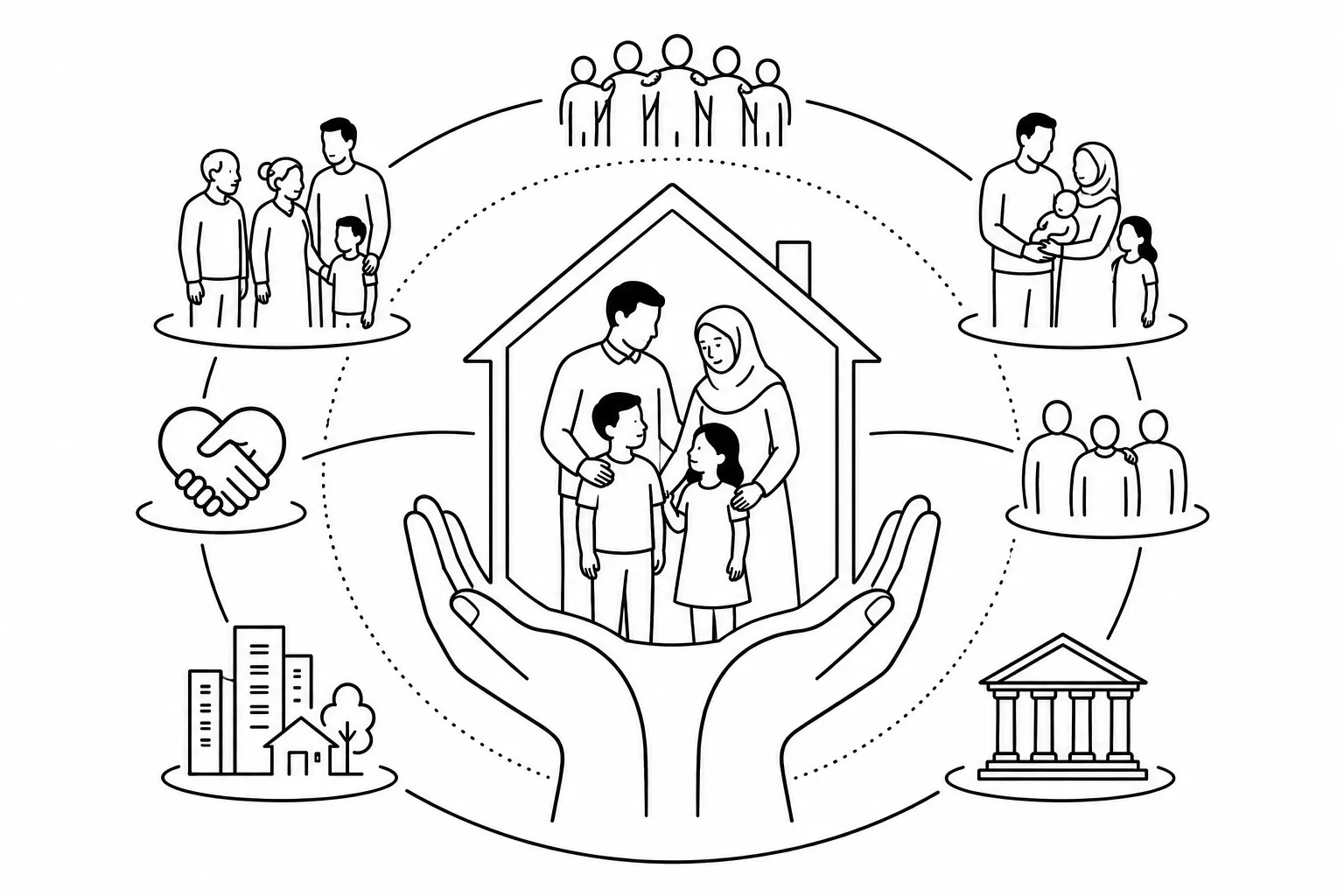
The modern state, with the resources, legislation and institutions at its disposal, was expected to make the founding and stability of the family easier: through housing support, protection of motherhood and fatherhood, balancing work and family life, providing counselling and reconciliation services, and guaranteeing the rights of spouses and children.
But what happened in some societies is that state intervention turned more toward regulating the legal consequences of changing relationships than toward addressing the causes that make marriage and the forming of a family harder.
When job opportunities come late, housing costs rise, family networks weaken and having children becomes a professional and economic burden, and young people are nevertheless asked to build stable families, moral exhortation alone is not enough. Protecting the family requires a social and economic environment that makes commitment possible, not merely asking individuals to commit.
On the side of upbringing, it is not enough for educational institutions to treat early sexual relationships merely as a reality needing health regulation. Health protection is important, but it is no substitute for upbringing in meaning, limits, responsibility, and respect for one's own body and for others. An education that tells a young person how to avoid harm, without helping him understand the value of commitment, treats part of the problem and leaves its root.
Not a Condemnation of Individuals
This reading does not aim to condemn persons or to ignore the complexities of their lives. A person may enter an unstable relationship because of an emotional need, an economic circumstance or a painful family experience, and may hold a different conception of marriage and the family as a result of the environment in which he grew up.
But respect for the human being does not mean refraining from discussing ideas and social patterns. Society has the right to ask about the effect of these shifts on children, on psychological stability, on solidarity between generations, and on the ability of relationships to endure illness, old age and financial hardship.
Nor does criticism of individualism mean a call to dissolve the individual within the family, or to justify injustice in the name of preserving it. A family that strips a person of his dignity or shields violence is not the model worth defending. What is required is not a return to every form of the traditional family, but the recovery of the meanings without which a family cannot stand: covenant, responsibility, affection, justice, belonging and continuity.
Toward Recovering the Meaning of the Covenant
A relationship based on gratification alone may continue as long as the gratification lasts, but it is endangered when circumstances change. The family, by contrast, begins from the acknowledgement that life does not stay in one state, that a partner may fall ill, grow weak and change, that children need many long years of care, and that trust is not built through relationships that can be quickly replaced.
For this reason marriage has been more than a declaration of love; it is the turning of love from a private feeling into a declared responsibility, and the carrying of the relationship from the possibilities of the moment to the horizon of a lifetime.
The challenge facing societies today is not a choice between a traditional family restored with all its faults and a modern individual freed from all its bonds; it is to build a family that preserves a person's freedom and dignity and at the same time asks him to answer for those he has chosen to share his life with.
We need a family in which leadership does not turn into tyranny, nor equality into conflict, nor freedom into a shirking of consequences, nor sacrifice into the cancelling of the self.
Not every relationship is a family, just as merely living under one roof does not make a home. The family is a moral and human structure that begins with choice, is made firm by covenant, ripens through responsibility, and endures through mercy, justice and loyalty.
And the question that ought to occupy us remains: how do we restore the covenant's value and make founding a family both possible and attractive, without ignoring the transformations of the age, the demands of work, and a person's aspiration to freedom and dignity?
The answer lies neither in denying reality nor in surrendering to it, but in building a family model that joins firmness of values with flexibility of means; a model that preserves fitrah (innate human nature), achieves justice, and restores to the human relationship its deepest meaning: that a person should find in the other tranquillity, responsibility and a pledge, not a passing station on a long road of searching for the self.
References
[١] Zygmunt Bauman, Liquid Love: On the Frailty of Human Bonds, Arabic translation by Hajjaj Abu Jabr (Beirut: Arab Network for Research and Publishing, 2016).
[٢] Office for National Statistics (UK), “Families and Households in the UK: 2025,” 17 April 2026:
Office for National Statistics
[٣] OECD, “Marriage and Divorce,” Society at a Glance 2024:
OECD — Marriage and Divorce
[٤] Heather M. Foran et al., “Cohabitation, Relationship Stability, Relationship Adjustment, and Children's Mental Health Over 10 Years,” 2022:
The study published in PMC
[٥] OECD, “Marriage and Divorce,” op. cit.
[٦] Jeffrey M. Jones, “LGBTQ+ Identification Holds at 9% in U.S.,” Gallup, 16 February 2026:
Gallup
Related service: Pre-marriage counselling
Questions people hesitate to ask
What is the difference between marriage and cohabitation?
In cohabitation, two people share a home and parts of daily life without marriage, leaving the level of commitment, its limits and when it ends to their changing judgement. A marriage is not just two people under one roof; it rests on a declared commitment, defined rights, accepted responsibility and a present tied to a shared future.
What does liquid love mean?
It is a concept the sociologist Zygmunt Bauman used to describe part of the change in modern relationships: bonds that form quickly, tolerate little and break easily, reflecting a wider culture that favours flexibility, consumption and avoiding long-term commitments. The relationship shifts from a covenant that founds a family to an individual experience.
Share your thoughts
Have you been through something like this, or has a question come to mind? Write it here. Your words may help another reader.
No comments yet. Be the first to start the conversation.