Screens Between Spouses
 Dr. Abdulqawi Al-Qadasi · 4 min read
Translated from the Arabic. Read the original (العربية)
When the far-away is closer than the one sitting beside us
When the far-away is closer than the one sitting beside us
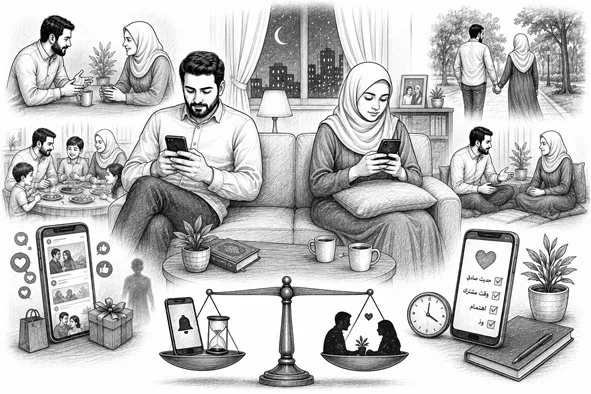
A husband and wife sit in one room. There is no quarrel between them, no raised voices, no visible problem. Each holds a phone; one follows the news and work, the other moves between messages and video clips. Half an hour passes, then an hour, and perhaps the whole evening ends without any real conversation.
They are close in space, and far apart in attention.
Technology did not enter our lives as an enemy of the family; it has shortened distances, eased work and learning, kept the expatriate in touch with his family, and allowed spouses to communicate through their day. The problem begins only when the tool that brings the distant near becomes something that pushes the near away.
Attention, the relationship’s precious resource
A marriage needs a simple and precious resource: attention. That you speak and the other looks at you, that you tell a story and he listens, that you feel your presence matters more, in that moment, than the notification that appeared on the screen.
The phone has gained a remarkable power to interrupt these small spaces. A couple begins a conversation, a notification arrives, and one of them glances at it. He returns to the conversation, then another message comes. He may not mean to ignore his partner, yet the message that arrives, with repetition, is clear: there is always something outside this room that deserves my attention more than you.
Modern research on relationships points to a link between what is sometimes called “technoference,” when phones and technologies interrupt the interaction between partners, and higher conflict over technology use and lower scores on some measures of relationship satisfaction.[1]
This does not mean that the phone creates unhappiness on its own; human relationships are more complex than that. It means that repeated use at times that are meant to be shared can become a real source of friction.
When comparison enters the home
The matter does not stop at time and attention; screens have brought into the home a vast world of comparisons.
A person sees couples on holidays, lavish gifts, celebrations, restaurants, and words of love posted for everyone to see. Then he looks at his ordinary life: a tired husband back from work, a wife busy with the children, bills waiting, a simple dinner.
He may forget that what he sees on the screen is a carefully chosen moment, while he compares it with his whole life.
We do not see the argument that preceded the photograph, nor the loan with which they bought the car, nor the silence that followed the celebration. With repeated exposure to these images, the familiar things we have may grow pale beside lives made for display.
So dissatisfaction may enter the home through a window the couple did not notice.
Boundaries with others
Screens open another space that calls for awareness: the boundaries of relationships with other people. Emotional boundaries do not always erode through a single big decision; they may begin with an ordinary message, then turn over the days into a recurring space of talk and confiding, until a person finds himself awaiting a notification from someone outside the marriage more than he awaits the words of his life partner.
Guarding the relationship does not mean that spouses live in a state of mutual inspection, each checking the other’s phone and counting his messages and calls; a trust that needs constant monitoring becomes exhausting.
What matters more is that there be clear boundaries that both understand: what do we consider appropriate? What behaviour, if it came from our partner, would hurt us? Which spaces should remain private to our relationship?
Privacy is a right; secrecy that destroys trust is something else.
Winning back the shared spaces
The solution may be simpler than we imagine. The aim is not to declare war on phones, but to take back some spaces from them: a table that needs no screen, a conversation before sleep that notifications do not interrupt, and a walk in which the couple look at the road and at each other, not at a small device in their hands.
It may help to agree on times when the phone is kept as far away as possible, especially when one of them wants to talk about something important. It is not a matter of a rigid number of hours, but of a mutual message that says: when you need me, I can be present with you.
These arrangements do not mean that the home must be entirely free of screens, or that spouses must cut themselves off from work, the news and friends. The point is that technology should stay in its natural place: a tool we use, not a force that takes hold of our attention and decides the shape of our presence at home.
Children learn from what they see
Example extends here to the children. It is hard to ask a child to leave his device off the table while he sees his father answering messages and his mother scrolling through her phone. If a family wants to win back its gathering, its conversation and its warmth, the beginning is with the adults.
In simpler times, homes knew moments of togetherness naturally: after a meal, over tea, or in the evening sitting-room. Not all those gatherings were deep or ideal, but they gave people something we sometimes lack today: to be truly together.
We do not need to return to a time without technology; that time will not return, and there is no need for it to.
We need only not to allow the whole world to enter our home at every moment.
For the person whose words we are searching for on a distant phone may be…
sitting right beside us, waiting for us to lift our eyes to him.
[1] Brandon T. McDaniel and Sarah M. Coyne, “‘Technoference’: The Interference of Technology in Couple Relationships and Implications for Women’s Personal and Relational Well-Being,” Psychology of Popular Media Culture 5, no. 1 (2016): 85–98.
Related service: Marriage counselling
Questions people hesitate to ask
How do phones affect a marriage?
Phones drain the attention a relationship needs: a notification that interrupts a conversation, repeated often, says something matters more than the partner. The article cites research linking technology interference in couples' interactions to more conflict and lower satisfaction, while noting the phone alone does not cause unhappiness.
How does comparing with others on social media hurt a couple's contentment?
People see trips, gifts and celebrations on screen and compare them with their whole lives, forgetting these are carefully chosen moments that hide the quarrels, debts and silences behind them. What they have then looks dull, and discontent enters the home through a window the couple did not notice.
How can a couple take their time back from screens?
Not by declaring war on phones but by reclaiming spaces: a meal without screens, bedtime talk without notifications, walks together, and agreeing to put the phone away for important conversations. Clear boundaries with others matter, without mutual phone-checking, and the example for children starts with the adults.
Share your thoughts
Have you been through something like this, or has a question come to mind? Write it here. Your words may help another reader.
No comments yet. Be the first to start the conversation.