Explanations of Sexual Desire: Why Do We Desire, and Who Gives Desire Its Meaning?
 Dr. Abdulqawi Al-Qadasi · 7 min read
Translated from the Arabic. Read the original (العربية)
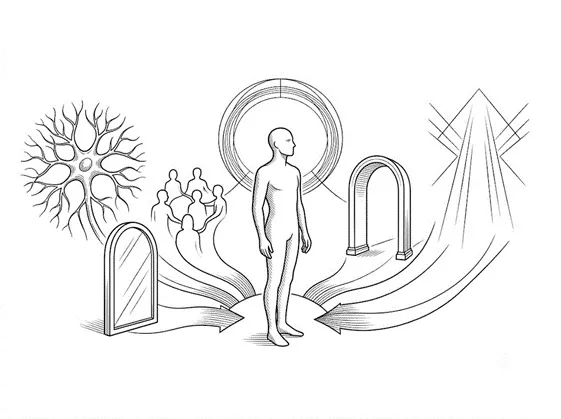
Desire sometimes awakens in a person before he understands it: he feels an attraction, or misses closeness, or looks for tranquillity (sakan) in another person. But where does this inclination come from? From the body alone, or from the self, from memory and from society? And is it enough to know the source of desire in order to decide how we ought to deal with it?
The answers to these questions have been spread across many sciences and schools of thought; each field looked at one side of the human being and sometimes tried to explain the whole picture through it. But the human being is too vast to be reduced to a hormone, a past experience, a social habit or a single philosophical idea.
Biology: The Body Awakens the Drive
Biology regards sexual desire as part of a living system tied to reproduction and the continuation of the species. It studies the effect of hormones, the brain and the nervous system, and the processes that activate the drive or dampen it.
Research points to a relationship between the level of the hormone testosterone and sexual desire, particularly in men, but this relationship does not work in isolation from health, age, psychological state, the nature of the relationship and personal experience. A published study titled “Testosterone and Sexual Desire: A Review of the Evidence” sets out part of this relationship.
The body prepares the drive, but it does not alone write the story a person will live, nor does it determine the way he will express his desire.
Psychology: Desire Is Part of a Person’s Story
Psychology approaches the inner experience: how does a person live his desire? And how do his image of himself, his sense of safety, his earlier experiences and the nature of his relationships shape the way he seeks closeness?
Sigmund Freud held that sexual energy, which he called “libido,” is an influential force in the development of personality and behaviour, and he presented his view early on in his book Three Essays on the Theory of Sexuality. But later schools of psychology rejected reducing human drives to sexual desire, and gave wider room to the need for attachment, safety, esteem, belonging and meaning.
Some modern psychological models regard sexual response as the result of a balance between two forces: one that pushes a person toward approach and arousal, and another that calls him to stop and be cautious. This balance differs between people, and is also affected by anxiety, confidence, psychological pressure, the nature of the relationship and the expected consequences. A scientific review of the dual control model surveyed the studies published on this model between 2009 and 2022.
This helps us understand why desire varies from one person to another, and why its strength changes in the same person according to his psychological state and the circumstances of his life.
Sociology: Society Gives Desire Its Language
A person does not live his desire in a vacuum. From childhood he learns from family, friends, education and the media what is considered beautiful or acceptable, how love, marriage, manhood and womanhood are understood, and what behaviour is expected of each party.
The sociologists William Simon and John Gagnon used the concept of “social scripts”: society supplies people with images and expectations through which they learn to interpret their feelings and act upon them. Their study “Sexual Scripts: Origins, Influences and Changes” can be consulted.
But the influence of society does not mean that it creates desire from nothing. Culture may direct its expression, or arouse it, or exaggerate it, or set limits for it, but it does not abolish its biological basis. For this reason it is not enough to explain desire by biology alone, nor is it right to regard it as merely a social construction. The truth is closer to an interaction: a body that responds, a self that remembers, a culture that interprets, and a will that chooses.
Philosophy: Does Everything We Desire Deserve to Be Done?
Philosophy is not content to ask about the source of desire; it moves on to its meaning. Is freedom that a person does everything he desires? Or is the deeper freedom his ability to choose what he sees as good, even when desire calls him to something else? And does a person treat the other as someone with dignity, or as a means of satisfying a passing need?
Some modern philosophies focused on freeing desire from inherited constraints, and saw in a number of taboos the mark of power and society. In his book The History of Sexuality, Michel Foucault studied the effect of language, institutions, knowledge and power on the way a person understands himself and his desires.
This current helped expose forms of repression and exploitation, but it left a question that cannot be ignored: if desire becomes its own point of reference, who protects the weak, the child, the family, and the rights of those who bear the consequences of relationships?
Religion: Desire Is an Energy That Needs a Purpose
Religion offers a different angle; it does not deny the body, nor does it count desire a sin in itself, but it does not make it the highest authority for a human being.
In the Islamic conception, appetite was created for a wisdom, and marriage was made a path to tranquillity, affection and mercy and the continuation of life, as the Most High said:
“And of His signs is that He created for you from yourselves mates that you may find tranquility in them; and He placed between you affection and mercy. Indeed in that are signs for a people who give thought” (Qur’an, al-Rum 30:21).
What is required is not to kill desire, but to refine and direct it; for a person’s worth is shown not in the absence of desire, but in the way he manages it, and in his ability to combine the right of the body with human dignity and responsibility toward others.
Abu Hamid al-Ghazali regarded appetite as a force necessary for the continuation of life, but one that needs the balance of reason and the Shariah; if it is abolished, its function is disabled, and if it is left without restraint, it enslaves its owner. His treatment can be consulted in the Book of Breaking the Two Appetites from Ihya’ ‘Ulum al-Din [The Revival of the Religious Sciences].
This balance is among the most beautiful features of the Islamic approach; it neither despises the body nor sanctifies it, but puts it in its place within the whole human being.
Explanation Is Not Justification
Each field offers part of the truth: biology tells us how the drive moves, psychology shows how we live it, sociology explains how its language is formed, philosophy asks about its freedom and meaning, and religion gives it a purpose and a moral scale.
But knowing the source of desire is not enough to judge every behaviour that arises from it; there is a difference between explaining a desire and justifying the response to it. The sciences can describe an aspect of what is, but they do not alone decide what ought to be, nor do they by themselves answer questions of goodness, dignity, responsibility and justice.
Here the role of the fitrah (innate human nature) in the Islamic conception stands out, not as a passing feeling but as an original disposition to know truth and goodness. This disposition may be clouded by appetite, habit or the pressure of the environment, and so divine messages come to remind the human being of what he was created upon, and to give him the scale by which he reviews his desires and choices.
Understanding desire helps a person manage it, but it does not relieve him of his responsibility. A person’s worth is not that he does not desire, but that he knows which desire deserves to be followed, and which needs to be refined or resisted.
In this way instinct turns from a force that may lead to chaos and exploitation into an energy that builds a family, creates a home of tranquillity, preserves dignity and gives life its noble human continuation.
References
- Vi Nguyen, Austin Leonard and Tung-Chin Hsieh, “Testosterone and Sexual Desire: A Review of the Evidence”, Androgens: Clinical Research and Therapeutics, vol. 3, 2022.
- Erick Janssen and John Bancroft, “The Dual Control Model of Sexual Response: A Scoping Review, 2009–2022”, The Journal of Sex Research, vol. 60, no. 7, 2023.
- William Simon and John H. Gagnon, “Sexual Scripts: Origins, Influences and Changes”, Qualitative Sociology, vol. 26, 2003.
- Sigmund Freud, Three Essays on the Theory of Sexuality: The 1905 Edition, translated by Ulrike Kistner, Verso, 2017.
- Michel Foucault, The History of Sexuality, Volume 1: An Introduction, translated by Robert Hurley, Pantheon, 1978.
- Abu Hamid al-Ghazali, Ihya’ ‘Ulum al-Din: Kitab Kasr al-Shahwatayn [The Revival of the Religious Sciences: The Book of Breaking the Two Appetites], Dar al-Ma‘rifah, Beirut.
Related service: Marriage counselling
Questions people hesitate to ask
Where does sexual desire come from?
Not from a single source. Biology shows how hormones and the brain awaken the drive, psychology how security, experience and relationships shape the way it is lived, and sociology how society gives it a language. The truth is closer to an interaction: a body that responds, a psyche that remembers, a culture that interprets and a will that chooses.
How does Islam view sexual desire?
Islam does not treat desire as sinful in itself, nor make it the highest authority in a person. Desire was created for a wise purpose, and marriage made a path to tranquillity, affection and mercy. The aim is to refine desire, not kill it; al-Ghazali held that abolished desire loses its function, while unrestrained desire enslaves its owner.
Share your thoughts
Have you been through something like this, or has a question come to mind? Write it here. Your words may help another reader.
No comments yet. Be the first to start the conversation.