Family Theory: Towards a Model That Unites Fitrah, Rights and Belonging
 Dr. Abdulqawi Al-Qadasi · 8 min read
Translated from the Arabic. Read the original (العربية)
How do we protect a person’s freedom without losing the family, and build a strong state without making it a substitute for the home?
We are not facing two choices with no third: a traditional family we restore in every detail, or a modern individual we free from its bonds until he is independent of it. Between the two lies a third way: to preserve for the human being his freedom and his rights, and at the same time to preserve for him the home he belongs to, the relationships that give him meaning, and the society and state that support him when his own capacity, or that of his family, falls short.
This is the idea on which the family theory rests, which I put forward in my book The Contemporary Family: Towards a Theory Inspired by Revelation, Fitrah and Human Experience.
The theory starts from a truth that is very simple yet deeply significant: a human being does not begin life as an independent individual. He comes into the world from a man and a woman, a frail child who needs many years of care before he can rely on himself. From this beginning the family arises as the first environment that embraces the human being and raises him, and then the circles of his belonging widen to the clan, society and the state.
But acknowledging this truth does not mean that every historical form of the family was right, nor that we must restore the past as it was. Some societies knew injustice toward women, the squandering of some of the child’s rights, domineering parents, and interference by the extended family in the lives of its members. On the other hand, humanity has made great gains in education, health, the protection of rights and social protection, and has given the human being a wider space for choice and independence.
For this reason the theory does not rest on preferring the past to the present, nor religion to human experience; it draws on three complementary sources: the fitrah (innate human nature), in what it reveals of the human need for partnership, care and belonging; revelation, in the values of affection and mercy, kindness, justice, benevolence, devotion to parents, the keeping of kinship ties and the safeguarding of rights; and human experience, in the sciences, laws, institutions and beneficial policies it has accumulated.
A Family Built on Partnership, Not Conflict
At the centre of this conception stand the man and the woman as partners in building life, not as teams competing for power and standing.
They are equal in the root of human dignity, and between them lies such similarity and difference that the relationship is wider than the idea of sameness or rivalry. For this reason the theory does not impose on all families one rigid distribution of roles; both spouses may work, one of them may devote himself or herself to care at some stage, and roles may change with health, income, age and the circumstances of life.
What matters is that responsibility not be lost, that flexibility not turn into chaos, nor difference into conflict.
The Child Has Rights… and Has an Embrace
When a child comes, he becomes a human being with rights and dignity, yet he does not become an individual detached from his natural context.
He has a right to protection, health, education and safe growth, and at the same time a need for stable relationships and a family to belong to. So the starting point is to support the family so that it can perform its function, not to hasten to put an institution in its place.
If poverty is the problem, we help the family overcome poverty. If the parents’ weak skills are the problem, we offer them training and support. And if the family itself becomes a source of real danger, the protection of the child takes precedence; for preserving the family does not mean preserving harm.
Independence That Does Not End in Estrangement
Children grow up, and with them grows the space of their independence. The parents’ authority recedes, the son or daughter becomes responsible for his or her own life and decisions, and may then marry and found a new family with its own privacy.
But independence need not turn into estrangement.
Here the theory restores the standing of the extended family as a safety net, not a central administration of its members’ lives. Homes, finances and decisions may become independent, and cities and countries may grow far apart, but the relative remains a relative: he asks after you, visits, supports you in sickness, weakness and crisis, and preserves for the generations their memory and belonging.
And the wider the circle of kinship, the lighter the authority to interfere, while the bond and the support remain. The right of the parents is not like that of the paternal or maternal uncle, and their relationship with a child is not like their relationship with a grown son who has his own family and decisions.
The Family Is Not Alone
The theory does not make the family bear what it cannot bear.
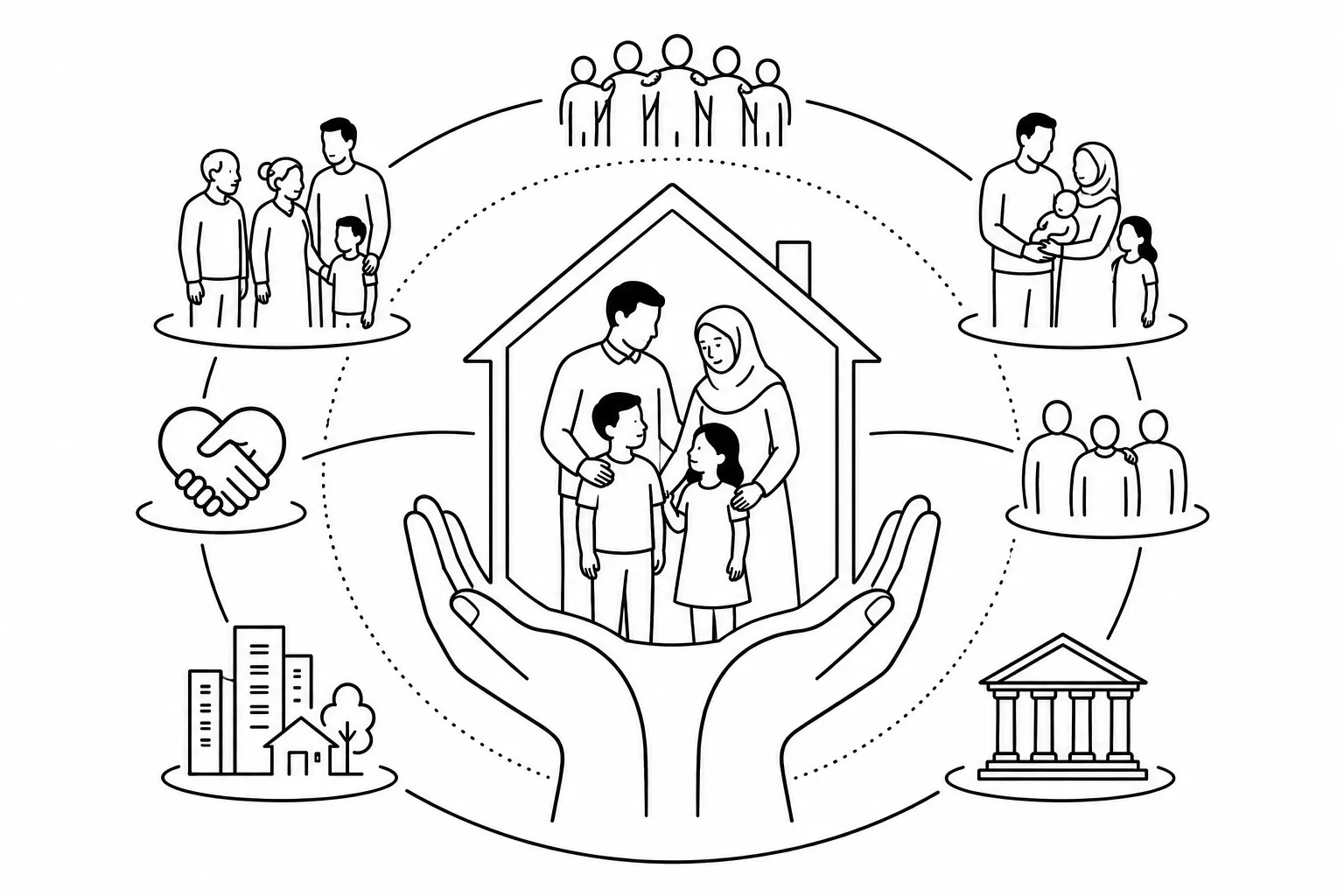
The family is not a hospital, nor a school, nor a judiciary, nor a social security system. So two necessary circles surround it: a living society and a just state.
Society supports the family through associations, endowments, initiatives, and institutions of rehabilitation, counselling, mediation and mutual support. The state brings what the nearer circles cannot provide: law, security, education, health, social protection, the protection of rights and specialised services.
But the relationship between these circles is not one of replacement; it is a relationship of complementarity.
If the family can care for its child or its elderly in a safe and beneficial way, it is wise for the state and society to help it do so. If it fails, services and institutions step forward. And if an assault occurs, the law intervenes.
In this way the strength of the family does not become a reason for the state to withdraw, nor does the strength of the state become a reason to hollow the family of its functions.
The worth of this structure appears more clearly in wars, disasters and economic crises. When institutions weaken, the family, the clan and the community become networks of resilience. And the more circles of support surround a person, the less likely he is to fall if one of them fails.
Justice Is Not Enough on Its Own
The theory distinguishes between rights and graciousness.
Rights are a necessity, and justice is a foundation that must not be neglected. Every individual has his dignity, property, boundaries and rights, which must not be violated in the name of the family.
But a family that stops at the limits of rights alone may become just without necessarily becoming warm.
For a great part of family life rests on things the law can neither impose nor count: a father who gives his child his time, a mother who stays awake when her son is ill, a husband who stands by his wife, a wife who supports her husband, a son who cares for his parents, and a brother who opens his home to his brother in crisis.
This is why the Qur’an says: “Indeed, Allah orders justice and good conduct…” (Qur’an, al-Nahl 16:90), and says, even at the time of parting: “And do not forget graciousness between you” (Qur’an, al-Baqarah 2:237).
Justice protects the family from injustice, and benevolence gives it its soul.
The Six Principles of Family Theory
This conception can be summed up in six governing principles:
- The human being is a family creature: he begins his life within relationships of care and belonging, and remains in need of them even as their forms change with age.
- The family is a relationship before it is a service: what institutions provide in education, health and care is necessary, but it does not replace all that the family gives of love, presence and belonging.
- Independence does not mean estrangement: the individual has his dignity and his decision, and the small family has its privacy, while parents, the wider family and kin remain a source of connection and mutual support.
- Justice preserves rights, and benevolence enriches the relationship: rights are not squandered in the name of the family, and the family is not reduced to a reckoning of rights and duties.
- The wider circle supports the nearer one and does not take its place, so long as it can perform its function safely: the clan supports the family, society supports both, and the state protects all and steps forward in cases of incapacity or harm.
- The strength of the family is not at the expense of the individual, and the strength of the state is not at the expense of the family: the aim is the complementarity of all these circles in the service of the human being.
From the Family to the Human Being
The ultimate aim of the theory is not to preserve a social institution called the family merely for its own survival, but to make the human being.
The home is the first place where the child learns love, trust, belonging, responsibility, the governing of desires and respect for others. From it he goes out to school, the market, society and the state, carrying with him a large part of what took shape in his earliest years.
For this reason, investing in the stability of the family is not a private matter for its members, but a long-term investment in the human being who will build society and its institutions.
Nor does this theory offer a closed recipe that all peoples must copy. Cultures, economies, laws and patterns of housing and work differ, and humanity will keep inventing new solutions. It offers only a framework within which every society can develop its own means:
To preserve the fitrah without rigidity, freedom without individualism, rights without selfishness, kinship without domination, and the role of the state without letting it replace the family; and to add to justice that space of benevolence which makes life worth living.
The whole conception can be condensed into a single equation:
A fitrah that preserves the origin + values that give meaning + rights that safeguard the human being + a family that bears its responsibility + a clan that keeps belonging + a society that supports + a state that protects and assists = a more balanced human being, and a society more cohesive and better able to endure.
This is the essence of the family theory: not to return the family to the past, nor to leave it behind as we move on to the future, but to take with us the finest of what the fitrah, revelation and human experience have taught us, and to carry on building.
For the aim in the end is not to protect a particular form of the family, but to protect the human being who finds in it his first home, his first relationship and his first sense of belonging.
This article is drawn from the book: The Contemporary Family: Towards a Theory Inspired by Revelation, Fitrah and Human Experience, by Dr. Abdulqawi Al-Qadasi.
Related service: Marriage counselling
Questions people hesitate to ask
What are the six principles of family theory?
The human being is a family being; the family is a relationship before it is a service; independence does not mean estrangement; justice protects rights and kindness enriches the relationship; the wider circle supports the nearer one without replacing it while it can do its job safely; and family strength must not cost the individual, nor state strength the family.
How does family theory see the relationship between the family and the state?
As complementarity, not replacement. If a family can care for its child or elderly member safely, the state and society should help it do so; if it cannot, services step in; if abuse occurs, the law intervenes. Family strength is no excuse for the state to withdraw, nor state strength a reason to empty the family of its roles.
Share your thoughts
Have you been through something like this, or has a question come to mind? Write it here. Your words may help another reader.
شكرا لك وغفر لوالديك
حفظك الله ورعاك حبيبنا