The Cumulative Average in the General Secondary Certificate: When Hours of Examination Cancel Years of Learning
 Dr. Abdulqawi Al-Qadasi · 9 min read
Translated from the Arabic. Read the original (العربية)
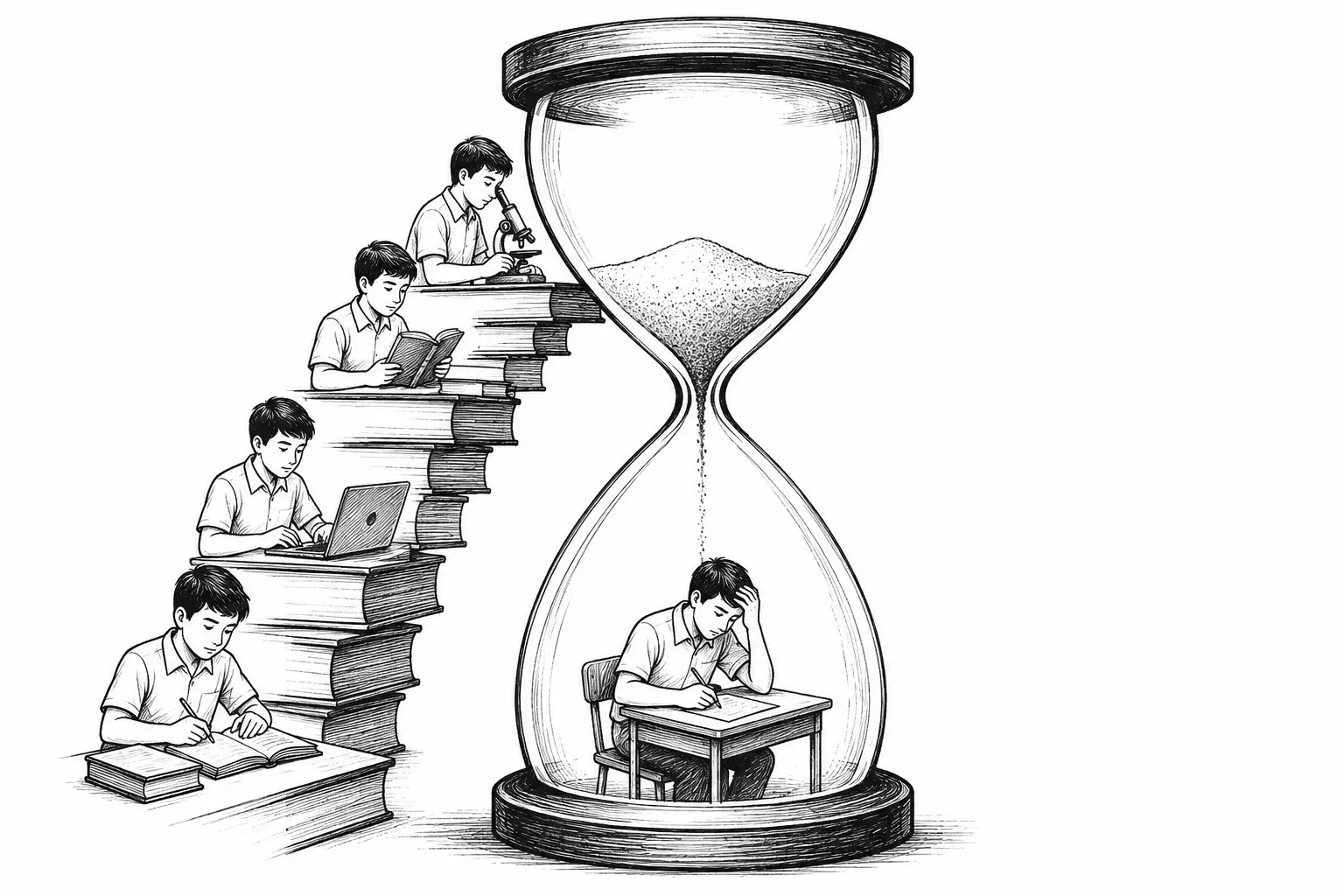
A Call to Review Assessment in Yemen’s General Secondary Certificate
The aim of assessment is not to pass the student by any means, just as the strictness of an education system is not measured by the number of students who fail in it. The more important question is: does the result a student obtains reflect his real level of learning, fairly and accurately?
This question deserves our pause as we look at Yemen’s General Secondary Certificate system, and in particular the relationship between the cumulative average and the final ministerial examination.
The idea of the cumulative average is, in principle, a good step; for it acknowledges that a student’s learning does not happen on the day of the examination alone, but takes shape over years of study, interaction, tests, classwork, assignments and activities. And when 50% of the mark is allotted to cumulative performance and 50% to the ministerial examination, this means the system recognises two sources for judging a student’s attainment, each with its own weight and value.
But the problem appears when the student stumbles in the ministerial examination; for the cumulative average can then lose its effect on the result, whatever the student achieved in the preceding years.
Let us take a simple example that shows the problem:
A student obtained 25 out of 50 in the cumulative average, then obtained 25 out of 50 in the ministerial examination. His total, according to the components of assessment, is 50 out of 100.
By contrast, another student obtained 50 out of 50 in the cumulative average, but stumbled in the ministerial examination and obtained only 24 out of 50. This student’s total is 74 out of 100.
Even so, the first may pass while the second fails; indeed, only his ministerial examination mark is shown for him, as if the fifty marks he earned over his course of study had never been part of his assessment.
The issue here is not to defend a student who obtained ten marks in the final examination, nor to demand that he pass merely because his cumulative average is high. The question is rather: if the cumulative mark represents an accredited attainment of the student, how can another component of assessment cancel its effect entirely?
If we trust the cumulative average, it should be a real part of the result. And if we do not trust it, then the problem is not with the student but with the cumulative assessment system itself, and it should be reformed and regulated, rather than being first counted and later having its effect cancelled.
The Student Is Bigger Than a Single Examination
The concept of educational assessment has developed over past decades, and the assessment of learning is no longer confined to the question: how many answers did the student get right in a final examination? The wider question has become: what has the student learned? And what knowledge and skills is he now able to show and apply?
For this reason UNESCO affirms that the assessment of learning uses a wide range of methods and tools to measure how well students have mastered knowledge and skills, and that assessment data are used not only to award certificates but also to improve curricula and teaching methods and to inform educational decisions.
A recent report by the Organisation for Economic Co-operation and Development (OECD), issued in 2026 on contemporary upper secondary certificates, affirms the same meaning in a striking way. The report studied 71 upper secondary systems and certificates, and found that 57 of them use multiple assessment tasks. The report holds that combining different tools and tasks helps draw on the strengths of each tool and offset its weaknesses, and also allows a wider range of the student’s skills to be measured.
This does not mean the final examination is worthless. Standardised external examinations matter for achieving a degree of comparability, reliability and control of standards, which is why they still exist in many education systems. But their existence is one thing, and turning them into an instrument that can wipe out all other evidence of the student’s learning is another.
For the final examination, however well it is built, remains a measure of the student’s performance at a particular time and under particular conditions. A student may enter the examination ill, or affected by a sudden family circumstance, or suffering severe test anxiety, and the result may also be affected by factors relating to the examination itself and the way it is administered. For this reason, relying on multiple sources of assessment usually gives a fuller picture than relying on a single high-stakes measurement.
And When the Educational Conditions Are Exceptional
This matter grows in importance when we look at the Yemeni reality.
The Yemeni student does not always reach the ministerial examination after a stable and complete school year. The educational process has passed through years of turmoil, the living conditions of teachers and families have been damaged, and education has seen interruptions, strikes and disparities between schools in the regularity of study, the completion of curricula and the provision of a suitable learning environment.
It is only fair here not to attribute every weakness that appears on the examination paper to the student alone.
For the educational result is the responsibility of a whole system: a curriculum, a teacher, a school, a family, a learning environment and sufficient learning time, with the student at the heart of this system. And the weaker the learning opportunities available to him, the more necessary it is to be exact before interpreting the mark of a single examination as the full expression of his abilities and attainment.
This does not mean lowering standards because of circumstances; it means improving the fairness of measurement.
The state may say that success is achieved only by obtaining 60% or 70%, for example, if studies show that this is the appropriate level. The student then knows that he must gather from the various components of his assessment what brings him to the required level of mastery.
But raising the pass standard is one thing, and cancelling marks the student has already earned is another.
What Do Other Education Systems Do?
There is no single global model of the general secondary certificate that we should transplant to Yemen. Countries themselves differ in how far they rely on schools and on external examinations. And perhaps this diversity is the most important lesson: the ministerial examination in its traditional form is not the only possible model for ensuring the quality of a secondary certificate.
In Finland, for example, assessment at the upper secondary stage rests on varied evidence of what the student has learned and become able to do, and combines formative and summative assessment. The Finnish National Agency for Education explains that the results of the national matriculation examination are separate from the course grades the student obtains during his studies.
New Zealand offers a different model; the NCEA certificate combines internal assessment carried out by teachers and schools with external assessment. And external assessment itself is not limited to the traditional examination; in some subjects, portfolios of work are submitted and assessed externally. At the same time, the results of internal assessment are subject to external controls and review to ensure that schools’ decisions are consistent with national standards.
This is an important point, because one legitimate objection to increasing the weight of the cumulative average is that schools and teachers differ in their level of strictness and in how they award marks. The solution is not necessarily to abolish the school’s role; it can be in building clear national standards, training teachers, reviewing samples of students’ work, and controlling the quality of school assessment.
For the equation is not between two options only: either a ministerial examination that decides the student’s fate, or school marks without controls. There is a wide space between them in which to build a model that combines fairness and reliability.
Perhaps We Need a Broader Review of the General Secondary Certificate
Addressing the problem of the cumulative average can be the beginning of a larger discussion, not its end.
Perhaps the time has come to study a new model for the General Secondary Certificate in Yemen, one that moves gradually from the dominance of the final examination to a more balanced system: continuous assessment that is stronger and more reliable, national examinations specified where there is a real need for them, and tasks, projects and other tools that measure aspects a paper examination cannot measure well.
Here we can also rethink the many functions we load onto the General Secondary Certificate.
For we want it, at one and the same time, to decide the student’s success at school, to determine his level, to qualify him for university, to rank him among thousands of applicants, and to determine his eligibility for certain scholarships and specialisations. Perhaps it would be better to separate some of these functions.
The student who has met the requirements of secondary education should receive his certificate according to clear standards. As for the university, it has the right to set admission conditions suited to the nature of its specialisations. The student of medicine or engineering, for example, needs a high level in science and mathematics, while the student of law, languages or the humanities needs other knowledge and abilities.
Likewise, scholarships can have standardised criteria and tests suited to their nature and specialisations, instead of the General Secondary examination alone bearing the task of sorting for every purpose.
What Can Be Done Now?
Rebuilding the General Secondary system is a project that needs study, trial and gradual progress, and a sudden move from one system to another would not be wise.
But addressing the present problem can begin with a simpler step: that the cumulative mark a student has earned be preserved for him, and not disappear merely because he stumbled in the ministerial examination.
And if the ministry sees a need to require a minimum in the final examination, this minimum can be studied scientifically, while the student’s true result stays visible. It would be said, for example: the student obtained 60 out of 100, but did not meet the passing condition in the ministerial component, rather than his mark being turned from 60 to 10 as though the rest of his attainment had never existed.
In the longer term, a specialised educational committee could be formed to study the General Secondary system as a whole: the weight of the cumulative average, the reliability of school assessment, the appropriate weight of the final examination, the possibility of diversifying assessment tools, and the relationship between the secondary certificate and university admission and scholarships.
Reviewing the system does not mean leniency, just as developing the ministerial examinations or relying on them less does not mean wanting everyone to pass.
For true strictness is not to fail a student who has learned, just as justice is not to pass a student who has not.
Strictness and justice together mean building a system able, with the greatest possible honesty, to know what the student has actually learned.
And perhaps the question that deserves to be put before those responsible for education in Yemen is not only:
How many students passed, and how many failed?
but the more important question:
What have our children actually learned? And is the system by which we measure them able to show that fairly?
When this question becomes the starting point, then reviewing the cumulative average and the General Secondary system will not be a retreat from quality, but a step on the road to reaching it.
References
- Organisation for Economic Co-operation and Development (OECD). The Theory and Practice of Upper Secondary Certification. Paris: OECD, 2026.
https://www.oecd.org/en/publications/the-theory-and-practice-of-upper-secondary-certification_b3fea5ba-en.html - United Nations Educational, Scientific and Cultural Organization (UNESCO). Learning Assessments.
https://www.unesco.org/en/learning-assessments - Finnish National Agency for Education. What is General Upper Secondary Education?
https://www.oph.fi/en/education-and-qualifications/what-general-upper-secondary-education - New Zealand Qualifications Authority (NZQA). About Standards, on standards and internal and external assessment in the NCEA certificate.
https://www2.nzqa.govt.nz/qualifications-and-standards/about-standards/ - New Zealand Qualifications Authority (NZQA). NZQA Assessment Rules for Schools and Tertiary Education Organisations, 2026.
https://www2.nzqa.govt.nz/ncea/ncea-rules-and-procedures/nzqa-assessment-rules-for-schools-teos/
Related service: Parenting and education counselling
Questions people hesitate to ask
What is the problem with the cumulative average in Yemen's general secondary certificate?
The system gives 50% of the grade to cumulative performance and 50% to the ministerial exam, but if a student stumbles in that exam, only the exam grade may appear. The cumulative average then loses its effect, however high, and a student with a higher total can fail while another passes.
How can secondary-school assessment be reformed without lowering standards?
By keeping the cumulative grade the student earned instead of letting it vanish after one weak exam. If a minimum exam score is required, it should be studied scientifically while the true result stays visible, and a specialist committee should review the whole system, including cumulative weighting, school assessment reliability and varied assessment tools.
Why is a final exam alone not enough to judge what a student has learned?
Because it measures performance at one moment and under specific conditions. A student may sit it while ill, affected by a family emergency or severe anxiety. Combining several sources of assessment usually gives a more complete picture than relying on a single high-stakes measure.
Share your thoughts
Have you been through something like this, or has a question come to mind? Write it here. Your words may help another reader.
No comments yet. Be the first to start the conversation.