The Dawn of Creation: How the Family Was Born Before States and Civilisations
 Dr. Abdulqawi Al-Qadasi · 4 min read
Translated from the Arabic. Read the original (العربية)

“Before the state existed… there was the family. Before law existed… there was the family. Before cities were built… there was the family.”
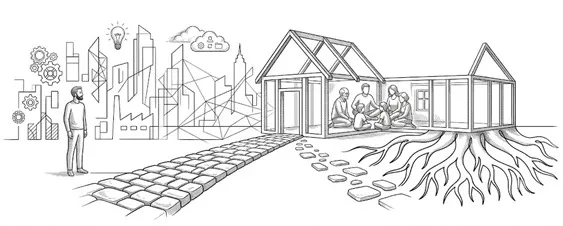
It is striking that the religions, for all their differences, begin the story of humankind in almost the same way. It did not begin with a king, or a city, or a civilisation, but with a man, then a woman, then a family. It is as though the first message carried by this shared narrative is that the family is not the fruit of civilisation but the origin from which civilisation itself emerged.
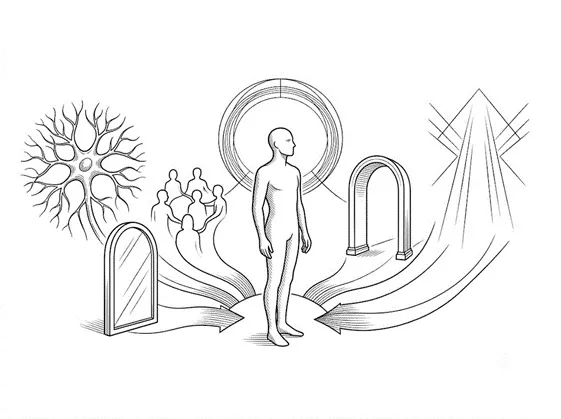
Yet the Noble Qur'an is not content to narrate the beginning; it draws attention to the meaning hidden behind it. It presents the story of creation not merely as a historical event but as a key to understanding the human being, to understanding his need for the other, and to understanding the secret that made the family the first institution humanity ever knew [1].
1. The first moment in Paradise: belonging before procreation
Let us return to that first moment… when Adam (peace be upon him) found himself in Paradise. Everything was present: bliss, beauty, serenity. Yet divine wisdom willed that the scene be completed by the creation of Eve.
It was not that Paradise lacked anything, but that the human being, in the origin of his fitrah (innate human nature), is not complete alone. When we reflect on what Imam al-Tahir ibn Ashur says in his commentary Al-Tahrir wa al-Tanwir [Liberation and Enlightenment], we find an illumination that touches the heart of this beginning, at God Almighty’s words: “…created you from one soul…” [Surah An-Nisa: 1]. Ibn Ashur does not see this verse as a mere description of the origin of creation, but as the foundation of a profound meaning: the single origin is the secret of intimacy, and it is what makes the relationship between man and woman a relationship of belonging before it is a relationship of acquaintance [2]. Eve did not come from outside; she came from the very same origin, to be a natural extension of Adam, and not merely a beginning of procreation but a beginning of belonging.
2. The philosophy of “tranquillity” (sakan): when the home becomes a homeland
Then a single Qur'anic word comes along that sums up the whole philosophy of the family: “that you may find tranquility in them” [Surah Ar-Rum: 21] [1].
The Qur'an did not say: that you may live with her, nor: that you may cooperate with her, but chose the word “tranquillity” (sakan). Here the discussion leaves the bounds of the material relationship and reaches the depths of the human soul.
The thinker Abbas Mahmoud al-Aqqad dwelt long on this meaning in his book Al-Mar'ah fi al-Qur'an [Woman in the Qur'an], and concluded that tranquillity is not a house in which a person takes shelter, but a state of serenity in which he finds himself after the toil of life [3]. A house may be magnificent and yet remain desolate if tranquillity is absent from it, and it may be modest yet become a whole homeland if it is filled with affection and mercy. In short, tranquillity is the moment when you take off the armour with which you fought all day long, and nothing remains between you and the one you love except your humanity.
3. Fitrah in the face of hardship
When Adam and Eve descended to the earth, circumstances changed: the time of ease ended and the time of striving and hardship began. There the family appeared for the first time in its practical form: with no laws to regulate it and no institutions to care for it, and yet it came into being, because it was not the daughter of law but the daughter of fitrah.
In this context, modern psychology approaches the same meaning. In his famous book The Art of Loving, the thinker and psychologist Erich Fromm holds that love is not a passing emotion but a practice embodied in care, responsibility, respect and knowledge [4]. From this perspective, the roles of Adam and Eve were not a social obligation imposed by custom, but a natural expression of complementarity: care, protection and the sharing of life’s burdens were not a struggle over roles, but cooperation to build life.
4. The family: the first fortress and the enduring school
From this small family came the first child, then the first pair of brothers, the first lesson in love, the first test of jealousy, and the first crime humankind ever knew. The family became the first school in which a human being learns how to love, how to differ, and how to bear responsibility for his actions.
Everything has changed since that day; villages arose, then cities and states, laws appeared and civilisations followed one another, but one thing has remained constant: that whenever the world grows narrow for him, a human being goes back to look for a place “in which to find tranquillity,” not a place “in which to dwell.”
Perhaps this is the secret of the family’s survival to this day. It is not merely a social bond, nor a legal contract, but the first fortress in which a person’s identity is formed and his trust in the world grows. And if the state makes the system… the family makes the human being.
List of references and sources:
The Noble Qur'an (the verses cited: Surah An-Nisa, verse 1; Surah Ar-Rum, verse 21).
Muhammad al-Tahir ibn Ashur, Al-Tahrir wa al-Tanwir [Liberation and Enlightenment] (Dar Sahnun, on the interpretation of God Almighty’s words: “…created you from one soul…”).
Abbas Mahmoud al-Aqqad, Al-Mar'ah fi al-Qur'an [Woman in the Qur'an] (Dar Nahdat Misr, an analytical study of the concepts of affection, tranquillity and psychological serenity).
Erich Fromm, The Art of Loving (a psychological and philosophical study of the nature of love as an activity and a conscious practice of care and responsibility).
But how does this family develop today, as it faces the demands of the modern age and its fast-moving challenges?
Related service: Marriage counselling
Questions people hesitate to ask
What does tranquillity (sakan) mean in the verse 'that you may find tranquility in them'?
The Qur'an chose sakan rather than living or cooperating together, reaching beyond the material bond to the depths of the soul. As al-Aqqad saw it, sakan is not a house but a state of tranquillity where one finds oneself after life's toil; a grand house can feel desolate, a modest one a homeland when filled with affection and mercy.
Share your thoughts
Have you been through something like this, or has a question come to mind? Write it here. Your words may help another reader.
No comments yet. Be the first to start the conversation.