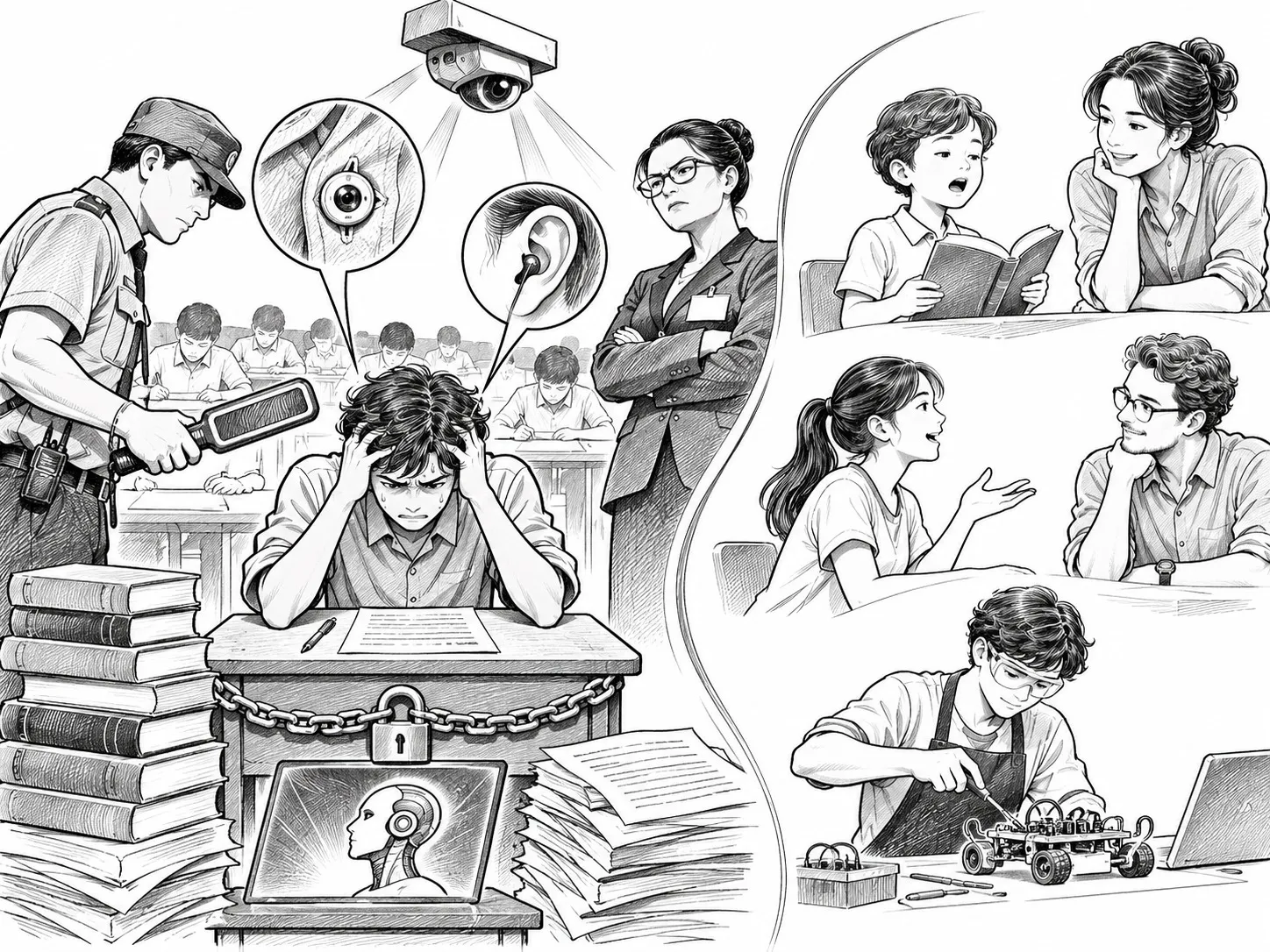
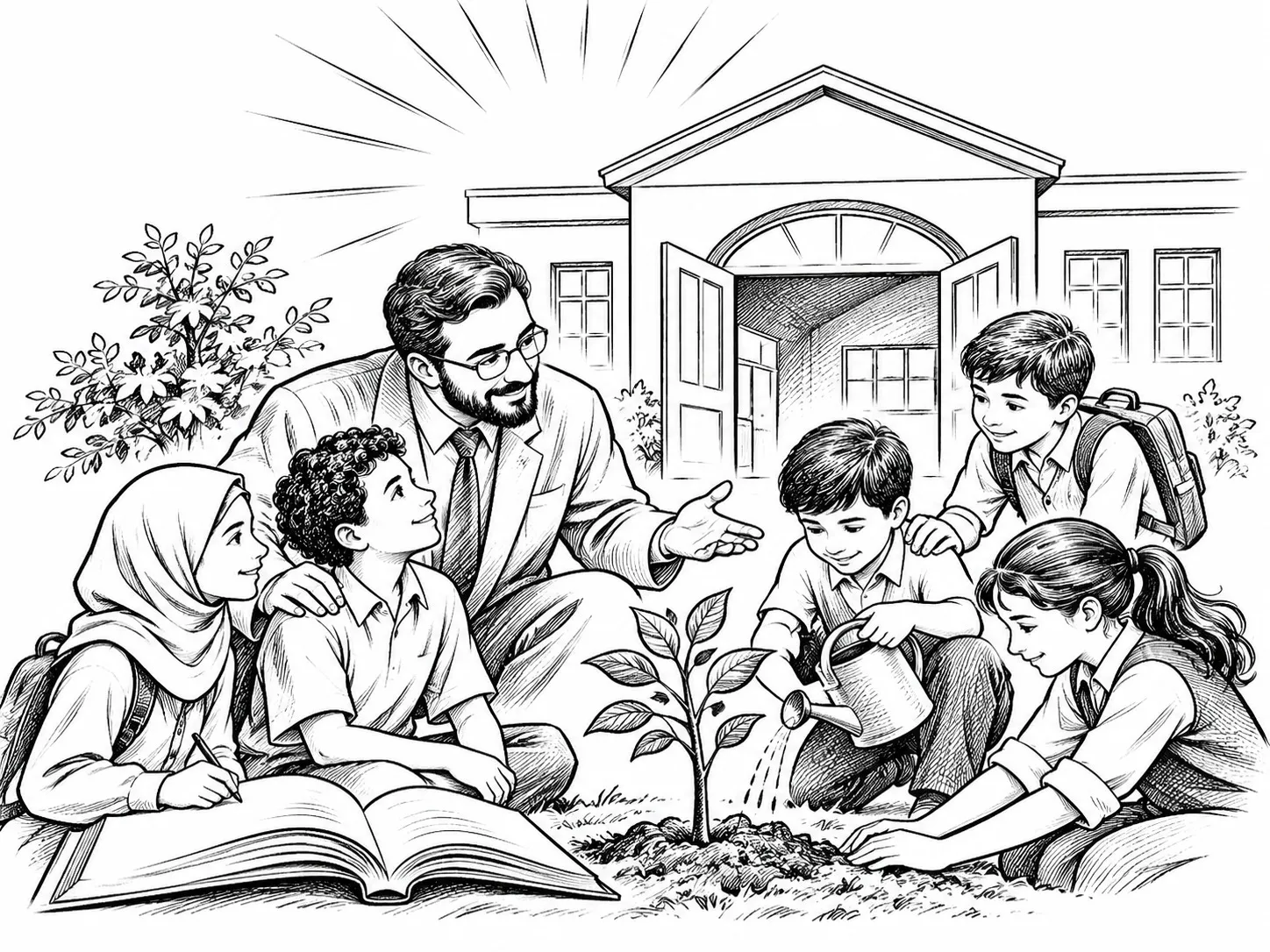
Education on Trial… When the System Becomes the Accused!
 Dr. Abdulqawi Al-Qadasi · 14 min read
Translated from the Arabic. Read the original (العربية)
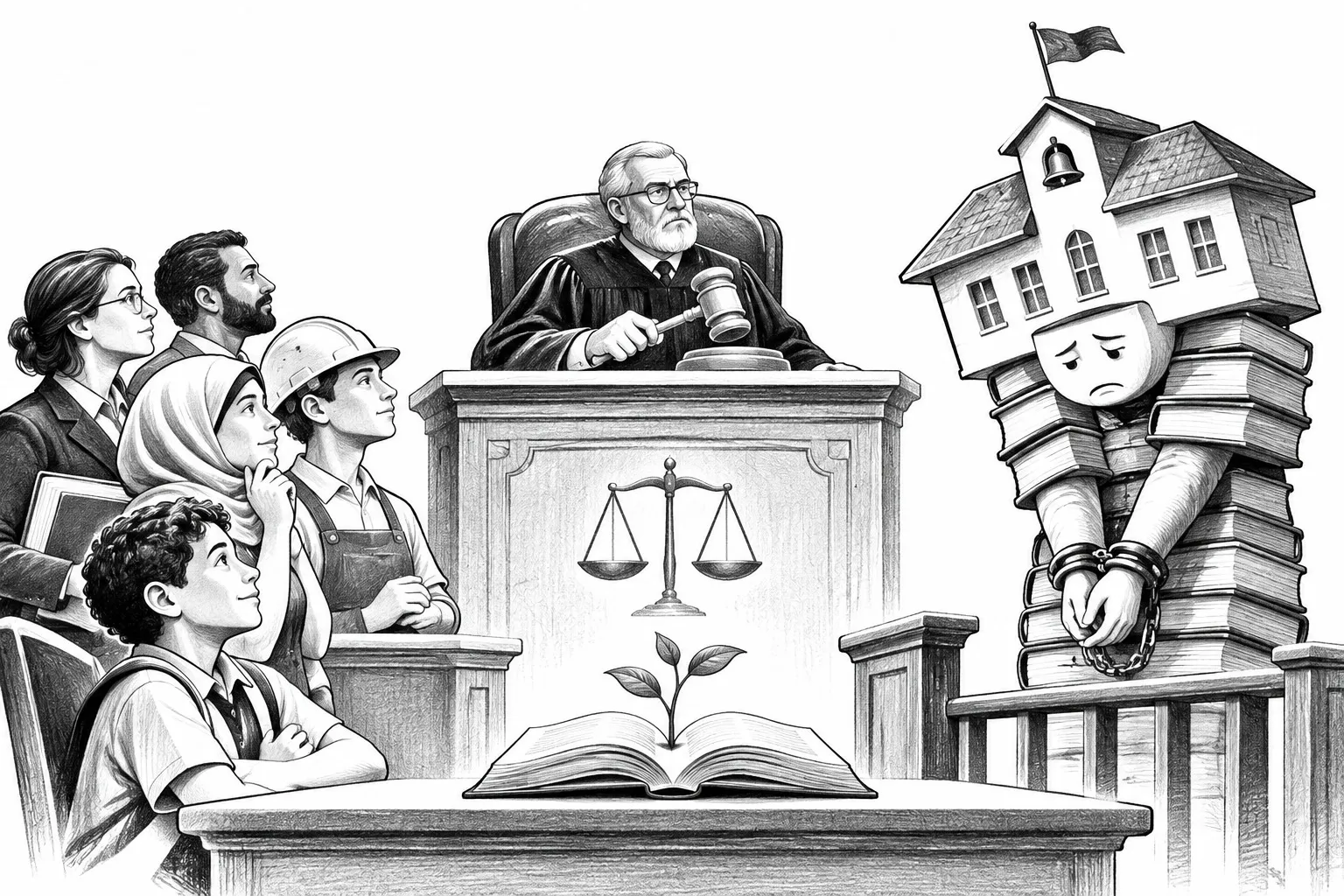
Imagine the education system being summoned to a courtroom, not to pass judgement on students with success or failure, as it is used to doing, but to sit this time in the dock and be questioned about the fate of whole generations that passed between the walls of its schools!
The judge enters, the session begins, and the prosecutor stands to put an unfamiliar question:
How many talents have been wasted because their owners did not excel in mathematics? How many creative minds were described as weak because they did not memorise what was asked of them? And how many students left school convinced that they were failures, not because they were unable to learn, but because they could not learn in the way that was imposed on them?
Silence falls over the courtroom.
Then the education system steps forward to defend itself, saying:
I opened schools to millions, taught generations to read and write, produced doctors, engineers and scientists, and helped build states and advance societies. So how can I be put on trial today as though I had given nothing?
Here the judge intervenes:
No one denies your achievements, but the court does not look only at what you achieved yesterday; it also asks whether you are still able to carry out your mission today.
For not every system that succeeded in one age is necessarily able to respond to the needs of another.
The first witness comes forward: a student who spent twelve years at school and holds a certificate proving that he passed every grade, yet he cannot say what he has truly mastered, or what he can offer himself and his society.
The judge asks him: What did you learn?
He answers: I studied dozens of subjects, memorised hundreds of lessons, and got through thousands of questions.
The judge asks him again: And what can you do today with what you learned?
The student hesitates, then falls silent.
The second witness comes forward: another student, who could not continue his formal schooling, but taught himself, acquired skills, mastered a trade, and became able to create and produce. Yet whenever he knocked on the door of an institution, the first question he faced was: Where is your certificate?
He answers: These are my works, these are my skills, and this is what I can accomplish.
But the doors close in his face, because he does not hold the required piece of paper.
At this the judge wonders:
Was the certificate created to bear witness to a person's competence, or has the person come to be required to prove his worth through the certificate alone?
Then a teacher enters the courtroom carrying her students' files, and says:
I know my students are different. Some learn quickly and some need longer. One is gifted at thinking, another at design, a third at manual work, and a fourth at communication and leadership. But the system asks me to teach them the same content, in the same period, then measure their progress with similar exams and pass different judgements on them.
And if one of them stumbles in a subject, he may be required to repeat a whole year, even if he has mastered the rest of the subjects!
The judge pauses at this statement and asks:
If a person stumbles in one skill, why do we require him to repeat the other skills he has mastered?
Would it not be more fitting to give him the time and support he needs to master what he stumbled in, and then allow him to continue his journey?
Another witness is called, this time from outside the school: a man who learned his trade in a workshop, a woman who gained her expertise from life and work, and a young man who built his knowledge from books and digital platforms.
All of them possess real competences, but the system does not know how to recognise them, because it is used to asking: Where did you learn? How many years did you study? And which institution granted you the certificate?
It rarely asks: What do you know? What have you mastered? And how can you prove it?
Here the judge turns to the representative of the education system:
Is the school the only road to knowledge? And are the years a person spends inside the institution sufficient evidence of what he has learned?
The system answers: No, but there must be standards that guarantee the quality of education and protect society from false claims.
The judge says:
That is a sound defence. The court does not call for abolishing standards, but for reconsidering what those standards measure. Nor does it demand recognition of every claim of competence, but rather that every person be given the opportunity to prove his competence through fair and reliable assessment, regardless of the road he took in learning.
Then comes the most uncomfortable question:
Why do we insist that all learners walk the same road, at the same speed, and arrive at the same stations at the same ages?
Why do we treat time as though it were the measure of learning, instead of letting learning determine the time it needs?
And why do we tie a person's move from one stage to the next to the number of years he has spent, more than to what he has become able to know, understand and accomplish?
The education system returns to its defence:
But societies need organisation, states need shared standards, and we cannot leave education without a framework that brings the members of society together.
The judge answers him:
True. Education is not a purely individual matter, and societies cannot stand without shared knowledge and values. But having a shared foundation does not mean imposing a single track on everyone throughout their lives, just as the differences between learners do not mean abandoning fairness, quality or public responsibility.
People can come together in the foundation, and then their ways and tracks can diverge according to their abilities, inclinations and readiness.
Before the session is adjourned, a small child who was not called as a witness steps forward and asks the judge:
Sir, may I ask a question?
The judge gives him permission.
The child says:
Why do you always ask what we should learn, and never ask first what kind of person you want us to become?
Everyone falls silent.
For the trial has suddenly moved from the question of curricula, exams and certificates to the deeper question: what is the purpose of upbringing and education?
Do we want a person who only memorises information, passes exams and holds certificates? Or do we want a person who possesses knowledge and skill, thinks independently, holds to values, respects others, is able to learn throughout his life, and contributes to building his society?
And here the judge realises that the case is bigger than a school that needs developing, a curriculum that needs updating, or an exam that needs amending.
It is a matter of a whole philosophy that defines our relationship with the human being, learning, knowledge and society.
The historic verdict: from putting education on trial to rebuilding the education system
The judge rises and looks at the courtroom, now filled with students, teachers, parents and thinkers, and says:
Having heard the witnesses, reviewed the evidence and considered the defence of the education system, it has become clear to the court that the case is not one of a school that failed, a teacher who fell short or a student who stumbled, but of a system that needs to review the foundations on which it was built.
It has also become clear to the court that the fault does not lie in the existence of schools, curricula, exams and certificates, but in turning them from means of serving the human being into frameworks to which the human being is required to adapt, however different his abilities and readiness.
Therefore, the court does not rule to abolish formal education, nor to be content with patching some of its aspects, but rules to rebuild the education system according to a vision that makes the human being its aim, upbringing its mission, education its organised means, and learning its actual fruit.
Then the judge announces the articles of the verdict:
Article One: The human being is the aim of upbringing, education and learning
The court determines that the human being is not raw material for the educational institution to shape according to a single mould, but a being unique in his abilities, inclinations, readiness and needs.
And that upbringing is concerned with the integrated growth of the human being in his intellectual, emotional, moral, social and physical dimensions, while education is concerned with organising the experiences and opportunities that support this growth, and learning expresses what a person actually acquires in knowledge, competences, attitudes and experience.
Accordingly, the success of the system is not measured by the number of those who enrol in it or graduate from it alone, but by how far it contributes to building the human being, developing his abilities and enabling him to live a dignified life and take a useful part in society.
Article Two: A shared foundation is the right of all
The court determines that education should begin with a shared and flexible foundational stage that guarantees the acquisition of the basic knowledge, skills and values every person needs.
This stage is not limited to reading, writing and arithmetic, but extends to building character, developing thinking, discovering abilities, inclinations and talents, and providing organised upbringing and suitable guidance.
Fairness is not achieved only by putting all children in front of the same exam, but by giving every child a real opportunity to acquire the basics, taking individual differences into account and offering the support needed.
Article Three: Multiple tracks instead of a single road
The court determines that the differences between human beings in their abilities, inclinations and readiness require a variety of educational tracks after the shared foundation.
Scientific, humanities, technical, vocational and other tracks are to be made available, without considering one of them a road to success and another a sign of failure.
These tracks are to be flexible and interconnected, allowing movement between them and return to them according to readiness and the competences acquired, and they are not to become final judgements on the learner's future.
For it is not fair to impose a single road on everyone and then put them on trial because they did not reach its end at the same speed.
Article Four: Mastery is the basis of progress, and time is a means of organisation
The court determines that school years and fixed ages should not alone be the basis for a learner's advancement or for judging his progress.
A learner who has mastered a particular competence is not to be made to wait simply because his classmates have not yet mastered it, and a learner who needs more time is not to be judged a failure simply because he did not reach mastery within the set time.
Progress is to be granted according to proven competences and the level of readiness to move on, while maintaining the necessary educational and developmental requirements.
Time is used to organise learning, not to stand in for the evidence that it has happened.
Article Five: Assessment to reveal learning, not to pass judgement on the person
The court determines that the assessment system is to be rebuilt so that it distinguishes between assessment that helps the learner know his progress and address his weaknesses, and reliable verification that proves his mastery of the required competences.
Assessment is not to be limited to recalling information in a standardised exam, but is to rest, according to the nature of the competence, on understanding, performance, application, production and achievement.
Stumbling in a particular competence is to be a reason for offering support and additional learning opportunities, not a reason for throwing away what has already been mastered.
Article Six: Recognising learning wherever it was gained
The court determines that the school and the university are not the only sources of knowledge and competence, and that a person may learn from a teacher, a book, work, experience, research, the digital environment or self-directed practice.
Therefore, fair and reliable mechanisms should be established to recognise prior, self-directed, professional and non-formal learning, whenever the required competences are proven by verifiable evidence.
The certificate is a document that bears witness to the attainment of specific competences; it is not a substitute for those competences, nor sufficient evidence of them merely because it has been issued.
The decisive question should not be: where did you learn and how many years did you study? But: what have you learned, what have you mastered, and how can you prove it?
Article Seven: Redefining the function of the school and the university
The court determines that the school is not merely a place for drilling syllabuses and holding exams, but an environment for organised upbringing, building values, developing human relationships, discovering talents, and guiding and supporting learners.
Likewise, the university is not a certificate factory, but an institution of advanced knowledge, specialised qualification, scientific research and the production of knowledge.
University qualification is not to be measured by the number of years alone, but by the specialised knowledge and professional and research competences actually achieved, according to reliable standards that take into account the requirements of the specialisation and of practice.
Article Eight: Education is a journey that never ends
The court determines that learning does not end with obtaining a certificate, does not stop at a particular age, and is not confined to childhood and youth.
A person's life is a continuous journey of gaining knowledge and experience, renewing skills, developing oneself, and responding to the changes in society, work and knowledge.
Accordingly, the system should offer renewed opportunities to enter learning, leave it and return to it, without an interruption in study becoming a permanent closing of the doors to progress.
Article Nine: Fairness and quality are the system's responsibility
The court determines that flexibility does not mean chaos, that multiple tracks do not mean inequality in dignity or rights, and that recognising learning does not mean leniency in the standards of competence.
Therefore, rebuilding the education system requires clear governance, published standards, reliable assessment, quality assurance, organised piloting before expansion, and continuous review of results.
The aim is not to create a system that lets every person take any road without rules, but to build a system that gives everyone fair opportunities, recognises their differences, and guarantees the credibility of the competences they acquire.
The operative part of the final verdict
After these deliberations, the judge raises the document of the verdict and reads in a voice everyone can hear:
The court has ruled to rebuild the education system, not by abolishing its institutions, but by redefining their aims, their functions and their relationship with the human being.
It has ruled that upbringing is to be the integrated growth of the human being, education the organisation of experiences and opportunities, and learning the actual acquisition of knowledge and competence.
It has ruled for a shared foundation for all, followed by varied, flexible tracks that allow movement between them.
It has ruled that mastery is to be the basis of progress, and time a tool of organisation, not the sole measure for judging learning.
It has ruled that assessment is to be a means of revealing progress, supporting learning and verifying mastery, not a tool for sorting human beings and closing the doors of the future before them.
It has ruled for the recognition of competence wherever it was gained, whenever it is proven by fair and reliable evidence.
And it has ruled that the doors of learning are to remain open throughout life, and that fairness, quality and social responsibility are to be the governing guarantees of this structure.
Then the judge pauses for a moment and says:
We do not want a system that subjects the human being to its moulds, but a system that discovers his abilities, develops his readiness, guides his inclinations, and allows him to advance as far as he masters, and to learn wherever he finds a real opportunity to learn.
The judge strikes his gavel, announcing the end of the trial.
But the child who raised the first question raises his hand again:
Your Honour, we have heard the verdict, but when does it begin to be carried out?
The judge looks at the child, then at the teachers and decision-makers, and says:
It begins on the day we stop believing that changing the curricula alone is reform of education, that adding years of study is proof of its quality, and that a rise in the number of certificates necessarily means a rise in the level of competences.
It begins when we have the intellectual courage to review the assumptions that have governed the building of the education system, the institutional courage to try alternatives and evaluate them, and the moral courage to put the interest of the human being above the comfort of the system.
Then he adds:
We have spent a long time asking the human being to prove his ability to adapt to the education system.
The time has come to ask the education system about its ability to respond to the human being.
And here the session is adjourned, but the case is not closed.
The trial was not a call to demolish the school, nor to abolish the university, nor to do without the teacher, but a call to recover the meaning for which these institutions were created.
That the school be a place for the growth of the human being, the university a space for knowledge and research, the teacher an educator, guide and facilitator of learning, and the certificate reliable evidence of competence, not an end in itself.
Thus the trial of education does not end with condemning the past; from it begins the responsibility of building the future.
For the issue, at its core, is not how we improve the system we are used to, but how we rebuild a system that achieves the purpose for which education exists.
And this is the question from which it sets out:
“A Theory of Upbringing and Education: Towards Rebuilding the Education System”.
Dr. Abdulqawi Mukrid Al-Qadasi
Inspired by the book “A Theory of Upbringing and Education: Towards Rebuilding the Education System”.
A note on the source of inspiration
The dramatic framework of this article, built on putting the education system on trial, was inspired by the video I Just Sued the School System by the American artist Prince Ea, published in 2016.
The content of the verdict, and the concepts of rebuilding the education system in the article, rest on the vision the author presents in his book “A Theory of Upbringing and Education: Towards Rebuilding the Education System”. The article is neither a translation of the original video nor a transcription of its text.
The work referred to:
Prince Ea. (2016). I Just Sued the School System [Video].
Link to a search for the original video on YouTube https://www.youtube.com/results?search_query=%D9%85%D8%AD%D8%A7%D9%83%D9%85%D8%A9+%D8%A7%D9%84%D8%AA%D8%B9%D9%84%D9%8A%D9%85
Related service: Parenting and education counselling
Questions people hesitate to ask
What is wrong with today's education system?
The article argues that the fault is not the existence of schools, curricula, exams and certificates, but their turning from means of serving the human being into frameworks people must adapt to. Everyone is taught the same content in the same period, measured with similar exams, and a student may repeat a whole year for stumbling in one subject.
Why should a student repeat a whole year for failing one subject?
The article sees this as a result of tying progress to time rather than mastery. It calls for giving the student the time and support to master what he stumbled in and then letting him continue, so that stumbling in one competence leads to support and extra learning, not to throwing away what he has already mastered.
Does rebuilding the education system mean abolishing schools and certificates?
No. The court in the article does not rule to abolish formal education or standards, but to redefine the aims and functions of its institutions: the school as a place for human growth, the university as a space for knowledge and research, and the certificate as reliable evidence of competence rather than an end in itself, with clear governance, published standards and quality assurance.
Share your thoughts
Have you been through something like this, or has a question come to mind? Write it here. Your words may help another reader.
No comments yet. Be the first to start the conversation.