The Faces and Extensions of the Family: When the Walls Change and the Roots Hold
 Dr. Abdulqawi Al-Qadasi · 6 min read
Translated from the Arabic. Read the original (العربية)
A human being is born not only into a geography and a history, but into a family that gives him the first meanings of identity and belonging. In its embrace he learns language and values, discovers the meaning of responsibility, and sees his first image in the eyes of others.
Yet the shape of the family has not been one and the same in every time and place. Homes have widened and shrunk; generations have gathered under a single roof and then separated into scattered dwellings; and patterns of kinship have shifted with economy, work, migration and social change. Even so, one question has crossed the ages: how has the form of the family changed without its losing its spirit?
The Family Is an Institution That Adapts and Does Not Vanish
The image of the contemporary family may suggest to us that it is the natural, fixed form humankind has always known. But historical and anthropological studies draw a more varied picture: the family is among the human institutions most able to adapt to its environment, while its essential roles of care, nurture, cooperation and the transmission of values between generations continue.
As people settled on the land, as agriculture grew, property accumulated, and cities and states appeared, family and kinship relations took shape in different ways. In some societies extended families spanning more than one generation lived together; in others marriage ties played a role in cementing alliances; and some environments knew polygyny or different systems of descent, inheritance and residence after marriage.
None of this means that all societies followed a single historical path, or that one sole cause produced every pattern. The size of the family and the way it was organised were shaped by intertwined factors: the nature of work, ownership of land, the need for cooperation, wars, migration, mortality rates, and the customs and values of society.
The anthropologist George Peter Murdock’s Social Structure was a prominent work in the comparative study of the family and kinship across many cultures. Murdock concluded that the nuclear family is present as a basic unit within family forms that may be broader and more complex. And although later family studies have debated some of his generalisations, his work established an important truth: a difference in family organisation does not mean the absence of the family, but reveals human beings’ ability to reshape it according to their circumstances.
From here the more precise question is not: why were families never alike? but rather: what needs and circumstances led each society to organise kinship and responsibility differently?
When Islam Came to an Existing Reality
Islam came to a society that knew many forms of marriage, kinship and inheritance. It did not treat the family as a relationship without rules, but placed it within a framework of rights, duties and responsibility. It regulated matters of lineage, inheritance and the care of orphans, and it limited polygyny by number and by justice, affirming that family relations are sustained not by bare desire but by responsibility and the safeguarding of rights.
It is striking that Surat al-Nisa’ brings together, from its very opening, the unity of human origin, the fear of God and the ties of kinship: “O mankind, fear your Lord, who created you from one soul and created from it its mate and dispersed from both of them many men and women. And fear Allah, through whom you ask one another, and the wombs. Indeed Allah is ever, over you, an Observer” (Qur’an, al-Nisa’ 4:1).
The family, in this conception, is not merely an arrangement of housing but a moral bond that calls for kindness, mercy, justice and the safeguarding of rights.
The Extended Family: More Than One Roof
Sociologists use the term “the extended family” for the circle that goes beyond parents and children to include grandparents and grandchildren, paternal and maternal uncles and aunts, and other relatives. This pattern has historically been tied to shared or nearby living, the sharing of resources, and cooperation in work, upbringing and care.
Today, the shape of this extension has changed. Children grow up and marry, new homes are opened for them, and study or a job may carry them to distant cities and countries. From the outside, it seems that the large family has scattered; but many homes do not necessarily mean a divided family, because belonging comes before the shared roof.
Children’s leaving their parents’ home after marriage is not a threat to the family; it may be its natural extension. Every new home is a fruit of the first home. Nor is living together always the ideal arrangement; overlapping responsibilities, a lack of privacy and differences of temperament may lead to frictions that could have been avoided. For this reason, independent housing may preserve affection and give the new family room to find its own rhythm and bear its own responsibilities.
But independence is one thing, and estrangement is another.
When Homes Become Independent and Hearts Do Not Part
Today the strength of a family is measured not by how many sleep under one roof, but by its ability to remain present in the lives of its members despite the distances. Asking after one another, visiting, honouring parents, keeping the ties of kinship, supporting the weak, rejoicing in another’s joy and standing by him in hardship: all these are threads that keep the family’s fabric from tearing.
Modern means of communication allow new forms of this presence, but they do not fully replace human meeting. A phone call reassures and a message shortens the distance, yet the table that gathers the family, the handshake, the long sitting together with no appointment, have a meaning that the screen cannot make up for. And perhaps the one living abroad understands this better than anyone, when a family gathering becomes a memory whose return he waits for.
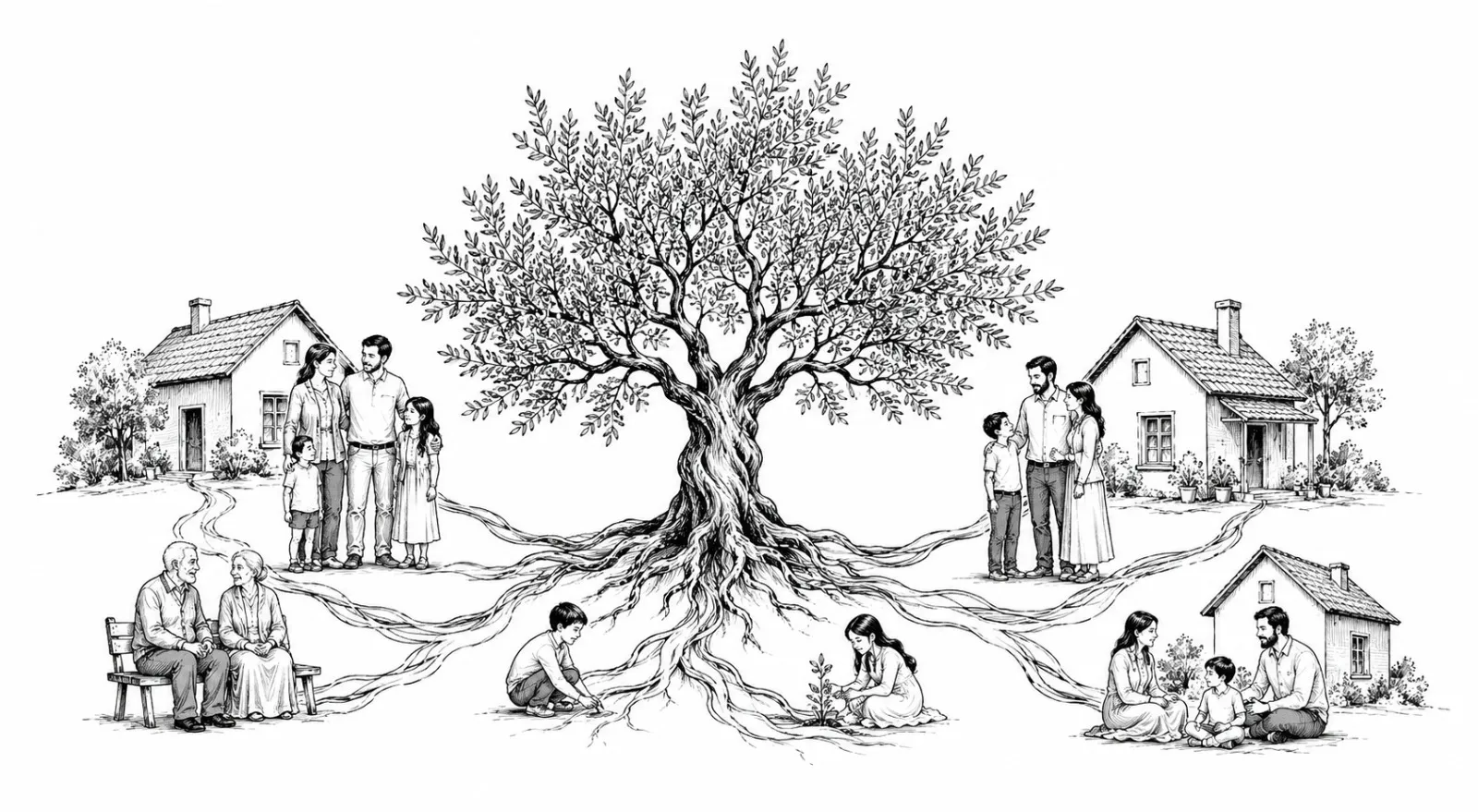
In this sense, the extended family has not disappeared; its address has changed. It is no longer necessarily one large house with a single door, but a network of homes joined by affection, responsibility and shared memory.
The Roots We Carry With Us
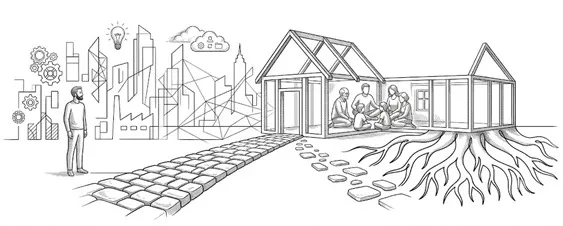
The greatest thing a family gives its children is not a house to live in forever, but roots they carry wherever they go. Successful independence does not uproot these roots; it makes them able to produce new branches.
So the extended family is not a call for spatial crowding, nor a demand that everyone live in the same way. It is a call for balance: that each home be independent in its privacy and responsibility, and remain joined to its origin through affection, kindness and mutual support.
The walls of the family have changed many times through history, and will go on changing as work, migration, technology and ways of living change. But as long as it can give a person belonging, care and meaning, its roots will remain deeper than its walls.
Yet a great transformation awaited the family, one that would reorder work, the city and the whole of daily time: the Industrial Revolution. That transformation was neither an invading army nor an abstract philosophy, but a machine that began to turn in a distant factory, then whose echo spread until it reached the heart of the home. That is another story, which begins with the family’s entry into the age of the machine.
References and Further Reading
- George Peter Murdock, Social Structure (New York: Macmillan, 1949). An indexed copy is at the Internet Archive, and a description of the book at Google Books.
- National Academy of Sciences, George Peter Murdock: A Biographical Memoir, which discusses his comparative method and his book Social Structure.
- Esteban Ortiz-Ospina and Hannah Ritchie, Urbanization, Our World in Data, on the movement of populations to cities and its relation to changes in housing and work.
- National Geographic Society, Industrialization, Labor, and Life, on the effect of industrialisation on patterns of settlement, work and family life.
- The Noble Qur’an, Surat al-Nisa’, verse 1, and verse 3.
Related service: Marriage counselling
Questions people hesitate to ask
Does children moving into their own home after marriage threaten the family?
No, it can be a natural extension of it; every new home is a fruit of the first one. Living together is not always ideal, since lack of privacy and differing temperaments can cause friction, so a separate home may preserve affection. But independence is one thing and estrangement another: the bond continues through dutifulness, visits and mutual support.
Share your thoughts
Have you been through something like this, or has a question come to mind? Write it here. Your words may help another reader.
No comments yet. Be the first to start the conversation.