Is It Time to Change the Education System?
 Dr. Abdulqawi Al-Qadasi · 10 min read
Translated from the Arabic. Read the original (العربية)
The Theory of Upbringing and Education… a vision for rebuilding the education system starting from the human being and his abilities.
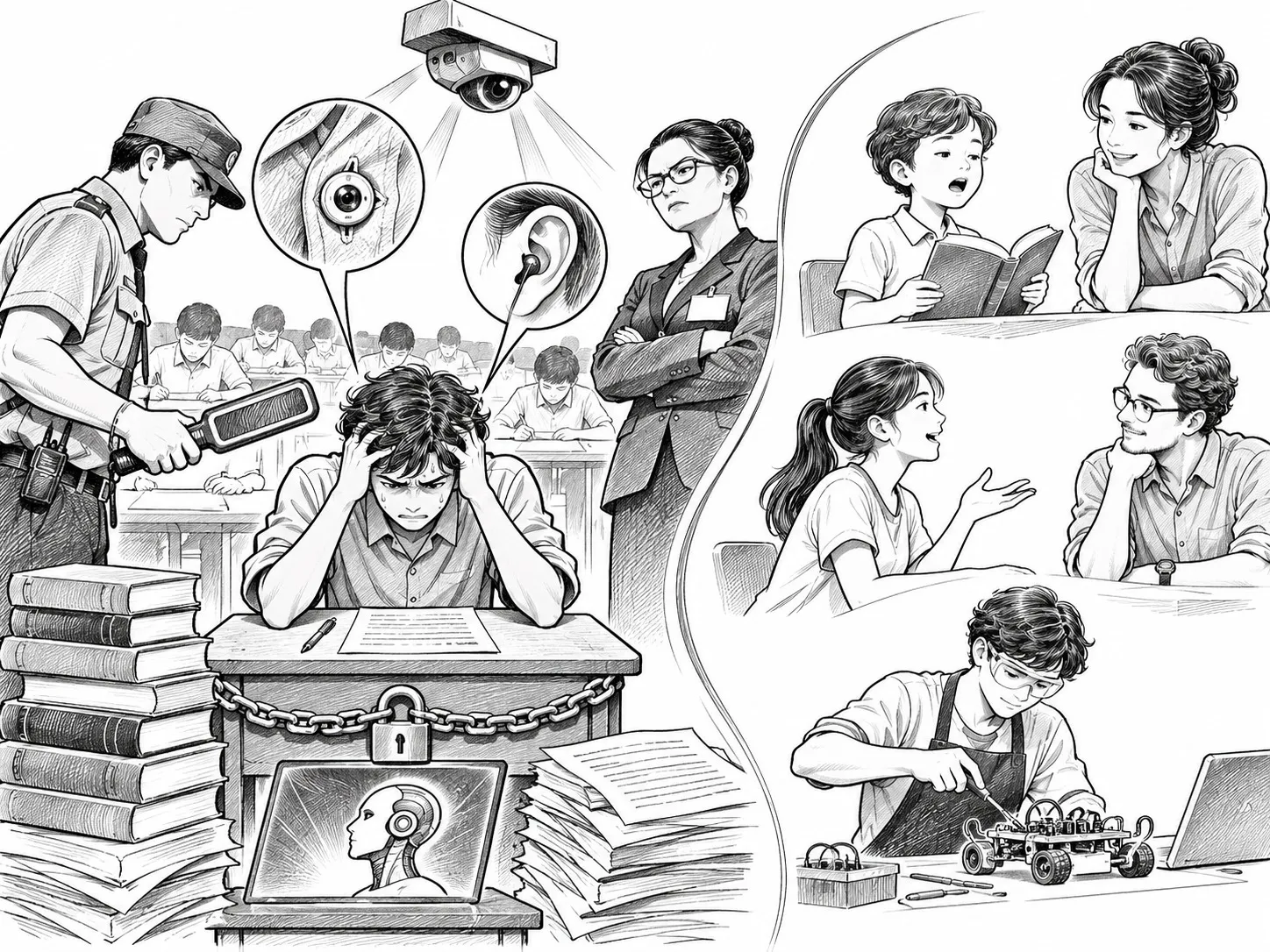
Imagine a child who can master what is required of him in mathematics within a few months, yet is required to wait until the school year ends before moving on to the next level. And imagine another child who needs more time to master reading, yet has to move on with his classmates because the year has ended, even if gaps remain in his learning.
The first waits for the system despite being ready to advance; the second advances with the system despite needing more grounding.
In both cases, the difference in the two children’s abilities was not the problem; the problem was the way the education system organises their learning.
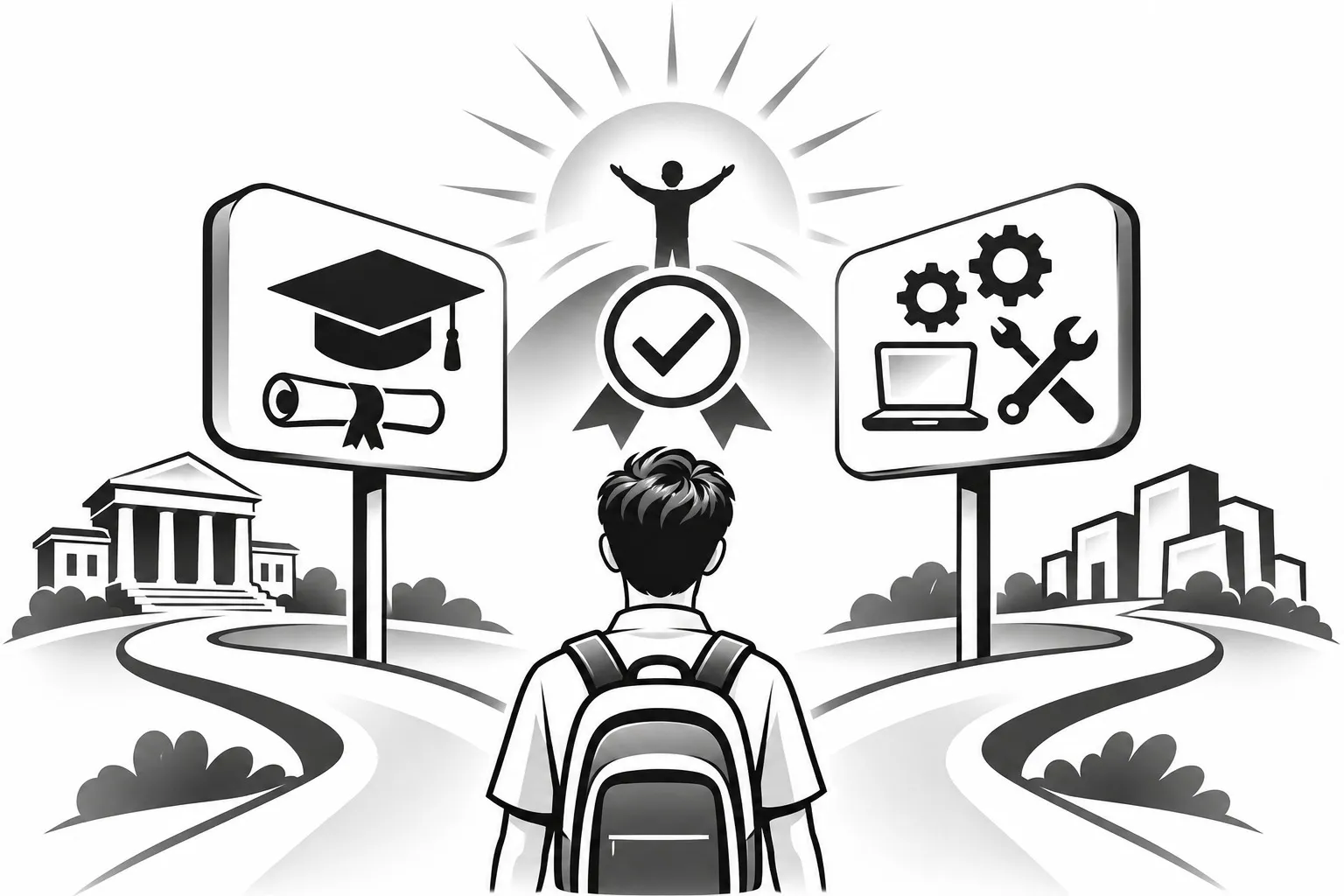
Now imagine a young man who has acquired advanced skills in programming, design or a trade through self-learning and practical experience, yet finds doors closed before him because he does not hold the required certificate, while another holds a certificate in the same field without it necessarily meaning that he has the same level of competence.
Here another question arises: should we judge what a person knows and can do, or the route he took to obtain that knowledge?
These are not imaginary cases far from reality, but pictures that reveal problems familiar to many teachers, educators and employers. And yet we usually look for solutions to them inside the system itself, without asking about the rules that produced them.
So has the time come to move from reforming education to rethinking the education system itself?
When we develop almost everything… except the rules that govern it
For decades, educators have been occupied with developing curricula, improving teaching methods, training teachers, introducing modern technologies, and updating methods of assessment. These efforts have achieved important things, and have helped widen learning opportunities and improve many educational practices.
But there is a paradox worth reflecting on: the sources of knowledge and the means of reaching it have changed enormously, and our understanding of the nature of learning and of the differences between learners has developed, while many of the basic rules for organising education have stayed as they were.
We still usually group learners by age, determine their progress by grades and years, distribute shared courses to them within similar timetables, and then award them certificates tied to completing specified stages and programmes.
There is not necessarily anything wrong with these means; they have played a great role in organising and expanding education. But the problem begins when we treat them as ends that may not be gone beyond, instead of seeing them as tools that can be reviewed and developed whenever means more capable of achieving learning appear.
The school year is not a direct measure of mastery, the grade is not an accurate expression of all of a learner’s abilities, the certificate is not always sufficient evidence of competence, and the school is not the only place where a person can learn.
And if we are aware of these facts, why are they not reflected more deeply in the structure of the education system itself?
From this question the journey of the theory began
Thinking about rebuilding the education system was not a passing idea, nor the result of being dazzled by a new technology or a different school experiment. It came after a long journey of reflection on the reality of upbringing and education, on the relationship between the school, the learner, the teacher, the curriculum and leadership, and between what we want from education and what the rules that organise it allow.
Through this journey, which took shape in the ten-book series Towards a Theory of Upbringing and Education, one question moved ahead of the others: what if the problem lay not only in the weakness of some components of education, but in the relationships that link these components to one another?
A teacher may have the ability to take individual differences into account, but the curriculum, the timetable and the exam do not give him enough flexibility. A school may succeed in developing an outstanding learning environment, but it cannot change the rules of progression and the recognition of qualifications. And opportunities to learn may multiply online, at work and in various institutions, while systems remain unable to recognise an important part of what a person acquires outside the usual path.
In this way initiatives may succeed within their limits without being able to overcome the constraints imposed on them by the rest of the system.
From here came the attempt to build The Theory of Upbringing and Education: Towards Rebuilding the Education System; not to cancel what generations have achieved, but to benefit from that achievement and from the accumulation of educational thought and human experience, in a vision that reorganises the relationship between the human being, learning, institutions, time, assessment, qualifications and governance.
What does the theory propose?
The theory starts from a principle simple in its wording and wide in its consequences: the education system should respond to the differences between people, their abilities and their needs, instead of obliging all learners to progress according to a single mould.
But this principle does not mean leaving learning to individual wishes alone, nor doing without standards or educational responsibility. It requires building a system that combines a shared foundation that society guarantees to all its children with varied opportunities that allow each person to develop his abilities and progress in the fields that suit him.
For this reason the theory proposes a shared foundational stage, in which all children acquire the knowledge, skills and values necessary for life and for continued learning: from language, reading, writing, arithmetic and thinking, to spiritual, moral, social and civic upbringing and general culture.
Yet learners sharing the core aims does not require them to be identical in how fast they reach them. Progress should be linked to the level of mastery, with attention to psychological and social maturity, support for those who need it, and wider opportunities for those able to advance.
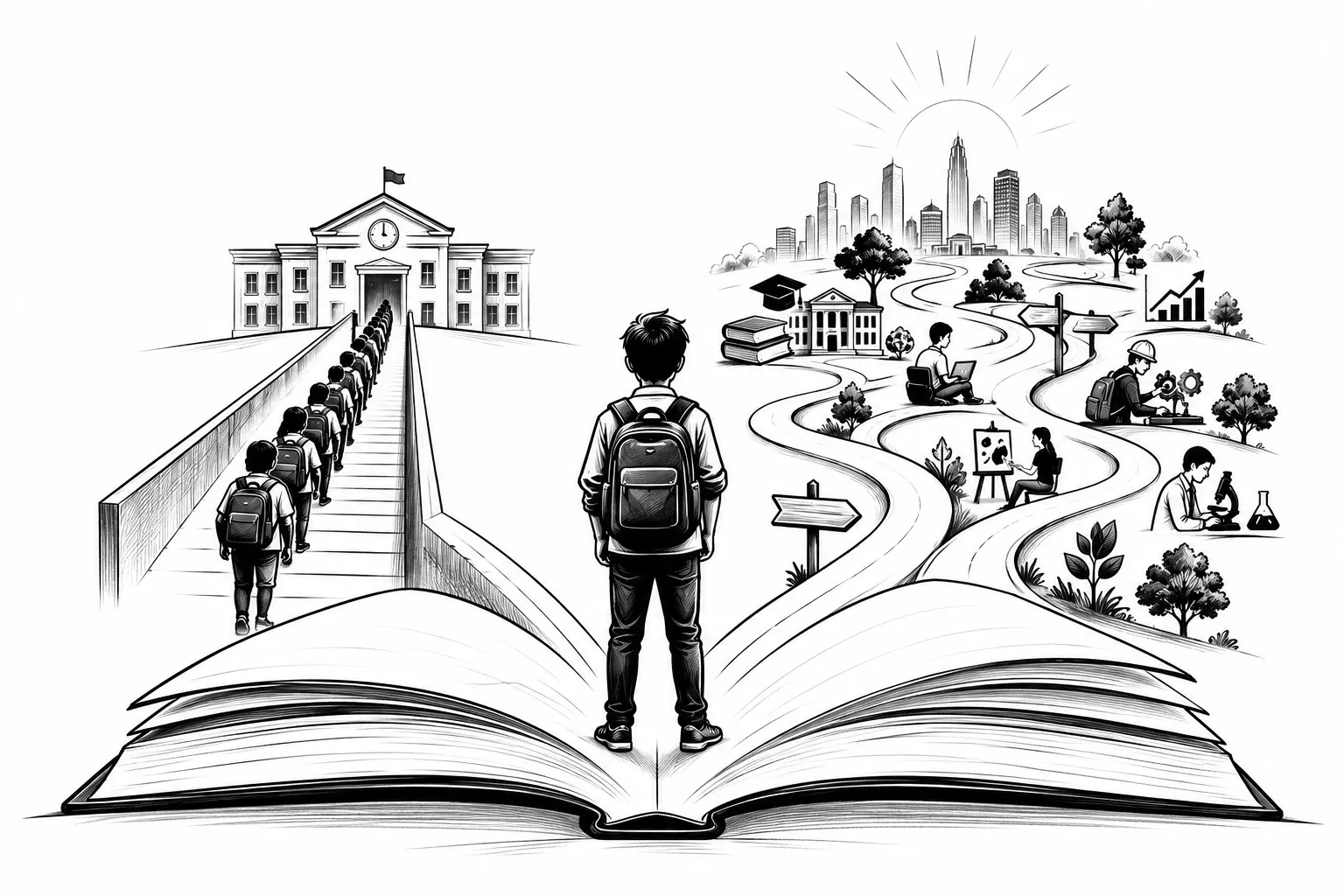
After this stage, the traditional academic route is no longer the path by which the worth of all learners is measured. Rather, academic, vocational, technical, artistic, research and other pathways become available, between which one can move and through which one can combine, without a person’s choice at an early stage becoming a final verdict on his future.
Not every learner is required to take the same route in order to succeed, not everyone who chooses a vocational path is less capable of thinking and creativity, and academic specialisation should not be separated from practical experience and life.
What if we separated learning from proving it?
Perhaps one of the most important issues the theory raises is reconsidering the relationship between acquiring knowledge and recognising it.
We have grown used to the certificate usually being tied to an institution, a programme and a period of study. But a person may learn the same knowledge by many routes: at school, university or an institute, at the workplace, or through research and self-learning.
So why do we not distinguish between the route by which a person acquired his competence and the way we verify that he has it?
This distinction opens the way to building a more flexible system of assessment and recognition, based on clear standards and reliable evidence, which gives a person the chance to prove what he knows and can do without always requiring him to study again what he has already mastered.
This does not mean that every skill can be proved by a quick test, or that professions linked to human safety can be practised without training, supervision and licensing. Every field has its nature and its requirements, and some competencies need long experience and practical work that cannot be reduced to a mark or a certificate.
But the principle that deserves discussion is: why do we make the route of learning the sole condition for recognition, if its results can be verified in a scientific and fair way?
Does the school become meaningless?
Some may think that talking about multiple pathways of learning and recognising competencies acquired outside institutions means diminishing the importance of the school and the teacher. In truth, the theory starts from a completely different view.
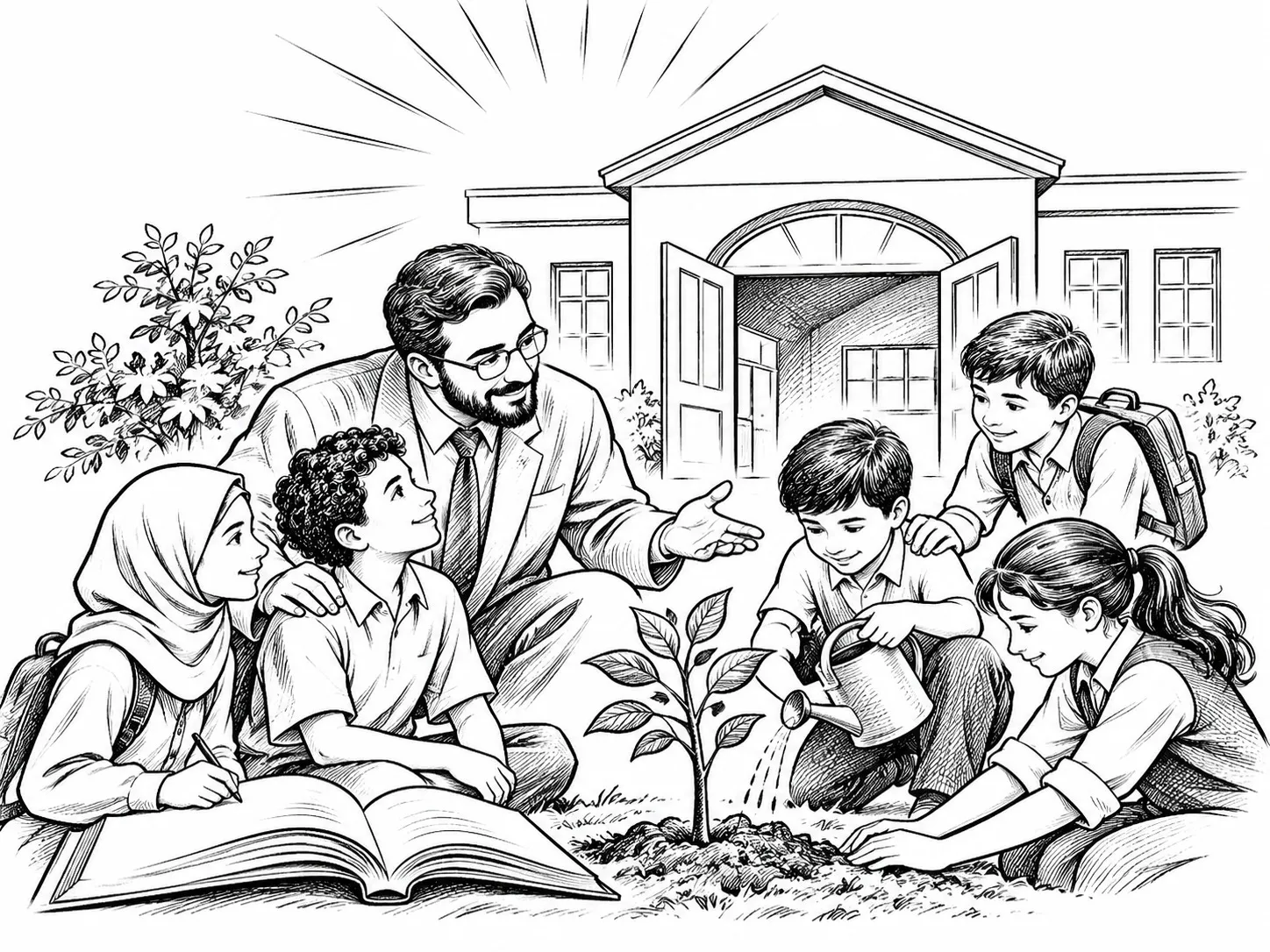
The school remains a fundamental environment for upbringing, character building, discovering abilities and developing human relationships. And the teacher does not lose his standing when sources of knowledge multiply; rather, his responsibility widens as an educator, expert and guide who helps the learner to understand, think and grow.
Indeed, freeing the school from some organisational constraints may give it a greater chance to carry out its educational mission, instead of a large part of its efforts being confined to finishing courses and preparing for exams.
The state, too, remains responsible for guaranteeing the right to education and the fairness and quality of its opportunities, even if the bodies that provide learning opportunities multiply. The flexibility of the system should not come at the expense of equity or reliability; it must rest on clear legislation, standards and mechanisms for assessment, accreditation and accountability.
Most importantly, upbringing in this vision does not reduce the human being to professional skills or measurable knowledge. A person needs values, responsibility, awareness and the ability to live with others as much as he needs knowledge, work and creativity.
What is new if some of these ideas are already known?
This is a legitimate question; indeed, I see it as one of the most important questions any new theory should face.
Learner-centred learning, competency-based education, recognition of prior learning, multiple pathways and lifelong learning are all ideas that various educational philosophies, experiments and institutions have addressed. Some of them have achieved important results within particular scopes.
For this reason, the theory I put forward does not rest on the claim that no one has known these principles before.
The addition the theory seeks is not to invent every part of the system, but to rebuild the relationships between its parts within a single vision.
What use is allowing a learner to progress according to his mastery if the certificate remains conditional on a fixed period? What is the value of diverse sources of learning if the system for recognising their results does not develop? How can multiple educational pathways be opened if the rules for moving between them are closed? And how can flexibility be achieved if legislation, governance, funding and assessment do not change?
Changing a single element may improve its performance, but changing the relationship between the elements may open the way to a different system.
And it is precisely here that the essence of the theoretical attempt lies: moving from scattered reforms to an integrated vision that reorganises the education system, while preserving the aims of humane upbringing and guaranteeing fairness and quality.
A theory for discussion, not for acceptance
I do not present this theory as a complete truth, nor do I claim that a written vision can on its own change the reality of education or remedy all its problems.
Any theory that seeks a transformation of this size needs critique, research, experimentation, comparison and evaluation. Applications may reveal difficulties that were not clear in the theoretical construction, or results that call for reviewing some of its assumptions and developing its mechanisms.
This, in my view, is not a weakness in the theory, but a condition for it to gain its scientific value.
The aim is not to replace a system we have grown used to with another system that we treat as a final formula, but to open the way to building a system able to benefit from knowledge and experience, to review its performance, and to develop its tools whenever the need arises.
Hence the book The Theory of Upbringing and Education: Towards Rebuilding the Education System represents the outcome of an intellectual and research journey, but it is not the end of the dialogue; it is the beginning of a stage in which I hope researchers, educators, teachers, universities, research centres and education policymakers will take part.
And now the question to educators…
If we were given the chance today to rebuild the education system, drawing on everything humanity has achieved in upbringing and education, and on everything we have learned about the differences between learners, the nature of learning and the possibilities of technology, would we choose the same structure we are used to?
Would we make age, grade and school year the main determinants of progress? Would we keep educational pathways separate as they are? And would we go on tying recognition of what a person knows to the time he has spent inside an institution, or would we look for means better able to verify his actual learning?
We may differ in our answers, and we may discover that some of what we want to change is still necessary, and that some of what we propose needs time, experimentation and safeguards. But the value of this dialogue begins with our readiness to review what we are used to, not with assuming that the familiar is always best.
I do not invite educators to agree with this theory; I invite them to question it, criticise it and test it, and to take part in answering a question I believe deserves to be at the forefront of educational debate:
Has the time come for us to rebuild the education system, not merely by changing what a person learns and how he learns it, but by reconsidering the rules that determine when he advances, where he learns, and how we verify and recognise his competence?
Perhaps the greatest development we could offer education is not to settle for developing what happens inside the system, but to have the scientific courage to rethink the system itself.
Related service: Parenting and education counselling
Questions people hesitate to ask
What is the difference between reforming education and rebuilding the education system?
The article argues that decades of developing curricula, teaching methods, teacher training and technology achieved important things, but stayed within unchanged rules: age, grade, school year and a certificate tied to time. Rebuilding means reviewing these rules and the relationships between the system's parts, because changing one element may improve its performance, while changing the relationship between elements may open the way to a different system.
Can skills learned outside school be formally recognised?
The article calls for distinguishing the route by which a person acquired competence from the way we verify it, through an assessment and recognition system based on clear standards and reliable evidence. This does not mean every skill can be proved by a quick test; professions linked to human safety still require training, supervision and licensing.
Do the school and the teacher lose their importance if learning pathways multiply?
The article argues the opposite: the school remains a fundamental environment for upbringing, character building and discovering abilities; the teacher's responsibility widens as educator and guide when sources of knowledge multiply; and the state remains responsible for guaranteeing the right to education and its fairness and quality.
Share your thoughts
Have you been through something like this, or has a question come to mind? Write it here. Your words may help another reader.
بارك الله فيك وبايامك وحياتك