Not Every House Is a Sanctuary
 Dr. Abdulqawi Al-Qadasi · 7 min read
Translated from the Arabic. Read the original (العربية)

How does a life partner become a source of safety and calm?
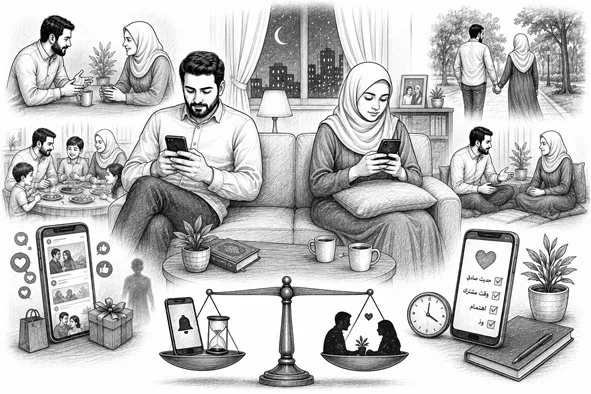
Not every house is a sanctuary. A house may be spacious, beautifully furnished and complete in every detail, and yet the couple who live in it feel no ease with one another. Another house may be small and modest, and whoever steps into it senses something that cannot be bought: peace of mind. What makes one house a place of residence, and another a dwelling for the soul?
When the Qur'an speaks of the marital relationship, it chooses an expression of great depth: “And of His signs is that He created for you from yourselves mates that you may find tranquility in them…” [Ar-Rum: 21]. It does not say “to dwell with her” but “to find tranquillity in her”; as though a spouse becomes the place a person returns to from the weariness and turbulence of life.
Tranquillity (sakan) in this sense is wider than a house. A house is walls, a roof and furniture; tranquillity is a feeling of psychological safety. It is being able to be yourself without living in dread of mockery or humiliation, knowing that your weakness will never one day be turned into a weapon against you, and coming home from the outside world to someone before whom you have no need to wear a mask.
A husband who spends his day at work may face competition, pressure and setbacks, and perhaps hear more criticism than appreciation. When he returns home, he does not always need someone to hand him solutions. He may first need a place where he feels that his worth does not hang on how well he did that day. A wife who has spent her day between home and work, or children, or study, needs the same: someone whose presence she experiences as a space of rest, not as a fresh list of demands.
And this tranquillity is not made by one party alone. It is true that the verse of Ar-Rum was revealed in the context of the wife being created for the man, but elsewhere the Qur'an portrays the relationship as mutual and intimate: “They are a clothing for you and you are a clothing for them” [Al-Baqarah: 187]. Each is a garment for the other: close to the other, covering the other, surrounding the other. There is a lovely meaning in this image. Just as the man needs tranquillity, so does the woman; and just as each waits for safety from the other, each is also responsible for giving it.
It is striking, perhaps, that modern psychology has approached this meaning from another angle. In attachment theory we meet the concepts of the “safe haven” and the “secure base”: a stable relationship gives a person someone to turn to in distress, seeking support and reassurance, and at the same time gives him a security that helps him set out into life, work and growth with confidence.[1] The point, of course, is not that the psychological concept explains the verse. It is that modern human knowledge here catches hold of a deep human need which the Qur'an, in the context of marriage, expressed in one eloquent word: tranquillity.
Yet this tranquillity can wear away, and sometimes it takes no great problem to bring it down. A home full of criticism, mockery, comparisons and threats of leaving at every quarrel leaves a person on edge rather than at ease. There may be no single great incident either spouse can point to, only hundreds of small moments carrying one message: you are under constant assessment here.
A single word can destroy a space of safety built over years. A husband tells his wife of something he is ashamed of, and she keeps it until a quarrel comes and then brings it up before her family. Or a wife tells her husband fears that no one else knows, and he uses them to mock her when he is angry. The dispute may end within hours, and both may apologise, but something else has been wounded: safety. Next time, a person will think twice before exposing his weakness.
This is why keeping secrets between spouses is not merely a matter of social etiquette; it is part of building tranquillity itself. A person cannot feel at ease with someone he fears will turn his privacy into a story told to friends and relatives, or into material to be used against him in anger. The Prophetic Sunnah is especially emphatic about the sanctity of the private intimacies between husband and wife.[2]
None of this means that privacy becomes a rule forbidding spouses to seek counsel when they need it, nor that tranquillity means staying silent about a fault so that no one is upset. The safe home is not the home whose people never disagree; such a home does not exist. The safe home is one in which a couple can disagree without either of them fearing for their dignity, their standing, or the continuation of the relationship at every dispute.
Hence the importance of the way we reproach. There is a great difference between saying to your partner, “That behaviour hurt me,” and saying, “You are always like this and you will never change.” The first speaks of an act that can be discussed; the second passes judgement on the whole person. And there is a difference between disagreeing over a financial decision and letting the disagreement turn into an insult to a person's family, education, appearance or past. Some words outgrow the problem that prompted them, and they remain in memory long after the problem itself has ended.
Among the loveliest things that build tranquillity is for each partner to know that the other is on their side. This does not mean agreeing with everything the other says or does; love does not abolish disagreement. It means that a deeper feeling remains present: we are not adversaries, even when we differ. We are two people in one house, and what befalls one of us touches the other.
The truth of this shows most clearly when circumstances change. Talk of love is easy in days of health and prosperity, but life does not stay in one form. One spouse may fall ill, lose a job, see their income decline, pass through a period of weakness, grow old, or become less able to give what they once gave. And here arises one of the hardest questions of shared life: does a person remain loved when he becomes less able to give?
Homes throughout history have given magnificent answers to this question: a man who tends his wife through a long illness; a woman who stands beside her husband when he is incapacitated or ruined; a couple who pass through financial hardship without either turning the other into the accused. These are not superhuman feats. They are the deepest picture of partnership, when the word “we” ceases to be a grammatical pronoun and becomes a lived reality.
It is a beautiful thing, perhaps, that in the verse of Ar-Rum tranquillity comes before affection and mercy: “…that you may find tranquility in them; and He placed between you affection and mercy” [Ar-Rum: 21]. Love needs safe ground to live on. It is hard for a person to draw near to someone he fears, to confide in someone he does not trust, or to find rest in a place where he must stay ready to defend himself.
Nor does this mean that a house can shut its doors against the weariness of the world. Worry will enter it, and illness, and money troubles; the pressures of work will reach it, and clashes of mood, and the problems of children, and the turns of fortune. The difference lies not in the absence of these things but in the question: when they come in to us, do we work together to face them, or do we make fresh weariness for one another on top of them?
And perhaps this is why the greatest homes are not those that know no problems, nor those whose owners have the most beautiful furniture, but those whose door a person can open after a long day and feel that behind it is someone who knows his weakness and his strength, his successes and his failures, who has seen in him what others do not see, and who is still a place where he feels safe.
Only then does the house turn from an address we live in into a tranquillity that lives in us.
At the end of a long day, a person may not need a bigger house, nor many words.
He may need only to look at the companion of his life and feel within himself:
Here I can be at peace.
References
- Mario Mikulincer and Phillip R. Shaver, “Adult Attachment Orientations and Relationship Processes,” Journal of Family Theory & Review, vol. 4, no. 4 (2012): 259–274.
- Narrated by Muslim, Sahih Muslim, Book of Marriage, chapter on the prohibition of divulging a wife's secret, hadith no. 1437.
Related service: Marriage counselling
Questions people hesitate to ask
What does sakan, tranquillity, mean in a marriage?
Tranquillity is wider than a house. A house is walls and furniture; tranquillity is a feeling of psychological safety: being yourself without dreading mockery or humiliation, knowing your weakness will never be turned into a weapon against you, and coming home from the outside world to someone before whom you need wear no mask.
What destroys the sense of safety between spouses?
It does not always take a big problem. Frequent criticism, mockery, comparisons and threats to leave at every disagreement keep a person on guard instead of at ease. A single word can do it, such as bringing up a secret or fear one partner confided, during a quarrel or to mock them; next time they think twice before revealing weakness.
How can you reproach your spouse without wounding them?
Speak about the act, not the whole person. Saying This behaviour hurt me addresses an act that can be discussed; saying You are always like this and will never change passes judgement on the person. Nor should a disagreement turn into insults about family, education, looks or the past.
Share your thoughts
Have you been through something like this, or has a question come to mind? Write it here. Your words may help another reader.
No comments yet. Be the first to start the conversation.