Are We Preparing Our Children for a World That No Longer Exists?
 Dr. Abdulqawi Al-Qadasi · 9 min read
Translated from the Arabic. Read the original (العربية)
When Life Changes… and the School Stays Where It Is
The first essay in a series preparing the ground for the project “A Theory of Upbringing and Education” that the author is developing, which seeks to reconsider the aims, paths, institutions and means of assessment of education in the age of artificial intelligence.
In the well-known saying: “Teach your children something other than what you were taught, for they were created for a time other than your own.”
A child carries his bag for the first time and enters school full of curiosity and eagerness. He delights in his new books, looks forward to his teachers and classmates, and asks about everything around him. Then the years pass, one after another, lesson after lesson and exam after exam, until he reaches the end of secondary school after twelve full years.
And the question we do not ask often enough is this: what has this student become able to do?
Does he master his own language in reading, writing and expression? Can he hold a conversation in a foreign language he has studied for twelve years? Has he acquired a trade or a skill? Does he know his abilities and inclinations? Can he run a small project, look up a piece of information and verify it, or solve a real problem? Is he better prepared to build his life, or is he still waiting several more years at university before he is allowed to enter the world?
I do not raise these questions from outside the field. I have spent more than thirty years in upbringing and education, and what I write here is the fruit of a long acquaintance with the school, the teacher, the student, the curriculum and the administration. In those years I have seen devoted teachers, families who sacrifice, students who work hard, and administrations that try to improve things. But I have also seen how many ideas collide with an educational ladder and a system that do not allow the school to stray far from the road laid out for it.
A school cannot move a student up several levels because he learned quickly, nor build him a radically different path that suits his abilities, nor excuse him from subjects he no longer needs, nor advance him on the basis of what he has actually mastered. Everyone must travel the same road: similar ages, fixed classes, set subjects, equal years, then examinations and certificates.
We speak constantly of individual differences and of individualised learning, yet we ask the fast student and the slow one to begin together and finish together. One gets 99% and the other 50%, and both move up to the next class on the same day. On paper we acknowledge the great gap between them, then ignore it when we build their educational paths.
So are we really measuring learning, or are we measuring the student’s ability to stay inside the system?
The modern school performed a great historical function. It helped spread reading, writing and the sciences, and it produced generations who built much of what our contemporary world has achieved. It would be unfair to judge yesterday’s school by today’s standards, or to tear down the whole history of education because our age has changed. But acknowledging the school’s merit does not mean worshipping its form, nor does it oblige us to remain captives of a mould that succeeded in an earlier time.
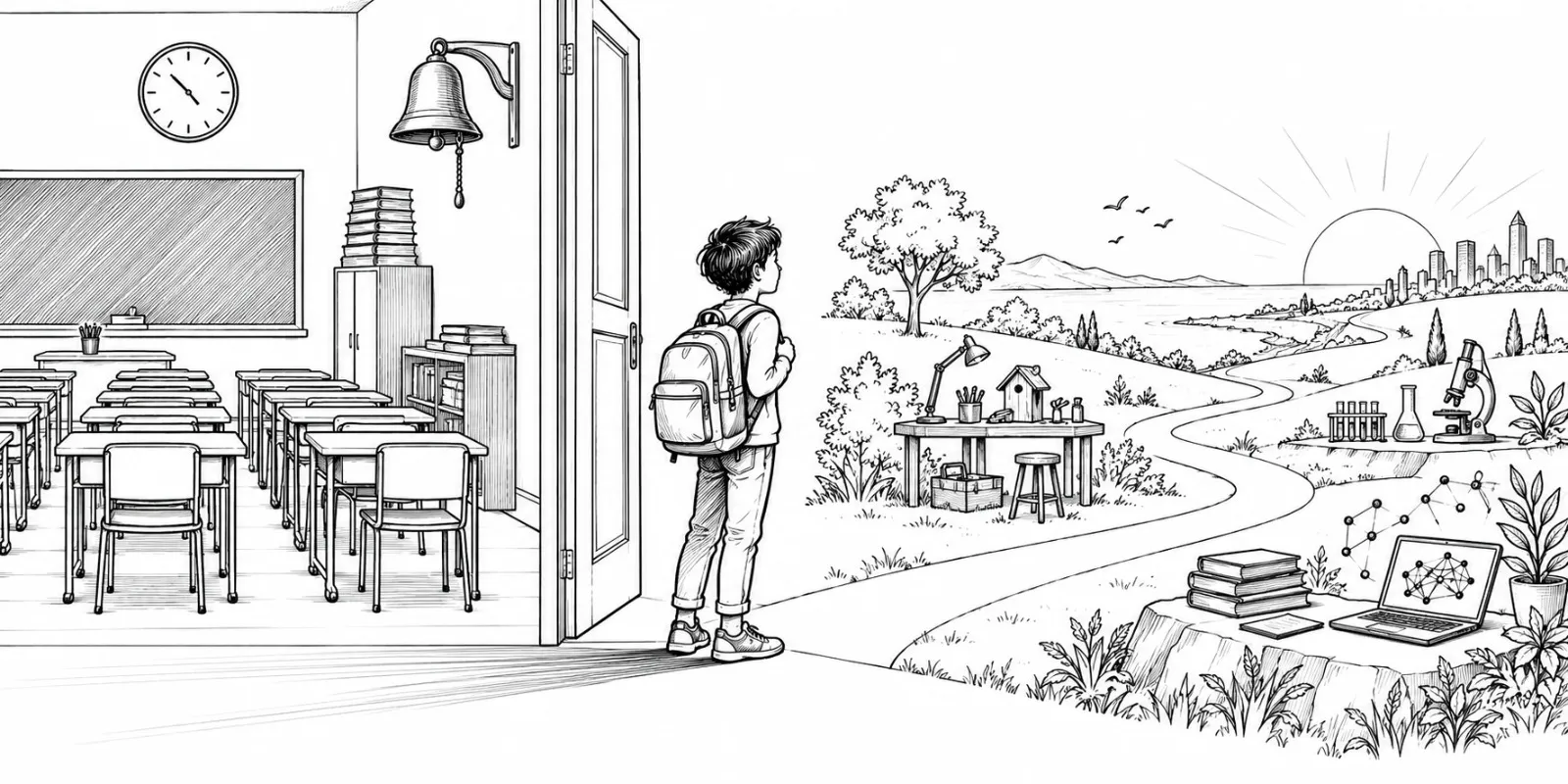
The world around the school has changed, while its basic structure has remained as it was. We have replaced the traditional blackboard with an electronic screen and the paper book with a digital one; we have brought the computer into the classroom and improved the desks, the buildings and the facilities. Yet the student still enters at a set hour, sits in a class tied to his age, receives a uniform meal of subjects, and then sits an exam that decides his progress and his future.
We have improved the school’s walls and tools, but we have not reviewed its idea enough.
Even more striking is that a student may study English for twelve years and graduate unable to hold a proper conversation, while in the evening he goes to an institute of his own choosing and, within months, makes progress he did not make in years. What changed?
The student’s mind did not change; his relationship with learning did. There he went willingly, knew why he was learning, and practised the language in order to use it. At school he was required to finish the syllabus and pass the exam.
The student does not hate learning, as we imagine. Look at him on the day of a trip, a sports event, or a project he loves: he arrives early and eager, spends great energy, cooperates, leads, experiments. Then look at him when the first lesson begins, followed by the second, the third and the fourth: boredom and complaint creep into him.
Perhaps our children do not reject learning at all. Perhaps they reject the form into which we have confined it.
Then the student enters university and spends four or five years, say, studying media. When he applies to a media organisation, it discovers that he lacks the required skills, and it may prefer someone who never studied media but learned through practice and training. Did the profession really need five years, or could much of its skill have been mastered in one intensive training year inside a real media environment?
He may enter a fast-changing technical field, begin studying particular knowledge and tools, and graduate years later to find that the world he was prepared for has changed, and that the job market has moved on to new technologies that were never part of his programme.
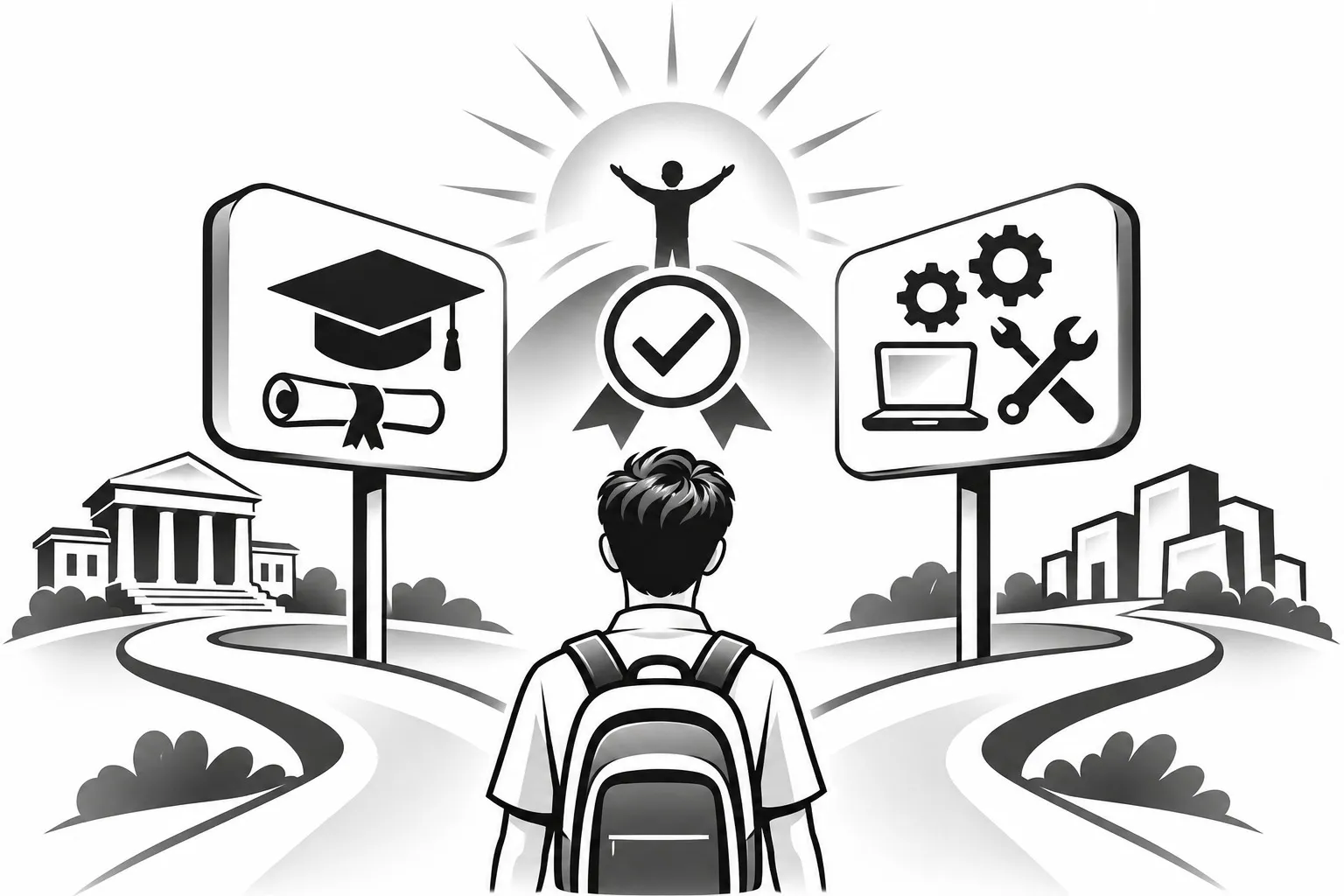
Conversely, a young man may have an evident talent for design, programming or brand-making, yet enter university not because he needs it but to obtain the title “university graduate”. At times we have become more concerned with the name of the certificate than with what a person knows and what he is able to produce.
Nor does the problem end with the bachelor’s degree. A doctoral student may spend years researching an extremely narrow point, after which the degree grants him a general qualification to teach a broad discipline, not all of whose aspects he necessarily has real experience in. His relationship with the subject of his research may end on the day of the defence; the thesis goes to a shelf where no one reads it, while the title stays with its holder for life.
On the other side, we may find a capable scholar or a field expert who spent his life in knowledge and work, yet the university does not allow him to teach because he does not hold a doctorate. We may find someone with scientific or industrial experience, able to teach our students what they will not find in books, yet the school turns him away because he did not take the prescribed formal route.
Is the certificate evidence of ability, or has it at times become a substitute for it?
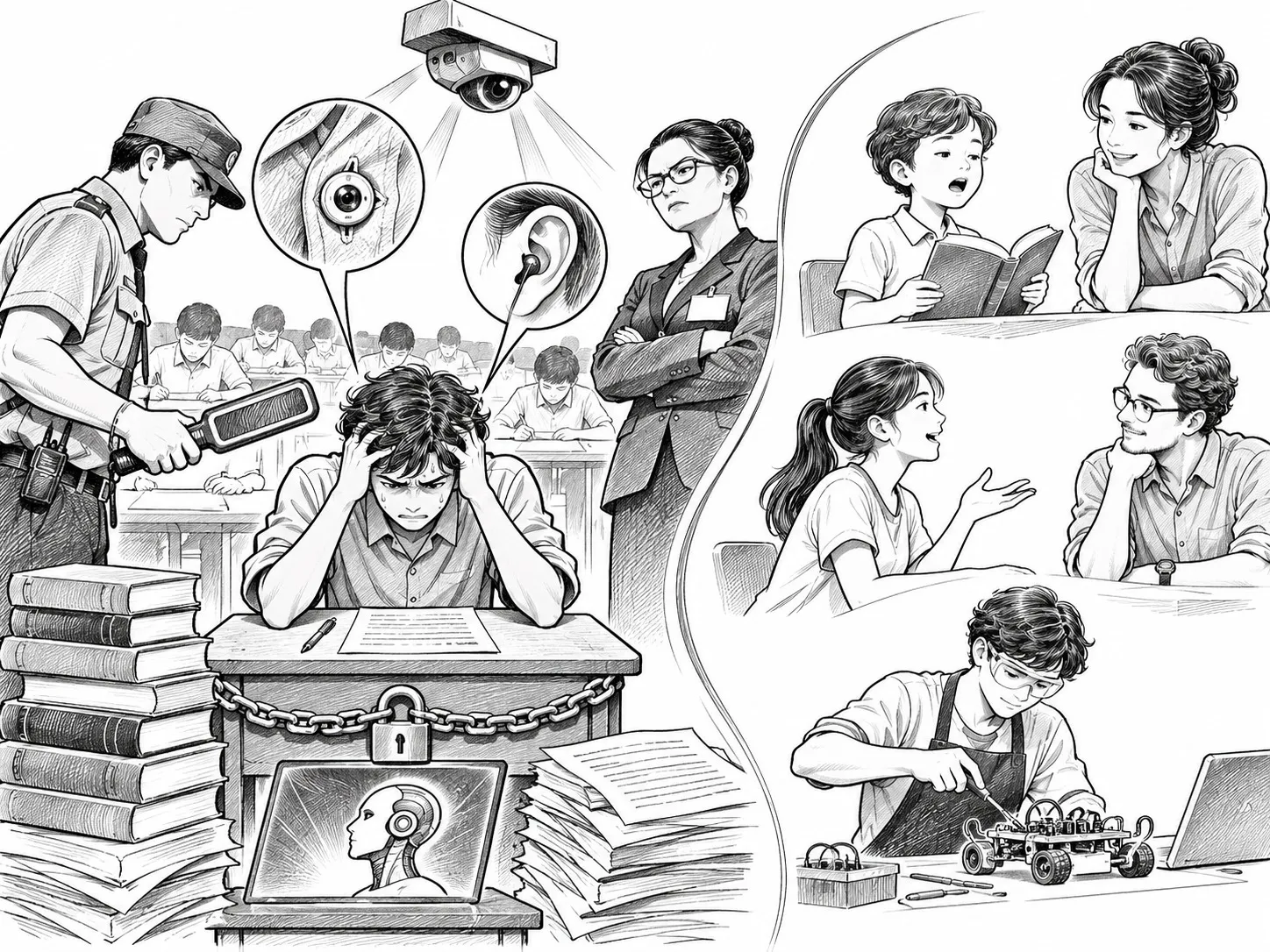
Even the assessment of students has turned into a vast machinery of fear and secrecy: fortified printing presses, secret questions, sealed envelopes, committees, invigilators and strict instructions; then the student enters the examination hall as if he were accused of cheating until proven innocent. Years of his life are reduced to hours, and his university and his future may be decided by a single mark obtained under exceptional psychological pressure.
Why does learning need all this siege?
A student who truly wants to learn programming, master a language, build a device or solve a problem cannot cheat himself. He may cheat to get a mark, but he cannot cheat to gain a capability. When he faces the field, the truth will appear, with no need for an invigilator or a sealed envelope.
Perhaps the time has come to move from an examination that guards the answer to an assessment that observes the ability, and from a certificate that says the student has studied to evidence that shows what he can do.
And why should education remain confined within four walls? The family teaches, the mosque teaches, the workshop teaches; the factory, the farm, the hospital and the market all teach. The internet can bring the best teachers and experts to a child living in a remote village where no specialist teacher is available. And artificial intelligence can offer every learner explanation and practice suited to his level and pace.
So why do we insist that all children go to the same place, at the same time, to learn the same things, in the same way, and then be examined with the same questions?
What if we had a shorter common foundational stage, in which the child learns his language, the basics of arithmetic, thinking, research, values, communication and self-directed learning, and then moves on into flexible paths in which he discovers his abilities and inclinations?
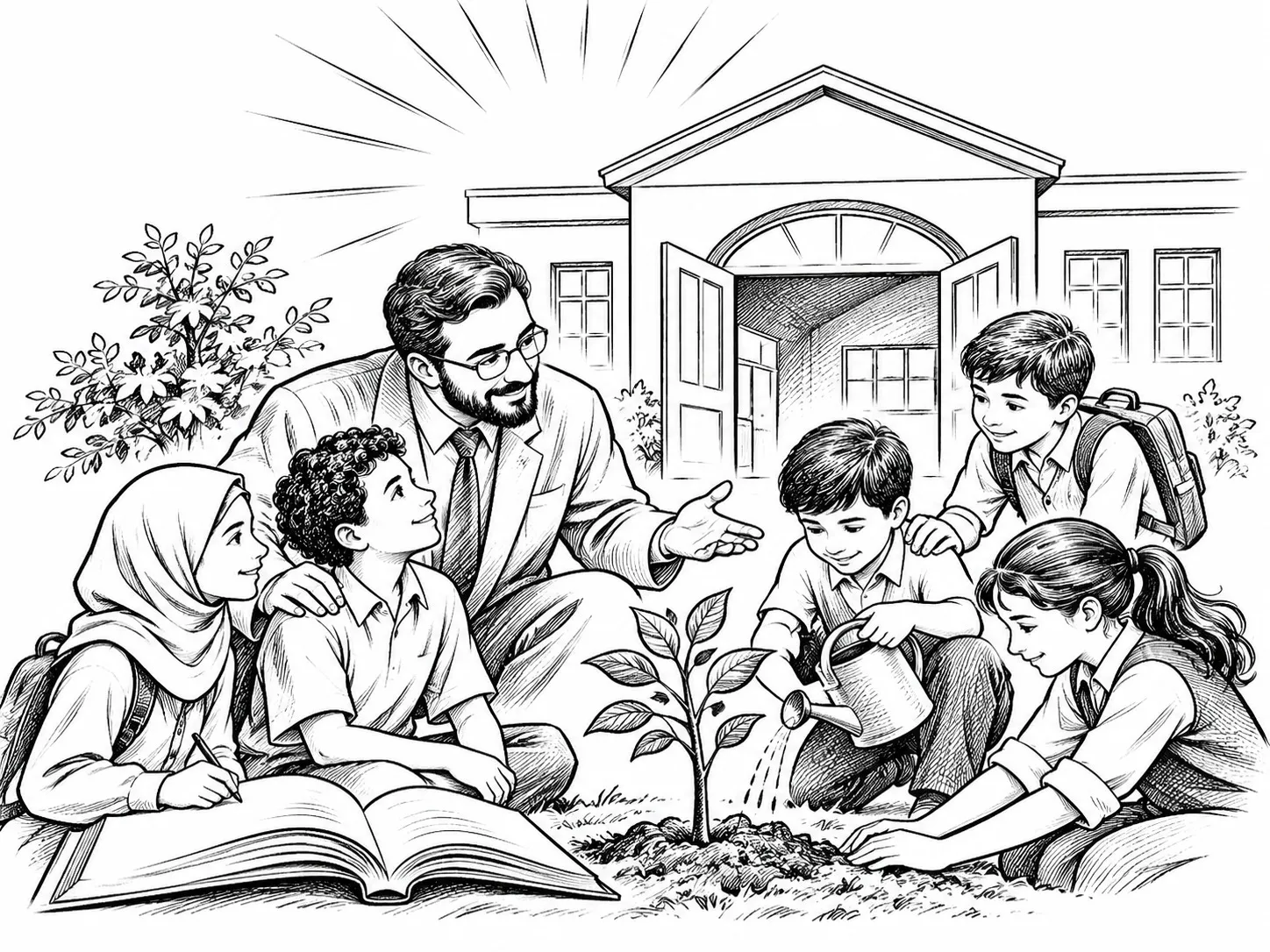
What if the school turned from a factory of certificates into an open centre for developing capabilities, with a laboratory, a workshop, a studio, a library and an incubator for projects, operating in person and remotely, and at many different times?
What if the factory, the farm, the media organisation and the research centre became genuine partners in education, rather than bodies that wait for graduates and then complain of their poor preparation?
And what if we did not ask the job applicant, “Where did you study, and for how many years?” but rather, “What do you know, what can you do, and what is the proof?”
Yet the education we call for cannot become mere vocational training, nor can its sole aim be to bring a person into the job market. Before we ask what the student can produce, we must ask: what kind of human being do we want him to be?
Here the relationship between upbringing and education returns. Who is responsible for building the child’s values and identity? The family, the school, or society? Can the school be neutral while it shapes the student’s way of thinking, his relationships, and his view of himself and the world? And what common ground should our children leave with before their paths diversify?
We do not want a skilled worker without values, nor a memoriser of information without capability, nor a certificate-holder without knowledge, nor a gifted person held back by a piece of paper he never obtained.
This is not a call to close the schools, abolish the universities, or leave children alone before screens. Nor is it a denial of the efforts of teachers or of the achievements of formal education. It is a call to ask a courageous question:
Is the system we inherited still able to prepare a human being for a world in which knowledge, work, technology and life have changed?
We do not need an old school to which we add new devices, but a new vision of education itself: a vision that frees it from the single place, the single time, the single curriculum, the single examination and the single road to success.
We need an education that begins with the human being, with his curiosity, abilities, inclinations and values, and then opens before him the family, the school, society, work and technology as complementary spaces for learning.
This essay is only the beginning of a broad series in which we re-read the journey of upbringing and education from its earliest beginnings, and discuss the school and the educational ladder, the university and the certificate, theories of learning, upbringing and identity, education beyond the walls, and tests and means of assessment, arriving at the construction of “A Theory of Upbringing and Education”, through which we seek to offer a vision suited to the human being and his new world.
We do not claim that all the answers are ready, nor do we offer a closed model that admits no revision. We simply open the questions, listen to experiences, read history and reality, and search for a way that is more humane, more flexible and more closely tied to life.
The revolution of artificial intelligence has begun to change the world. Shall we wait until everything around the school has changed, only to discover that all we did was upgrade the blackboard?
Perhaps it is time to stop asking only: how do we develop the school?
Rather, let us ask first:
Is the school we know the only possible form of education?
Related service: Parenting and education counselling
Questions people hesitate to ask
Why do students study English for years and still cannot speak it?
The author argues that when the same student makes rapid progress within months at an institute they chose themselves, their mind has not changed; their relationship with learning has. There they went willingly, knew why they were learning and practised the language to use it, whereas at school they had to finish the syllabus and pass the exam.
Share your thoughts
Have you been through something like this, or has a question come to mind? Write it here. Your words may help another reader.
ربنا يبارك فيك ويحفظك
بارك الله في عقلك وقلمك، لقد لامست أفكارك، تأملات كانت تدور في عقلي لكنها لم تخرج حيز الأفق.