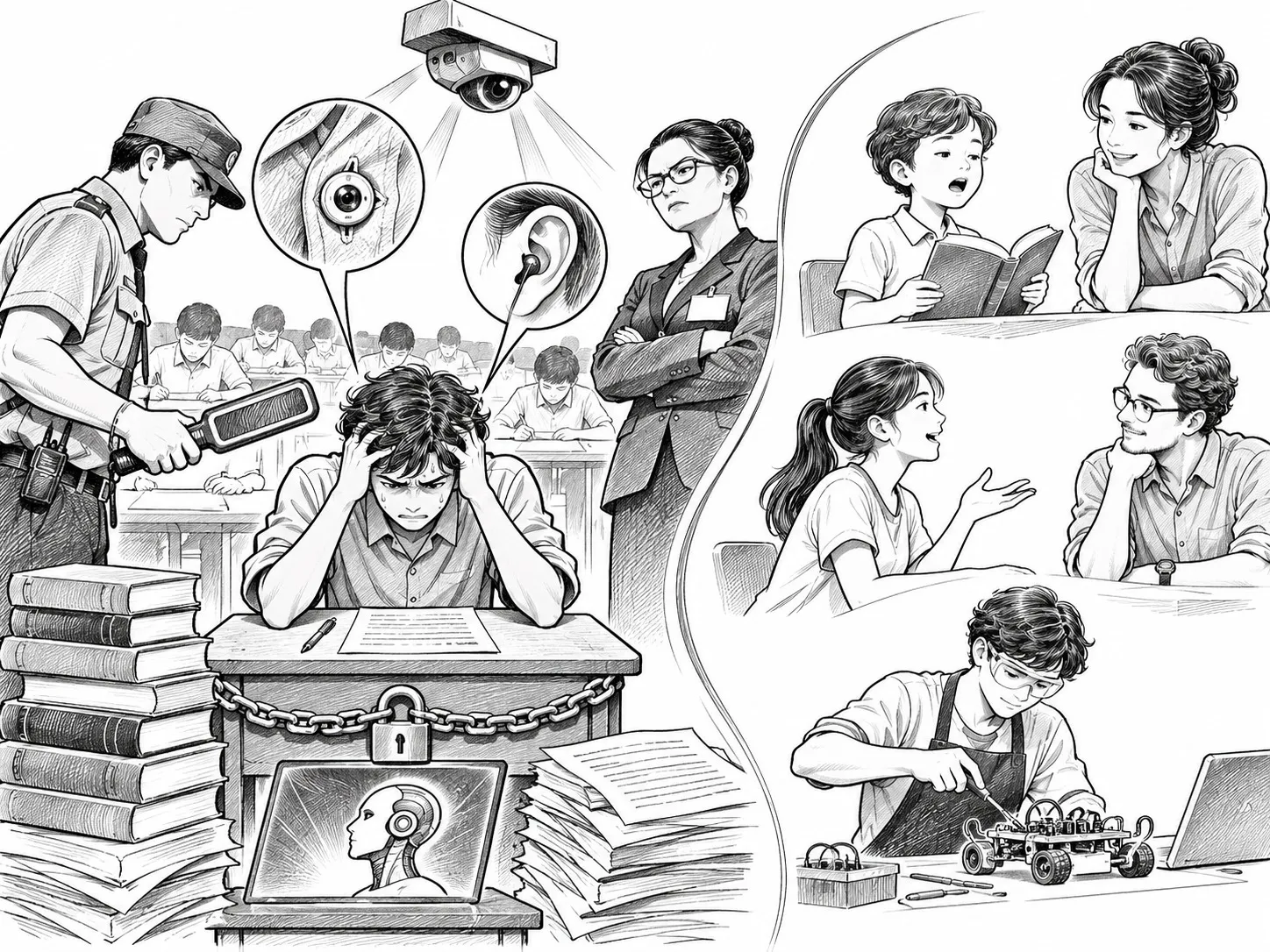
The Roots of Upbringing: Where Does Education Reform Begin?
 Dr. Abdulqawi Al-Qadasi · 8 min read
Translated from the Arabic. Read the original (العربية)
Whenever we speak of the crisis in education, we hurry to the solutions we know: we change the curricula, train the teachers, develop the examinations, buy new devices, and add platforms, technologies and artificial intelligence. We do all of this, and then discover, years later, that the school has changed a great deal in its form but not nearly as much in its substance.
Perhaps because, in many attempts at reform, we started from the wrong place.
Education does not begin with the book, nor with the teacher, nor with the classroom. Before all of that lie deeper questions: Who is the human being we want upbringing to help build? Why do we teach him? What should he know? Who decides that? What values do we want him to carry? And what place do the family, society, the state and the economy have in his upbringing?
These are the roots from which the school grows, whether we are aware of them or not.
A school that makes success synonymous with the grade carries a particular conception of success. One that gathers children of the same age into a single path, at a single speed, with similar subjects, carries an assumption about learning and about the differences between people. One that makes the certificate the end of the journey carries a view of what gives knowledge and skill their value. Even when we say that education is neutral, our choices about what we teach and what we neglect, what we reward and what we punish, carry values and messages that may speak louder than the words written in the curricula.
That is why the first question in education reform is not always: How do we teach? It may come before that: Why do we teach?
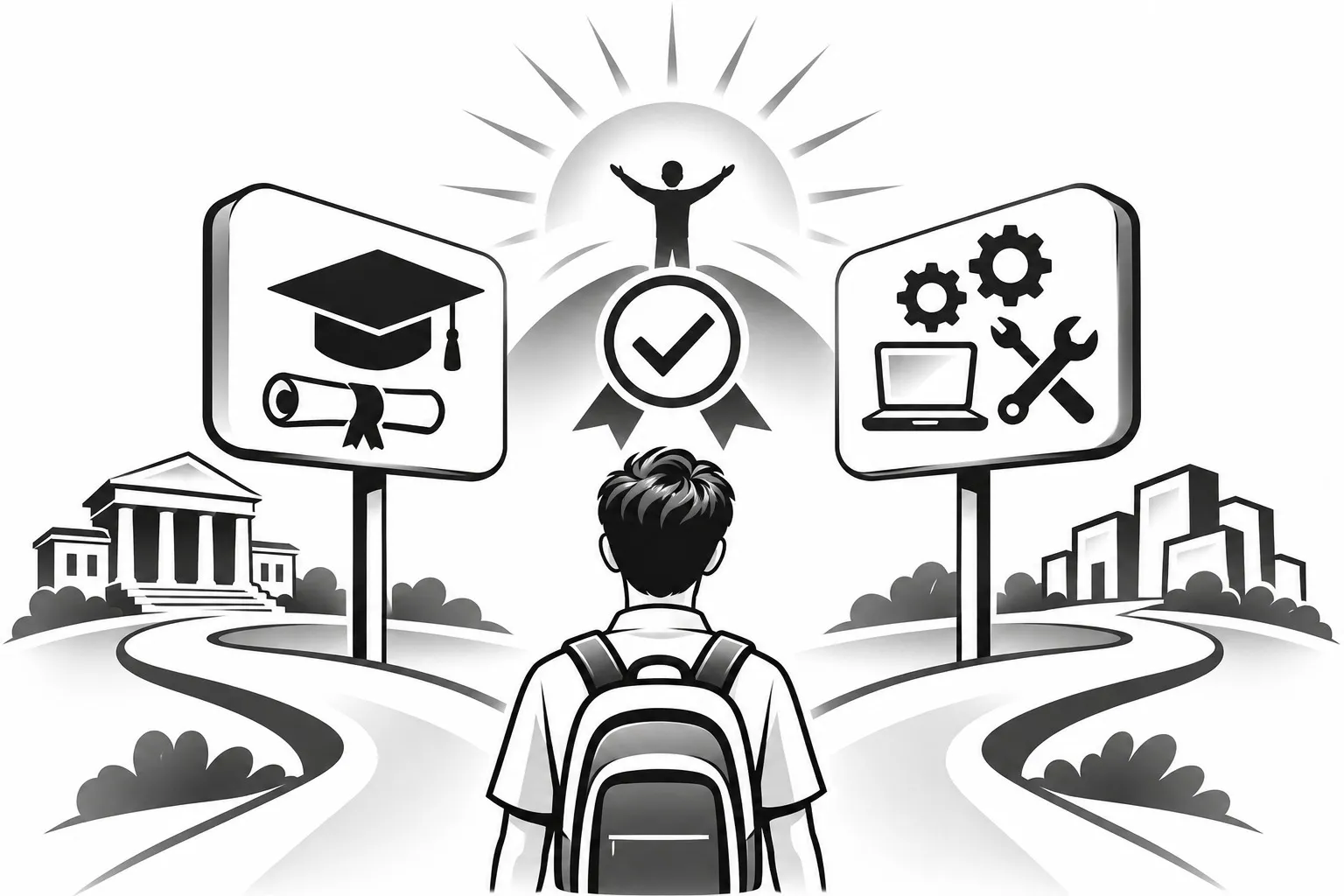
Do we teach a human being so that he may find a job?
Work is certainly important, and it is the duty of education to prepare a person for production, independence and taking part in the development of his society. But a person does not live in the job market alone. He lives in a family, deals with a society, needs meaning, values and identity, faces ethical and human questions, loves, disagrees, chooses and bears responsibility.
We do not need only a successful worker, but a human being able to work and to live together: one who thinks, learns, cooperates, respects others, knows himself and his society, has the capacity to choose, and can review his own ideas and keep on learning.
From here comes another question: What do we teach?
Humanity has accumulated so much knowledge that no single person can encompass even a small part of it. In our age the question is no longer how to get information to the student; information now reaches him before he reaches the classroom. The harder question is: which knowledge deserves a portion of his life? What should be common to all our children? And what may differ according to their inclinations, abilities and paths?
We need language, arithmetic, culture, identity, values and shared knowledge that help a person live with others, but we also need to prevent what is shared from becoming identical. People are not repeated copies, and an education that acknowledges individual differences in its books, then asks everyone to learn the same thing, in the same way, in the same time, leaves that acknowledgement with little effect.
Here we arrive at one of the deepest roots of upbringing: the human being is wider than the system we try to fit him into.
Philosophies throughout history have tried to understand this human being. Some exalted reason, values and meanings; others reconsidered reality and experience; pragmatism tied knowledge to action and problem-solving; existentialism and humanism gave the individual, his freedom and his voice a wider space; while critical thought reminded education that behind knowledge lie questions of power: who decides? who chooses? and for the benefit of which human being and which society?
Each school of thought lit a window, but a window is not the whole house.
That is why I do not see the future of upbringing in searching for a single philosophy and then trying to fit the human being into it, nor in gathering a little from each philosophy and declaring that we have made a new theory. What we need is deeper than that: principles that govern choice: a conception of the human being, a source of reference for values, an understanding of knowledge, a clear purpose for upbringing, and then a wide openness to human experience from which we learn, which we test and which we critique.
In the vision from which I start, revelation gives this journey a compass, but it does not close the door to reason and experience. The Qur’an that says, “And He taught Adam the names – all of them” (Qur’an al-Baqarah 2:31) is the same Qur’an that calls the human being to travel and observe: “Say, [O Muhammad], ‘Travel through the land and observe how He began creation’” (Qur’an al-Ankabut 29:20).
What is required, then, is not to search the texts for the number of school years, the length of a lesson, the form of an examination or the number of subjects. These are means made by human experience, and reason, research and experiment can develop or replace them. The reference gives us something deeper: Who is the human being? What is his dignity? What is his responsibility? What is the purpose of his knowledge? And by what measure does he use his capacity?
And this leads us to fitrah (innate human nature).
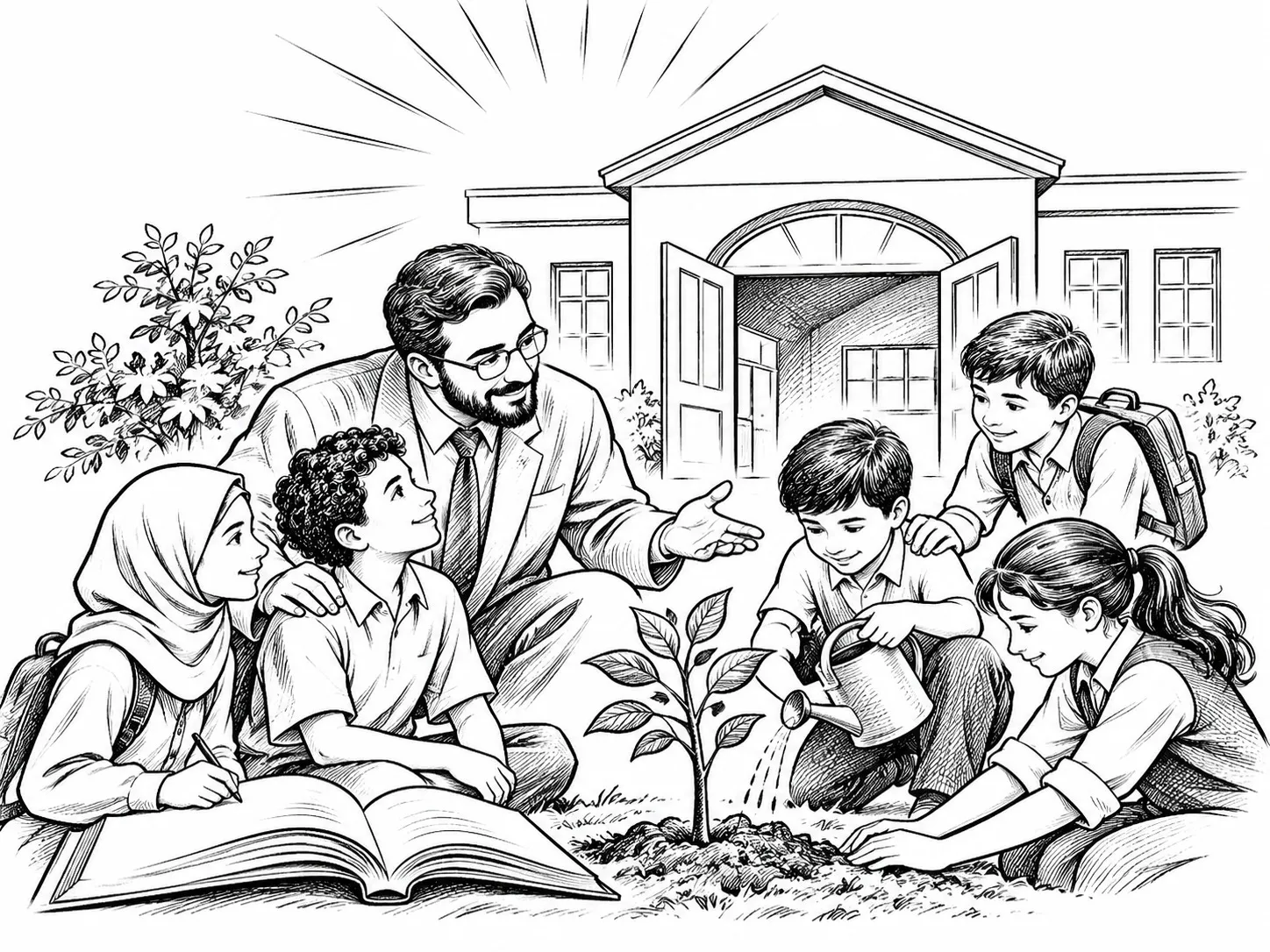
The child does not come into the world a blank page on which we write what we wish, nor does he come a complete human being who needs no guidance. He comes with predispositions and capacities, and then the family, culture, experience and education enter into shaping his course. Hence the image of the educator must change: not a craftsman who shapes raw material to a ready-made mould, but a discoverer, a carer and a guide, who helps a person discover what he can become, and refines and directs his capacities.
From here too, the dignity of the learner becomes a principle, not a detail.
The student is not a grade, nor a number, nor a prospective certificate. The mistake he makes does not diminish his human worth, just as academic excellence does not make its owner more dignified than others. Among the most dangerous things a school can do is to make a person feel that his worth is determined by his ability to adapt to its system.
The truth should be the reverse: the institution exists for the human being, not the human being for the institution.
But respecting the human being does not mean leaving him without guidance. Freedom that is not joined to responsibility may become a burden on its owner and on others. The child needs, in his early years, guidance, discipline and boundaries, but the success of upbringing is not measured by his remaining in need of them.
The successful educator is not the one who can control the student while he is present, but the one who helps him gradually do without that control.
Upbringing is not complete when a person obeys in the educator’s presence, but when he can choose well after the educator is gone.
Here the difference between education and training appears. We teach a person what responsibility is, but we also need to train him to bear it. We teach him cooperation, then let him cooperate. We teach him prayer, then train him in it. We teach him to think, then place him before real problems to think about.
Knowledge that does not turn into life may stay in the memory, whereas knowledge that is understood and practised has a greater chance of becoming part of the person.
This does not mean belittling theoretical knowledge; it is not required of every generation to rediscover what humanity has accumulated. But between a person knowing a thing and becoming able to practise it lies a distance that upbringing should fill. That is why I see education and training as two wings, and the journey does not go straight with only one of them.
Then we come to an equally weighty question: What is constant and what changes in upbringing?
This may be one of the great problems that has stalled education reform. We inherited historical forms and then treated them as part of the very meaning of education: the school in its familiar shape, the successive grades, dividing learners by age, lessons, examinations, certificates, and the ladder a person must climb rung by rung.
But are these ends or means?
If the aim is that a person should learn, why do we sanctify a single place for learning? If the aim is that he acquire capability, why do the years he spent in an institution become more important than proof of his capability? And if a learner can acquire what he needs in a shorter time, why does time itself become a condition of progress?
With the revolution of artificial intelligence, these questions are no longer a luxury.
We are facing tools that can offer learners different paths, adapt to their pace and levels, and open knowledge beyond the traditional walls and hours. What seemed impossible in mass education decades ago is now far easier to imagine.
But technology will not save education on its own.
We may bring artificial intelligence into an old school and end up with an old system with more modern tools. We may replace the book with the screen, the teacher with the platform, and the paper exam with the electronic test, and yet remain inside the same philosophy.
So we return, once again, to the roots.
Before we ask what artificial intelligence can do for education, we should ask: What do we ourselves want from education?
When the purpose becomes clear, changing the means becomes easier. Values do not need to change every time technology changes, but the means should not become sacred. Human dignity remains, justice remains, responsibility remains, and the pursuit of knowledge remains; as for the shape of the school, the length of the journey, the way of learning, the tools of assessment and the paths a person takes, all of these are open to review.
Here, in my estimation, any serious attempt to build an educational theory for the future begins.
It does not begin from drawing a new school, nor from proposing a new curriculum, nor from abolishing one examination and adding another. It begins before that, with defining the human being we want upbringing to help build, and the roots from which we want this human being to grow.
Only then can we ask about the school, the teacher, the curriculum, assessment, technology, the certificate and the educational ladder.
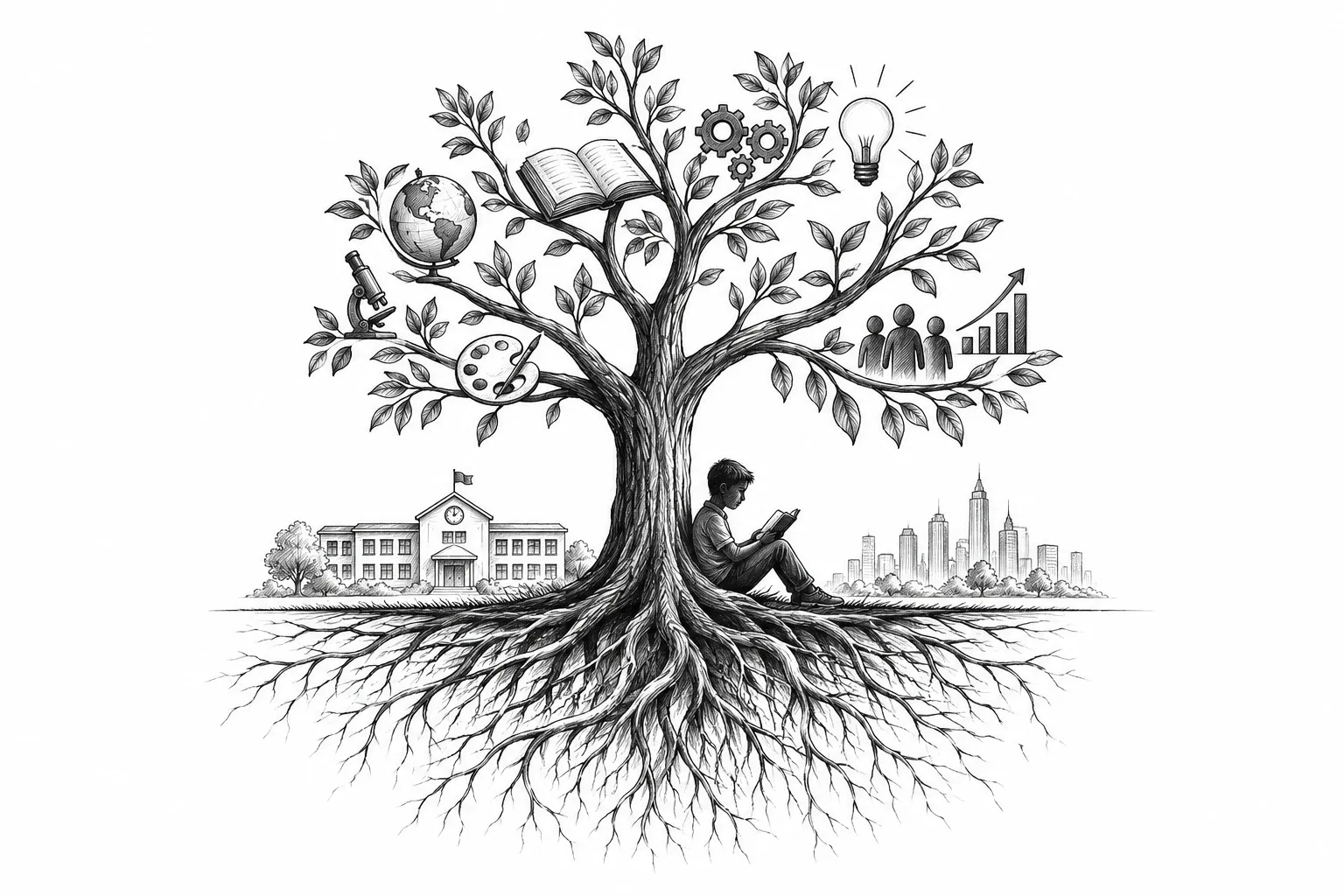
We have spent a long time pruning the branches of the tree of education, painting its trunk and replacing some of its leaves. Perhaps it is time to look beneath the ground.
If we want an education that is truly different, it is not enough to change what shows of the tree; we must first review the roots that give it life and direction.
Related service: Parenting and education counselling
Questions people hesitate to ask
Where does education reform begin?
Before curricula, teachers and exams: with defining the human being we want upbringing to help build, why we teach them, what they should know and which values they should carry. Once the aim is clear, changing the means becomes easier, and only then can we ask about school, curriculum, assessment and technology.
Is introducing artificial intelligence enough to reform education?
No. Technology will not save education on its own. We may bring AI into an old school and end up with an old system using newer tools, replacing the book with a screen while staying inside the same philosophy. So we must first ask what we ourselves want from education.
Share your thoughts
Have you been through something like this, or has a question come to mind? Write it here. Your words may help another reader.
جزاك الله كل خير
تسرني تعليقاتكم، إذا لديك أي ملاحظات أو إضافات أو نقد، سأكون شاكرًا لك
بارك الله فيك