The Family in Agrarian Society
 Dr. Abdulqawi Al-Qadasi · 6 min read
Translated from the Arabic. Read the original (العربية)
Renewal and Extension
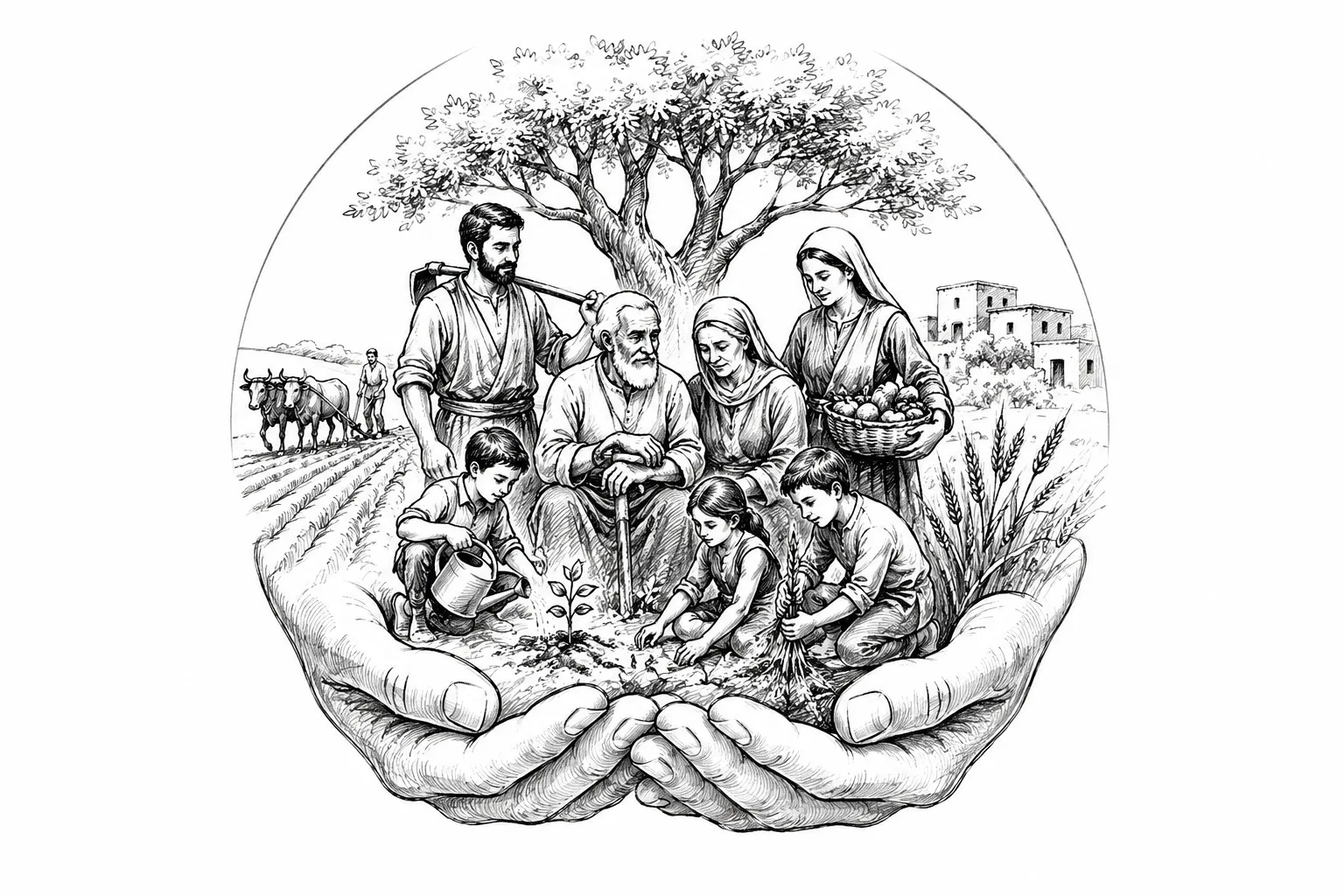
With steps the earth knows, the grandfather and his grandchildren go out at dawn to plough their shared dream; there is no room for individualism. They divide the toil of the day, and return at sunset to one roof and one pot. This is how millions of families lived for thousands of years, like a single body that cannot be divided. So how did the family grow to this extent?
At our previous stop, we left Adam and Eve as the family began its first journey on earth. It was a small family, facing life with limited means, yet carrying within it the seed from which all societies would grow. But history does not stand still; since the day his feet touched the earth, the human being has been not merely a creature that adapts to nature but one that reshapes it. As time passed, he discovered what may be the greatest transformation in the history of civilisation: that a small seed can give him stability, and that the land he sows today will feed him tomorrow. Perhaps the discovery of farming changed not only the relationship between the human being and the land, but also the relationship between human beings. In societies that lived by hunting and gathering, wandering was a necessity; but once the land became the source of livelihood, the human being no longer pursued food, for food now awaited him in the place he had chosen to settle. From here the villages began, and with them the family began to grow.
Ibn Khaldun dwells at length on this pivotal moment in The Muqaddimah. He holds that civilisation ('umran) arises only when human beings settle; that settlement creates shared interests; and that these interests strengthen the bonds of kinship and 'asabiyyah (group solidarity), since these were the first means of protecting land and wealth and of keeping life going[1].
From another angle, the historian Will Durant looks at the same stage and describes the agrarian family as the first economic institution humankind knew. In his book The Story of Civilization, he shows that the family was no longer merely an emotional bond but had become a complete unit of production. The land needs people to plough it, sow it, guard it, harvest it and store its yield, and the more working hands there were, the greater the chances of the family’s survival and prosperity[2]. Thus the child was no longer regarded as an added burden but as an extension of the family’s strength and future. And marriage, in many societies, went beyond the relationship between a man and a woman to become an alliance between two families, in which economic interests intersected with human bonds. This was not because love had disappeared, but because life itself had grown more complex.
Yet this transformation raises another question: if the family had grown, who managed this large entity? Was leadership born of strength, or of responsibility? If we merely read history, we would say that the nature of farm work imposed itself: the wide fields, the confrontation with the hazards of nature, and the defence of the land demanded great physical effort, so the man generally stepped to the front of the outward scene, while the woman became the heart that ran the inside; she kept the home, organised its affairs, raised the generations and held the family together. But was this merely a social custom, or does it reflect a deeper nature in the structure of the family? Here it becomes interesting to return once more to the Qur’an, not to search for a historical story, but for a philosophy of the relationship.
When the Qur’an spoke of the principle of qiwamah (responsible guardianship), it did not present it as a privilege or as absolute authority, but tied it to responsibility, financial maintenance and taking charge of the family’s affairs[3]. Imam Muhammad al-Tahir ibn ʿAshur pauses at this meaning and explains that qiwamah means taking charge of the household’s affairs through protection, care and management, not domination or superiority. It is a function that preserves the order of the family, just as every ship needs someone to bear responsibility for steering it, even though its arrival at safe harbour is achieved only by the effort of everyone aboard.
It is striking that this understanding accords with many modern psychological readings that view the family as a system of complementary roles, not an arena of struggle for power. Willard Harley, in his book His Needs, Her Needs: Building an Affair-Proof Marriage, does not speak of a superior man and an inferior woman, but of different needs which, when met, produce stability and, when neglected, begin to fracture. A man, on average, flourishes when he feels trusted, that his responsibility is valued, and that his presence makes a difference, while a woman flourishes when she lives in an environment where she feels safe, embraced and respected[4]. Although these needs may differ from one person to another, they show that complementarity is more realistic than the idea of complete sameness. The family is not a race to decide who stands at the centre, but a circle whose balance is upset if each party tries to occupy the other’s place.
Even so, history, as it always teaches us, offers no ideal models. In some agrarian societies, the authority granted to the head of the family became a means of domination, and custom at times grew stronger than the values it existed to protect. Here we must distinguish between the idea and the distortion in its application: qiwamah is one thing and tyranny another, just as freedom is one thing and chaos another. An error does not invalidate the principle; it only reveals the human being’s constant need to review and correct his practices. The psychologist Albert Bandura adds another dimension to this picture through his “social learning theory”: a child learns his future roles not so much from sermons and advice as from the scenes he lives through every day[5]. When he sees a father who carries responsibility with love rather than harshness, and a mother who runs her home with wisdom rather than submission, these images are imprinted on his heart and become part of his natural understanding of the family. Perhaps this explains why values are not passed on through words alone but through homes; a family does not bring up its children by what it says, but by what it lives.
Thus the agrarian family was not merely a larger gathering than the first family; it was a stage that reshaped the very concept of the family. The household grew, responsibilities grew, interests became entangled, and the family became a social, economic and educational institution that safeguarded the land, passed on experience and forged identity, before humanity knew schools, ministries or welfare institutions. But history did not stop here. With the growth of wealth, the widening of kingdoms and the emergence of social classes, the family began to enter a new and more complex stage. The question was no longer: how does the family grow? It became: how many forms can the family take? There we will draw near to one of the most fascinating stages of its history, a stage in which politics, wars, demography and the economy imposed new forms of union and redrew the boundaries of the single household. And here begins our next stop… when the family was no longer a single image but many faces, each with its own circumstances and each with its own story.
[1] ʿAbd al-Rahman ibn Muhammad Ibn Khaldun, Muqaddimat Ibn Khaldun [The Muqaddimah] (Beirut: Dar al-Fikr, the commonly used edition), chapter “That Bedouin life is older than settled life.”
[2] Will Durant, The Story of Civilization, Arabic translation by Zaki Naguib Mahmoud and others (Beirut: Dar al-Jil, 1988).
[3] A reference to the words of God Almighty in Surat al-Nisa’ (verse 34): “Men are in charge of women by [right of] what Allah has given one over the other and what they spend [for maintenance] from their wealth.” For its interpretation, see: Muhammad al-Tahir ibn ʿAshur, Tafsir al-Tahrir wa al-Tanwir [The Commentary of Verification and Enlightenment] (Tunis: al-Dar al-Tunisiyya li-l-Nashr, 1984).
[4] Willard Harley, His Needs, Her Needs: Building an Affair-Proof Marriage (Grand Rapids: Revell, 2001).
[5] Albert Bandura, Social Learning Theory (Englewood Cliffs: Prentice Hall, 1977).
Related service: Marriage counselling
Questions people hesitate to ask
What does qiwamah mean in the family?
The article presents qiwamah as a responsibility tied to providing for and looking after the family, not a privilege or absolute authority. Citing Ibn Ashur, it means managing the household through protection, care and planning, not domination, like a ship that needs someone to steer while everyone's effort brings it safely to shore.
How did agriculture change the family?
Once land became the source of livelihood, people settled, villages formed and the family grew. It became a unit of production needing many hands to plough, guard and harvest; a child became an extension of the family's strength, and marriage in many societies became an alliance between two families.
Share your thoughts
Have you been through something like this, or has a question come to mind? Write it here. Your words may help another reader.
من اروع ما كتبت كلام رائع وجدناه في بداياتنا ولا زال حتى اليوم في مجتمعنا امريكية اسمه الامش كل الاسرة وجعلها ونسائها اجمعهم الزراعية ويعلمون فيها صغيرهم والكلير رجلهم والمرأة
حفظك الله ورعاك شيخنا الحبيب