The First Knowledge
 Dr. Abdulqawi Al-Qadasi · 7 min read
Translated from the Arabic. Read the original (العربية)
When God Taught Adam the Names
The journey of learning did not begin with a school or a book. It began with a human being receiving knowledge and learning the names of things, then looking at the world with an eye that sees not only existing things but grasps their names, their meanings, and what can be made of them.
God says: “And He taught Adam the names – all of them. Then He showed them to the angels and said, ‘Inform Me of the names of these, if you are truthful.’ They said, ‘Exalted are You; we have no knowledge except what You have taught us. Indeed, it is You who is the Knowing, the Wise.’ He said, ‘O Adam, inform them of their names.’ And when he had informed them of their names, He said, ‘Did I not tell you that I know the unseen [aspects] of the heavens and the earth...’” [Al-Baqarah: 31–33].
This great scene opens with a plain verb: “He taught.” The human being did not begin life already knowing everything; he began able to learn. And this capacity was among the qualities that showed his standing and his readiness for life on earth.
The commentators differed over which names God taught Adam. Some said they were the names of all things, some that they were particular names, and other opinions were reported. It is not our aim to dwell long on this disagreement, but on the meaning that unites them: Adam learned the names, knew what they signified, and was then able to inform others of what he had learned.¹
It is striking that the Qur'an tells us what God taught Adam but does not say how that teaching took place, or how much time it took. This leaves a space that opens an important window on upbringing: the lesson is not in any single way of teaching, but in the learning taking place and bearing fruit in the human being. This is why the forms of teaching have varied through history; people have learned by hearing, watching, imitating and experiment, and have learned in the family, in society, at work and in houses of worship, and then in school and university. The tools and places have changed, while teaching has remained too wide to be confined in a single mould.
The meaning of knowledge recurs strikingly in this short passage: “He taught Adam,” and “we have no knowledge,” and “except what You have taught us,” and “it is You who is the Knowing, the Wise,” and then “I know.” It is as though the human story, as it begins, places knowledge at its heart: God is the All-Knowing and the source of knowledge; the angels stop at the limit of what God taught them; and Adam's distinction shows in the capacity he was given to learn and to inform others of what he had learned.
This does not mean the angels had no knowledge; they said plainly: “we have no knowledge except what You have taught us.” They had the knowledge God gave them, but they did not know what He taught Adam in that setting. So the human being's distinction rests not on the possession of knowledge alone, but on the cognitive readiness God granted him, suited to his task on earth.
The presenting of the named things to the angels, and then the command to Adam to inform them of their names, appears to show what God had singled him out with in knowledge. Ibn Ashur held that the teaching of Adam, and then the display of his merit in his receiving of it, was a demonstration of his worthiness to be a successor on earth.² Teaching thus came together with both honour and charge: honour in the capacity for learning given to the human being, and charge in that he should use what he has learned to fulfil his task.
A name may seem a small word, but it opens a wide door to knowledge for a person. A child sees many things before he knows their names; once he learns the name of a thing, he can tell it apart, ask about it, speak of it, and call it to mind even when it is out of sight.
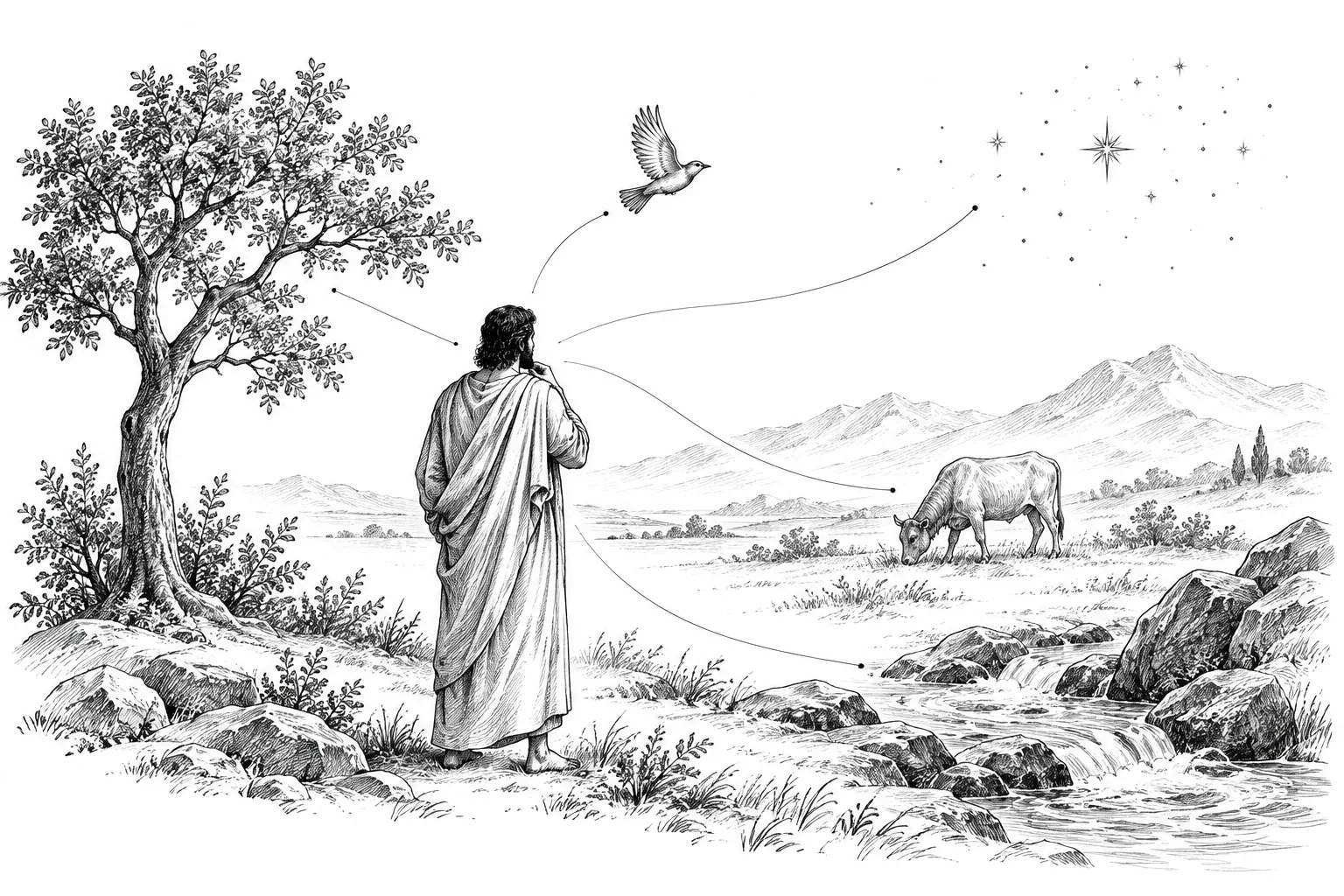
He sees a tree and learns its name, then distinguishes it from others, and learns where it grows, when it bears fruit, and how it can be used. He sees an animal and learns its nature, what makes it safe and what to beware of. In this way experience is not confined to the moment of seeing, but becomes knowledge that can be kept, passed on and added to.
Adam's link with naming also appears in the Book of Genesis, where the account says that the creatures were brought to him so that he might give them their names.³ Although the context differs between the texts, naming remains present at the beginning of the human being's relation to the world; he does not merely see things but brings them into the world of language, and then reaches understanding with others about them.
Ernst Cassirer held that the human being lives inside a world of symbols with which he makes the meanings of the things around him.⁴ A house is not only walls, a homeland is not only land, a family is not merely a group of persons. Behind every name lie meanings, memories, relationships and values, through which a person learns how to see himself and the world.
A child does not learn words singly; he hears them from his mother and father and from the people around him, and then begins to use them. Vygotsky showed that the word does not merely convey what we think, but helps to form thought itself.⁵ When a child learns the names of colours he does not just add new words to his memory; he becomes better able to tell them apart and to organise what he sees.
With words a person learns the meanings and values of his society. When a child hears words such as mercy, trustworthiness and justice, he is not learning abstract terms, but beginning to form a picture of the good and of how he ought to treat others. And when he learns the names of father, mother, grandfather and grandmother, he is not merely memorising kinship ties, but discovering his place within a family that has rights and duties. For this reason teaching is not the transfer of information alone, but participation in building the human being and in making the meaning by which he sees life.
The Qur'anic scene was not content to say that Adam learned; he was asked to show what he had learned: “O Adam, inform them of their names.” Knowledge appeared in his ability to inform, not in a length of time spent learning, nor in a title bestowed on him. Here a question arises that will accompany us on this journey: do we know that a person has learned because he spent years in school, or because something real has changed in his knowledge and ability?
A student may study a language for many years and still be unable to speak it, while another learns it in a shorter time because he practised it and needed it. A person may hold a certificate in a trade he has not mastered, while another who learned it through watching, training and work does it well. The problem is not the length of learning; some branches of knowledge need years. But the passing of time alone does not make knowledge, and sitting in a place of teaching does not always mean that learning has happened.
In the angels' reply there is another lesson: “Exalted are You; we have no knowledge except what You have taught us.” They did not claim a knowledge they did not have, and in this is a quality no less important than knowledge itself: that a person should know the limits of his knowledge and be able to say, “I do not know.”
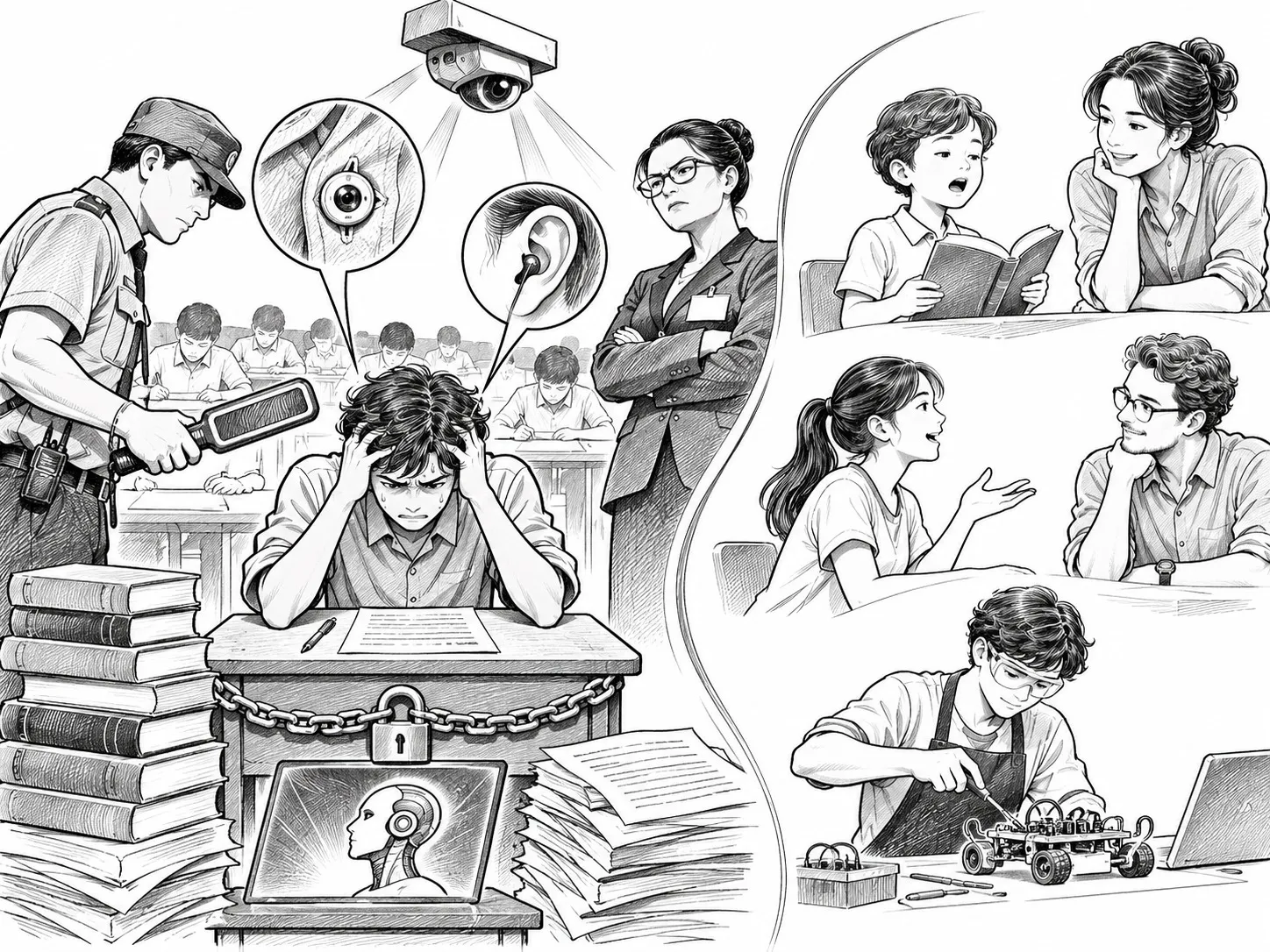
Yet some educational settings have made a mistake into an accusation and not knowing the answer into a source of shame. So the student learns to guess, or to repeat words he has not understood, instead of saying honestly: I do not know, but I can learn. When we make the learner afraid of asking and of error, we may push him to pretend to knowledge rather than to seek it.
In the first scene of teaching we find no classroom, no syllabus and no certificate, but we find the whole essence of teaching: a human being able to learn, a knowledge that brings him out of obscurity, a language that gives him the ability to understand and to express, a humility before the limits of knowledge, and a responsibility that begins with ability. Teaching was among the first things to accompany the human being, and one of the ways he was honoured and prepared for his task. That is why the journey of civilisation did not begin when the human being came to own things, but when he learned their names, understood their meanings, and knew how to turn knowledge into work.
References
- Al-Tabari, Muhammad ibn Jarir. Jami' al-Bayan 'an Ta'wil Ay al-Qur'an [The Comprehensive Exposition of the Interpretation of the Verses of the Qur'an]. Commentary on Surat Al-Baqarah, verse 31. Electronic Mushaf Project, King Saud University.
https://quran.ksu.edu.sa/tafseer/tabary/sura2-aya31.html. - Ibn Ashur, Muhammad al-Tahir. Al-Tahrir wa al-Tanwir [Verification and Enlightenment]. Commentary on Surat Al-Baqarah, verse 31. Great Tafsirs website.
https://www.greattafsirs.com/Tafsir_Library.aspx?AyahNo=31&LanguageID=1&MadhabNo=7&SoraNo=2&TafsirNo=54. - The Holy Bible. Genesis 2:19–20.
https://www.biblegateway.com/passage/?search=Genesis+2%3A19-20&version=NIV. - Cassirer, Ernst. An Essay on Man: An Introduction to a Philosophy of Human Culture. New Haven: Yale University Press, 1944.
https://yalebooks.yale.edu/2021/06/16/a-clue-to-the-nature-of-man-the-symbol/. - Vygotsky, Lev. Thought and Language. Edited and translated by Alex Kozulin. Cambridge, MA: MIT Press, 1986.
https://mitpress.mit.edu/9780262720014/thought-and-language/.
Related service: Parenting and education counselling
Questions people hesitate to ask
What is the educational lesson of God teaching Adam the names?
That humans began able to learn rather than knowing everything, and that teaching came together with honour and responsibility. The Qur'an tells us what God taught Adam but not how the teaching happened, so what matters is that learning takes place and bears fruit in the person, not one fixed form of it.
Share your thoughts
Have you been through something like this, or has a question come to mind? Write it here. Your words may help another reader.
من اجمل ما قرأت تسلم اليدات دكتور
بارك الله فيك