The Human Being: The Creature Who Learns
 Dr. Abdulqawi Al-Qadasi · 5 min read
Translated from the Arabic. Read the original (العربية)
He began knowing nothing… then learned how to change the world
Consider a child in his first days. He comes into life not knowing his mother’s name, nor the language he will speak, nor the way to his home, nor how to eat with his hand or put on his clothes. He knows nothing of fire, water, numbers or time, let alone the car, the aeroplane, the telephone or the computer. Then an astonishing journey begins: he listens, looks and imitates; he tries, errs and tries again; he asks, until within a few years he has acquired a vast store of knowledge and skills of which he possessed nothing at birth.
The Qur’an sums up this human beginning in the words of the Most High: “And Allah has extracted you from the wombs of your mothers not knowing a thing, and He made for you hearing and vision and hearts [i.e., intellect] that perhaps you would be grateful” (Qur’an, al-Nahl 16:78). And at the very beginning of the human story, teaching is present in His words: “And He taught Adam the names – all of them” (Qur’an, al-Baqarah 2:31). The human being does not come into the world carrying the details of the knowledge he will need; he comes equipped with the faculties that enable him to learn, and he finds before him a vast universe to look at, observe and discover. This is why the Qur’an directs him to travel and to look: “Say, [O Muhammad], ‘Travel through the land and observe how He began creation’” (Qur’an, al-‘Ankabut 29:20).
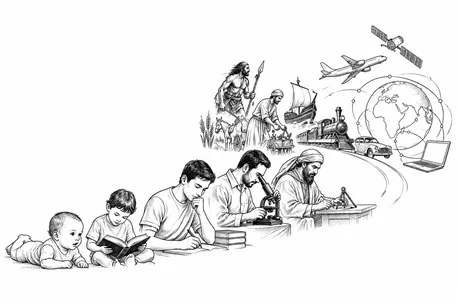
Nor did humankind need a school, in the sense we know today, to begin this journey. The world around him was the first field of his learning. He watched plants, animals and the seasons; he tested the materials he found around him; he learned from his successes and failures, then passed what he knew to his children and those around him. And here something of great importance happened: generations did not begin from zero. What one generation learned was passed, in part, to the next, which added to it and in turn handed it on to those who came after.
The history of transport offers a clear picture of this accumulation. The first human being knew nothing of the car, the train or the aeroplane, and the one who made a crude cart could not have imagined a vehicle covering hundreds of kilometres in a few hours. Yet no invention appeared out of a void. People made use of animals, built carts and ships, then developed engines, trains, cars and aeroplanes. Each stage drew on what came before and added something that made the next stage possible.
We see the same in the means of communication. News first travelled by voice and word of mouth; then writing carried a person’s words to farther places and times; postal systems developed; then came the telegraph, the telephone, radio, satellites and the internet. Today a person in Malaysia can see and speak, at the very same moment, with a person in Yemen, in America or anywhere else connected to the network. A distance that once required a long journey can now be crossed, in many forms of communication and knowledge, in a matter of seconds.
Even electricity, on which so much of our modern life rests, was not the discovery of one man who appeared suddenly, in a moment detached from history. It is the outcome of a long chain of observations, experiments, discoveries and applications, to which successive scientists and inventors contributed; each took something of what his predecessors had reached, and then added to it. Such was the case with medicine, engineering, agriculture, building and the other fields of civilisation. Everything we have reached is not the end of the road, but the furthest point the road has reached so far.
On this journey a person may appear who sees what others have not seen, or poses a question that never occurred to them, or whose observation leads him to a new idea. But an idea alone does not make a science or a civilisation; it needs observation, experiment, testing and work, and its author usually starts from knowledge that others made before him. Human beings do not create the laws of the universe; they discover something of the laws that God placed in it, using the intellect, senses and capacity for observation and experiment that God gave them, and then learn how to benefit from what they have discovered.
Here one of the greatest features of human knowledge emerges: cumulative learning. A person does not learn only from those who live around him; today he can sit down and learn from someone who died hundreds or thousands of years before he was born. Language, writing, books and institutions of knowledge have preserved the experience of humankind, so that a new generation can receive the yield of a long journey it did not live through itself, then review it, develop it and add to it.
For this reason, the task of education is no longer to make every child retrace humanity’s journey from its beginning. The student of physics does not need to rediscover on his own laws that took centuries to reach; the doctor does not begin medicine from the first experiments of early humans; the engineer does not reinvent the tools of building in every generation. Education gives a person an exceptional opportunity: to learn in a few years what humanity needed centuries to arrive at, and then to begin from that point.
This may be one of the most beautiful and profound meanings of education: that it shortens for a person the distance of the past, so that he may begin where others arrived, and then prepares him to go to a place they never reached.
For the aim is not to stuff the learner’s mind with what earlier people knew, but to give him enough of their knowledge to carry on the journey. Every generation needs not only someone who preserves what humankind has reached, but someone who asks a new question, tries a new path and discovers what was not known before. In this way knowledge is not merely an inheritance we receive, but a trust to which we add before we hand it on to those who come after us.
And if human beings have long been learning, building and accumulating knowledge, a question deserves our pause and presses itself upon us: how did people learn before the school, in the form we know today, became the dominant road to education? And how did scholars, thinkers, craftsmen and creators emerge from those environments and contribute to building civilisation?
It is a story that reminds us of a simple truth, perhaps hidden from us by how familiar the school has become: human beings began to learn before they built the school, and they built the school because they were creatures who learn.
Related service: Parenting and education counselling
Questions people hesitate to ask
What is the real purpose of education?
The article argues the aim is not to fill the learner's mind with what earlier generations knew, but to give them enough of that knowledge to continue the journey. Education shortens the distance of the past so learners start where others arrived, then prepares them to ask new questions and discover what was unknown.
Share your thoughts
Have you been through something like this, or has a question come to mind? Write it here. Your words may help another reader.
No comments yet. Be the first to start the conversation.