The Marital Partnership
 Dr. Abdulqawi Al-Qadasi · 5 min read
Translated from the Arabic. Read the original (العربية)
When the difference between man and woman becomes a strength for life
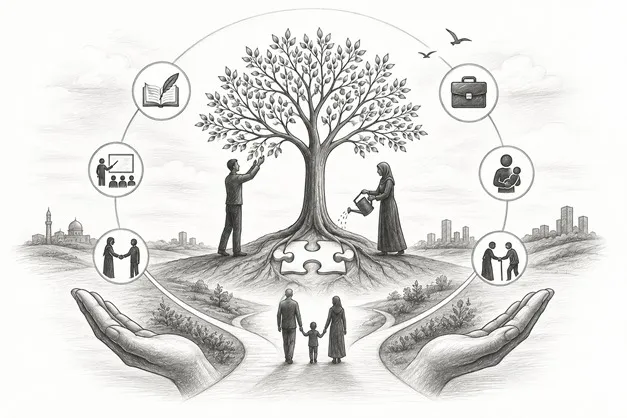
When we say that man and woman are partners, the mind usually turns to husband and wife, although the relationship between them is wider than marriage. A woman enters a man's life as a mother, sister, teacher, wife, daughter and colleague, and a man is present in a woman's life as a father, brother, teacher, husband, son and colleague. They meet in the family, in society, at work and in education, and it is hard to imagine either of them living in a world apart from the other.
From here, partnership is not merely a contract between spouses but a human meaning built on mutual support, the exchange of help and shared effort in building life. The Qur'an expressed this in the words of the Almighty: “The believing men and believing women are allies of one another” [At-Tawbah: 71]. The commentators explained this alliance as support, help and unity of word; believing men and believing women enter together into a circle of moral and social responsibility.[1]
The same meaning is affirmed by His words: “Never will I allow to be lost the work of [any] worker among you, whether male or female; you are of one another” [Al 'Imran: 195]. Man and woman stand within a single human structure; their difference does not erase them, nor does it turn into a wall that separates one from the other.[2]
When we look at history with this eye, it is no longer merely a story of perpetual conflict between the sexes. It is true that many societies have witnessed injustice, exploitation and imbalances of power, but daily life has continued to demand wide forms of cooperation. In the agrarian family, for example, the land needed someone to plant and harvest it, the animals someone to tend them, the food someone to prepare and store it, and the children someone to look after them. The distribution of these tasks differed from one society and set of circumstances to another, but life remained founded on shared burdens more than on two separate worlds.
In the modern age the tools and workplaces have changed, women's education and employment have widened, and machines have lightened many burdens, yet the need for partnership has not vanished. The home still needs managing, the child still needs care, money still needs earning and handling wisely, decisions still need consultation, and crises still need someone to carry their weight. Life has changed, but it has remained too heavy for one party to carry in every circumstance.
Partnership does not mean dividing everything in strict arithmetical equality. The husband may be the main provider, the wife may contribute from her own wealth by choice, or both may work. A woman may devote herself for a period to caring for her child, so the man bears a greater economic burden; then circumstances change and the wife needs time for study or work, so the husband takes on a larger share of the household. Balance is not achieved by each side performing the same number of tasks, but by distributing the burdens in a way that serves the family's interest, preserves rights, and does not leave either party carrying life alone.
This is why a family differs from a commercial company. Matters enter the marital relationship that do not admit rigid division: pregnancy, childbirth and nursing; illness and loss of work; a child who needs special care; two parents who are growing old. One spouse may, in one stage, give more than he or she receives, and then the days turn and he or she needs the other to carry the load. This does not cancel rights and responsibilities; it places them within a relationship wider than bare accounting.
The Prophetic Sunnah offers a practical picture of this partnership. Aisha, may God be pleased with her, was asked what the Prophet (peace be upon him) used to do in his house, and she said: “He used to be engaged in serving his family,” and when the time for prayer came, he would go out for it.[3] Standing and responsibility do not prevent a man from sharing in the affairs of his home, and giving help does not diminish the one who gives it.
Partnership does not stop at housework. At the Treaty of Hudaybiyyah, when the Companions found it hard to carry out the Prophet's (peace be upon him) command to sacrifice and shave their heads, Umm Salamah, may God be pleased with her, advised him to go out and sacrifice and shave without speaking to anyone; and when he did so, the Companions rose and did likewise.[4] This episode reveals a simple and profound meaning: wisdom is not determined by the sex of the one who offers it, and a sensible partner benefits from the other's opinion and sees no loss of standing in taking it.
A wife may be better at managing money, or more experienced in teaching the children, or better informed about some matter facing the family, just as a husband may be better suited in other respects. Mature partnership does not ask, “Who should win?” It looks instead at what serves the shared goal, while preserving the responsibilities that neither party may shirk.
Rivalry, by contrast, changes the nature of the relationship. Instead of seeing the other's ability as an addition to oneself, each side sees it as a threat to their place; success becomes comparison, and small details become arenas for proving oneself: who makes the decision? Who gave more? Who gave way? Who had the last word? The flaw lies not in the man's strength or the woman's independence, but in the relationship shifting from joint building to contending over position.
Partnership does not mean the absence of disagreement or the dispensing with clear responsibilities. It means that management serves the family and does not turn into a struggle for power. Nor does it require either spouse to dissolve into the other, or the two to share everything in equal measure; rather, each keeps his or her own character and responsibility, and what each has becomes help for the other and strength for the common structure.
Rivalry asks: who comes out ahead? Partnership asks: what can we build together?
[1] Al-Tabari, Jami' al-Bayan 'an Ta'wil Ay al-Qur'an [The Comprehensive Exposition of the Interpretation of the Verses of the Qur'an], commentary on Surat At-Tawbah, verse 71; Al-Baghawi, Ma'alim al-Tanzil fi Tafsir al-Qur'an [The Landmarks of Revelation in the Exegesis of the Qur'an], commentary on Surat At-Tawbah, verse 71.
[2] Al-Baghawi, Ma'alim al-Tanzil fi Tafsir al-Qur'an, commentary on Surat Al 'Imran, verse 195; Al-Razi, Mafatih al-Ghayb [The Keys to the Unseen], commentary on Surat Al 'Imran, verse 195.
[3] Al-Bukhari, Sahih al-Bukhari, Book of the Adhan, chapter on one who was attending to his family's needs when the prayer was called and went out to it, hadith no. 676.
[4] Al-Bukhari, Sahih al-Bukhari, Book of Conditions, chapter on conditions in jihad and in reconciliation with the people of war, and the writing of conditions, hadiths 2731–2732.
Related service: Marriage counselling
Questions people hesitate to ask
Does marital partnership mean splitting tasks equally?
No. Balance does not come from each spouse doing the same number of tasks, but from sharing burdens in the family's interest while protecting rights. The husband may be the main provider, the wife may devote a stage to caring for a child, and later circumstances may have the husband carry more of the household.
What is the difference between partnership and rivalry in marriage?
In rivalry each spouse sees the other's ability as a threat, success becomes comparison and small details become arenas to prove oneself. In partnership each keeps their own character and responsibility while what they have becomes support for the other; rivalry asks who gets ahead, partnership asks what we can build together.
Share your thoughts
Have you been through something like this, or has a question come to mind? Write it here. Your words may help another reader.
No comments yet. Be the first to start the conversation.