The Sexual Instinct
 Dr. Abdulqawi Al-Qadasi · 6 min read
Translated from the Arabic. Read the original (العربية)
Why did God place this strong inclination in the human being? Is instinct the same as desire, or is there a difference between them? What does the human being share with other living creatures, and what distinguishes him from them? And does everything a person feels become something he must follow, or does his freedom begin when he chooses how to direct what he feels?
A human being is born with dispositions within him that drive him toward what preserves his life: hunger calls him to food, fear alerts him to danger, the need for others leads him toward the group, and the sexual drive links his existence to the succession of generations. This does not mean that a human being is born carrying a fully formed sexual behaviour; he is born with an innate disposition that emerges and grows in its own time, shaped by the body, age, health, psychological state and the environment he lives in. Islam affirms this innate principle in the words of the Prophet (peace be upon him): “No child is born except upon the fitrah (innate human nature); then his parents make him a Jew, or a Christian, or a Magian”[1], which shows that the original state of the human being is a sound fitrah, after which upbringing, environment and culture come to direct that fitrah or to influence its course.
We usually call this disposition “the sexual instinct,” but the word needs some clarification. Instinct is a latent principle in the make-up of a person, not a passing event that comes over him and then disappears. Desire is the appearance of that disposition in the form of an inclination a person feels and which carries him toward a particular end. Instinct may exist without desire being present at every moment, just as desire may strengthen or weaken according to a person’s circumstances.
Appetite (shahwah) is the intensification of the inclination and the demand for its satisfaction. Al-Raghib al-Isfahani defined it as the soul’s yearning for what it wants.[2] Hence instinct, desire and appetite are not identical words: instinct is the origin, desire is the inclination when it is present in the soul, and appetite is the force of that inclination when it intensifies.
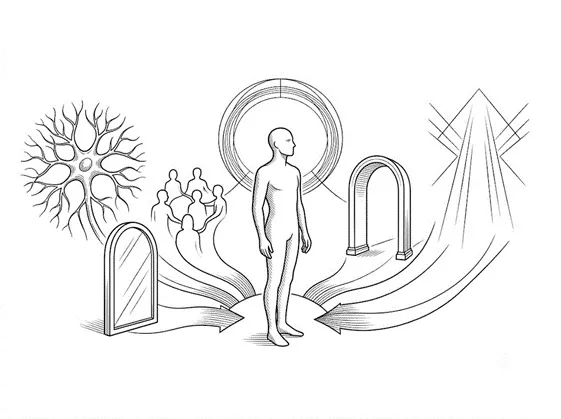
This distinction is not merely linguistic; it helps us understand the human being more deeply. The existence of instinct does not mean desire is always present; the presence of desire does not mean a person is compelled to follow it; and the intensifying of appetite does not cancel his ability to stop and think. A person may not choose every feeling that passes through him, but he has a space in which he chooses what to do with that feeling.
In the world of living creatures, the sexual drive is tied to an evident function: reproduction and the continuation of species. In sexual reproduction, genetic material from two parents comes together, and different combinations appear in the offspring, and this difference contributes to diversity within living populations. This does not mean that every difference is beneficial, or that sexual reproduction is the only way for life to continue; living things know many forms of reproduction. But the mixing and recombining of genetic material gives generations a measure of diversity that may help them face environmental changes and various pressures.[3] This explains one aspect of why instinct exists, but it does not by itself explain the way a human being lives it.
Abu Hamid al-Ghazali noted the link between appetite and the survival of the human species, and held that God made it a force that drives a person to the path by which offspring continue.[4] The drive that an individual lives as a private feeling thus performs, in the larger picture, a function that goes beyond the individual himself, for through it he takes part in the survival and continuation of life.
But the human being, though he shares with other living things the origin of this function, does not live his instinct in the same way. He does not move in response to his body alone; he is accompanied by a memory that recalls, an imagination that pictures, a reason that weighs, and a language that gives feelings names and meanings. He can foresee the consequences of his actions, and ask before acting: what will happen afterwards? Am I wronging anyone? Am I willing to bear what follows from my choice?
Culture also takes part in shaping the way a person understands his desire and expresses it. Society does not create the origin of instinct, but it shares in directing it through upbringing, custom, religion and law. A person learns from his environment to govern his desire and respect the other, but he may also learn from it to make light of the body or to look at a human being as a means of gratification. For this reason human instinct does not work in a vacuum, but always interacts with the ideas, values and images a person receives.
Here the most important difference appears, between the drive and the act. The drive occurs inside the human being, while the act goes out from him into the world and leaves its mark on others. Hence it is not right to make every desire a right, nor to make the mere feeling of it a sin. Responsibility begins when a person chooses the path he takes, and when his freedom meets the rights and dignity of others.
In the Islamic vision, appetite is not evil in its origin, nor is the body an object of contempt. God Almighty says: “Beautified for people is the love of that which they desire…” [Al Imran: 14]; He mentions the existence of the inclination in human nature, then directs a person’s choices and sets limits for them. What is required is not the abolition of instinct, which would not accord with the fitrah, but its refinement, so that it fulfils its purpose without wrong, exploitation or waste.
This refinement does not mean that a person lives at odds with himself; it means that he understands what goes on inside him and does not reduce his self to a moment of desire. A human being is greater than his appetite, and too honoured to become its captive; and it is wise to say to him: Be the leader of your own self, not a slave to your appetites, which lead you wherever they wish.
Strength is not always in advancing; it may lie in the ability to stop, to defer gratification, and to choose the path that accords with values and consequences.
Instinct supplies life with the energy to continue, but it does not by itself determine the form of a relationship or its meaning. Between an inclination that appears in the body and an act that takes place in reality stands the space of awareness, conscience and choice. In this space a person’s humanity begins: not when he denies his fitrah, nor when he surrenders to everything it calls him to, but when he listens to it, understands it, and then gives it the direction that safeguards his dignity and the dignity of others.
But instinct, however strong, does not by itself explain the story of the human being. It may explain the moment of attraction, but it does not explain why a man stayed with a woman, why a passing inclination turned into a covenant, a temporary desire into a responsibility, and a brief encounter into a shared life. Here a new question begins, perhaps one of the most important in this book: how was human attachment born?
[1] Muhammad ibn Isma'il al-Bukhari, Sahih al-Bukhari, Book of Funerals, chapter “If a boy accepts Islam and then dies, is the funeral prayer offered for him?”, hadith no. 1385. Muslim, Book of Destiny, chapter “The meaning of ‘every child is born upon the fitrah’,” hadith no. 2658.
[2] Al-Raghib al-Isfahani, Mufradat Alfaz al-Qur'an [Vocabulary of the Words of the Qur'an], ed. Safwan Adnan Dawudi (Damascus and Beirut: Dar al-Qalam and al-Dar al-Shamiyyah, 1992), entry “sh-h-w.” Book details
[3] Sarah P. Otto, “The Evolutionary Enigma of Sex,” The American Naturalist 174, Supplement 1 (2009): S1–S14, https://doi.org/10.1086/599084. Summary of the study
[4] Abu Hamid al-Ghazali, Ihya' 'Ulum al-Din [The Revival of the Religious Sciences] (Beirut: Dar al-Ma'rifah, n.d.), vol. 2, Book of the Etiquette of Marriage, chapter one, first benefit. Reference text
From the book: The Freedom of the Body… and the Sanctity of the Covenant, by Dr. Abdulqawi Al-Qadasi
Questions people hesitate to ask
What is the difference between instinct, desire and lust?
The article distinguishes them: instinct is a latent root in human make-up, desire is that disposition appearing as a felt inclination toward a goal, and lust is that inclination intensifying and seeking fulfilment. So instinct can exist without desire being present, and feeling desire does not oblige a person to act on it.
How does Islam view sexual desire?
In the Islamic view as the article presents it, desire is not evil in origin and the body is not to be despised. The Quran acknowledges the love of desires in human nature, then guides choices and sets limits. The goal is not to abolish the instinct but to refine it so it serves its purpose without injustice, exploitation or waste.
Share your thoughts
Have you been through something like this, or has a question come to mind? Write it here. Your words may help another reader.
No comments yet. Be the first to start the conversation.