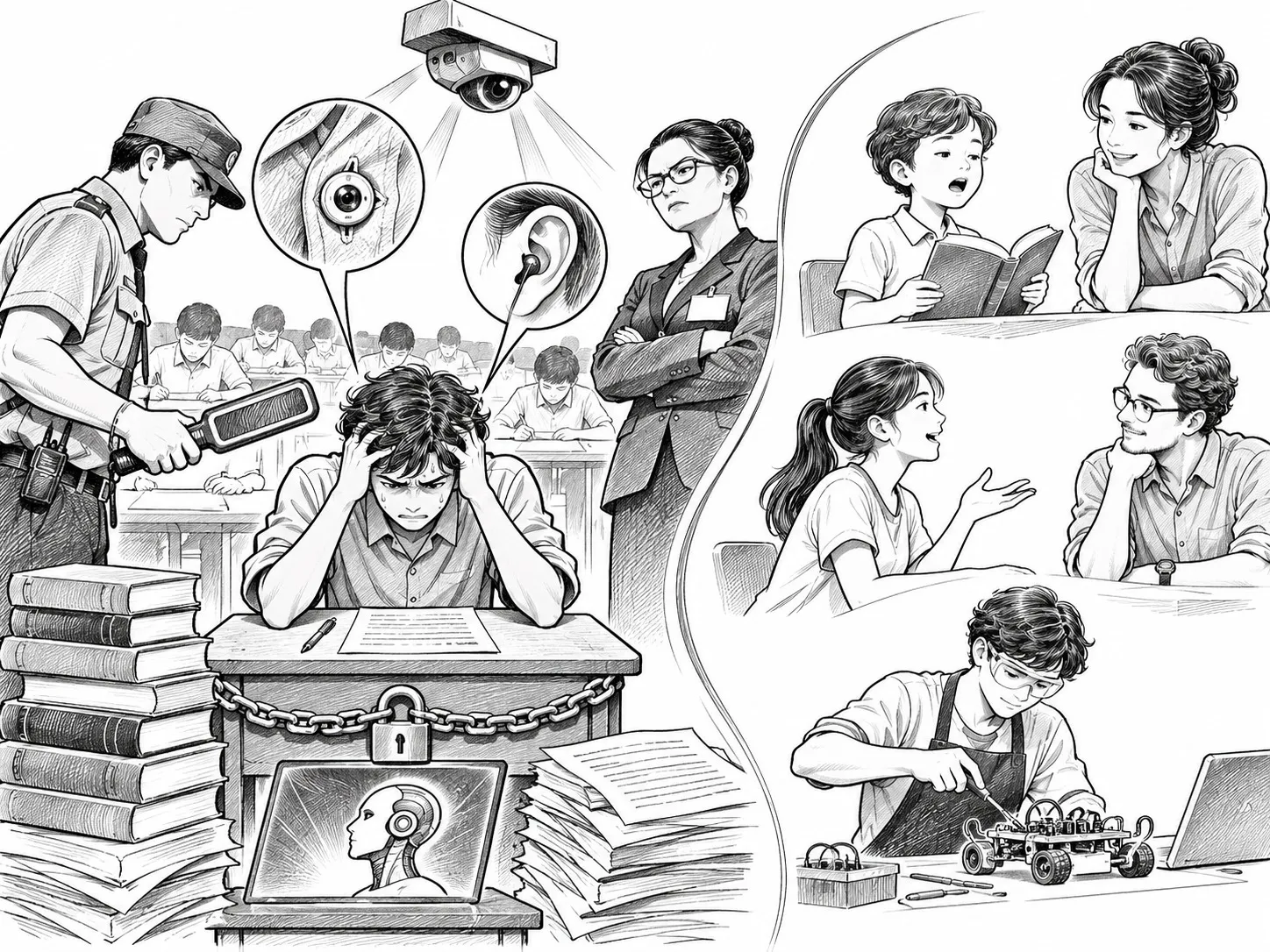
When Values Become Practice
 Dr. Abdulqawi Al-Qadasi · 6 min read
Translated from the Arabic. Read the original (العربية)
From talking about behaviour to daily life
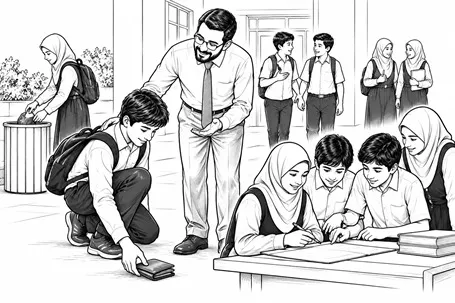
In one school, a student returned a wallet he found in the corridor, and his teacher thanked him in front of his classmates. In another school the same moment might pass without notice; the student did what he ought to have done, and that was the end of it.
But moments like this raise an important question: how does a value that a student knows become a behaviour he chooses when its moment comes?
We have spoken of the school as an educational community, of the influence of the teacher, of the classroom, and then of the playground, the activity and the trip. The most important challenge remains: that education should not stay a collection of scattered moments depending on the alertness of one teacher or the initiative of one administration, but that values should become part of the way of life in the school.
A school may put beautiful words on its walls: honesty, respect, responsibility, cooperation, trustworthiness. A teacher may explain their meanings, students may memorise them, and they may even answer questions about them in an exam. But a value does not become part of a student’s character merely because he knows its definition. Its strength begins when he finds himself in a real situation in which he can be truthful or lie, shoulder responsibility or evade it, respect someone different or mock him.
This is why the union of knowledge and action is a clear principle in the Islamic outlook. The Noble Qur'an condemns the separation of word from deed: “O you who have believed, why do you say what you do not do? Greatly hateful in the sight of Allah is that you say what you do not do” [As-Saff: 2–3]. In the Prophetic education, good character does not appear as abstract knowledge but as conduct practised in dealing with people. This brings us back to the heart of the matter: what matters is not only that the student knows the value, but that he finds opportunities in school to practise it.
Take honesty as an example. We can give a student a whole lesson on its virtue, but the test we hand back to him after marking offers a different opportunity. The teacher finds that the student received two extra marks by mistake. What happens if the student comes and tells him himself? If all that happens is that the two marks are quietly deducted, he may have done the right thing, but the school has wasted an educational opportunity. The teacher can correct the mark and at the same time honour the student’s trustworthiness; then everyone learns that honesty does not mean keeping a gain we did not earn.
So too with responsibility. A student forgets his homework for the third time, or does not complete the part he committed to in a project. We may content ourselves with recording a violation, but education begins when the student understands that every decision has a consequence, and that his responsibility is not only to avoid punishment but to repair what followed from his failing. If his failing held his team back, part of the learning is that he contributes to remedying the harm, rather than merely receiving the punishment.
Even apology needs practice. In some school environments, saying “sorry” becomes a formality the teacher demands to end a quarrel: shake his hand, apologise to him, and that is that. But an educational apology goes deeper: that the student understands what he did and how it affected the other, then takes responsibility and tries to repair what he spoiled. Then the word of apology is no longer a way out of the problem, but part of a person’s learning how to mend his relationships.
This is close to a broad Qur'anic educational principle: that responsibility is tied to deeds and to their recompense: “Every person, for what he earned, is retained” [At-Tur: 21]. A person does not grow morally by merely knowing what is right, but when he learns that his choices have consequences and that he must bear them.
But turning values into practice requires consistency from the school. If a teacher asks students to be punctual while constantly arriving late to his own lesson, or the school demands honesty and then tries to hide its problems when an outside body visits, or speaks of justice while applying the rules differently from one student to another, it is giving a practical lesson stronger than the words it speaks.
Here we are not talking about perfection; a school is a human institution and it errs. Indeed, an administration’s or a teacher’s admission of a mistake and putting it right can be an important educational practice in itself. The problem is not that a contradiction occurs once, but that contradiction becomes an established culture: one thing we tell the students, and another we practise when the value conflicts with self-interest.
Care must also be taken not to turn education in values into merely a system of rewards. If a student earns a point whenever he helps a classmate, and a certificate whenever he does a good deed, we may succeed in encouraging the behaviour, but we must gradually move from the question “What will I get if I do this?” to the question “Why should I do it in the first place?” The aim of education is not to produce a child who behaves well as long as he awaits a reward or fears punishment, but a human being in whom an inner compass forms, one that helps him choose when no one is watching.
We find clear roots for this idea in our educational heritage. Ibn Miskawayh made the aim of refining character that good deeds should issue from a person easily and steadily, rather than remaining an occasional effort; for him, character is tied to forming a disposition in the soul that shows itself in action.[1] Al-Ghazali likewise made character a firmly rooted disposition from which actions proceed, not merely a rational knowledge of what one ought to do.[2] The educational point here is important: a value reaches its goal when it moves from information to habit, and from external supervision to conscience.
This movement does not happen through a single lesson or a weekly campaign about the value of the month. It needs long repetition across different situations. The student learns to respect his turn in the classroom, then practises it in the canteen, keeps to the rules on the playing field, and respects his team’s time in the project. He grows used to returning what is not his, repairing what he has damaged, listening to someone who disagrees with him, and bearing the consequence of his decision. In time, the small situations begin to form a pattern of behaviour.
From here the school can ask itself about every value it proclaims: where does the student live it? If we say responsibility, what real responsibilities do we give him? If we say dialogue, where can he express a different opinion? If we say cooperation, where does he truly need others? If we say respect for diversity, how do we treat in school those who differ in culture, language, abilities or background?
This question is more useful than adding a new list of values to the walls.
This does not mean that the direct teaching of values is unimportant. The student needs to know, to understand, to discuss, and to ask about the reasons for right and wrong. But moral knowledge alone is not enough, just as practice without understanding may turn into a social habit whose reason a person does not know. Deeper education combines understanding, practice, repetition and review, until the value begins to move from outside to inside.
When a school reaches this level, education is no longer an activity that takes place in a particular lesson; it becomes something the student sees in the system, lives in his relationship with his teacher, practises with his classmates, tests in his choices, and bears the consequences of when he errs.
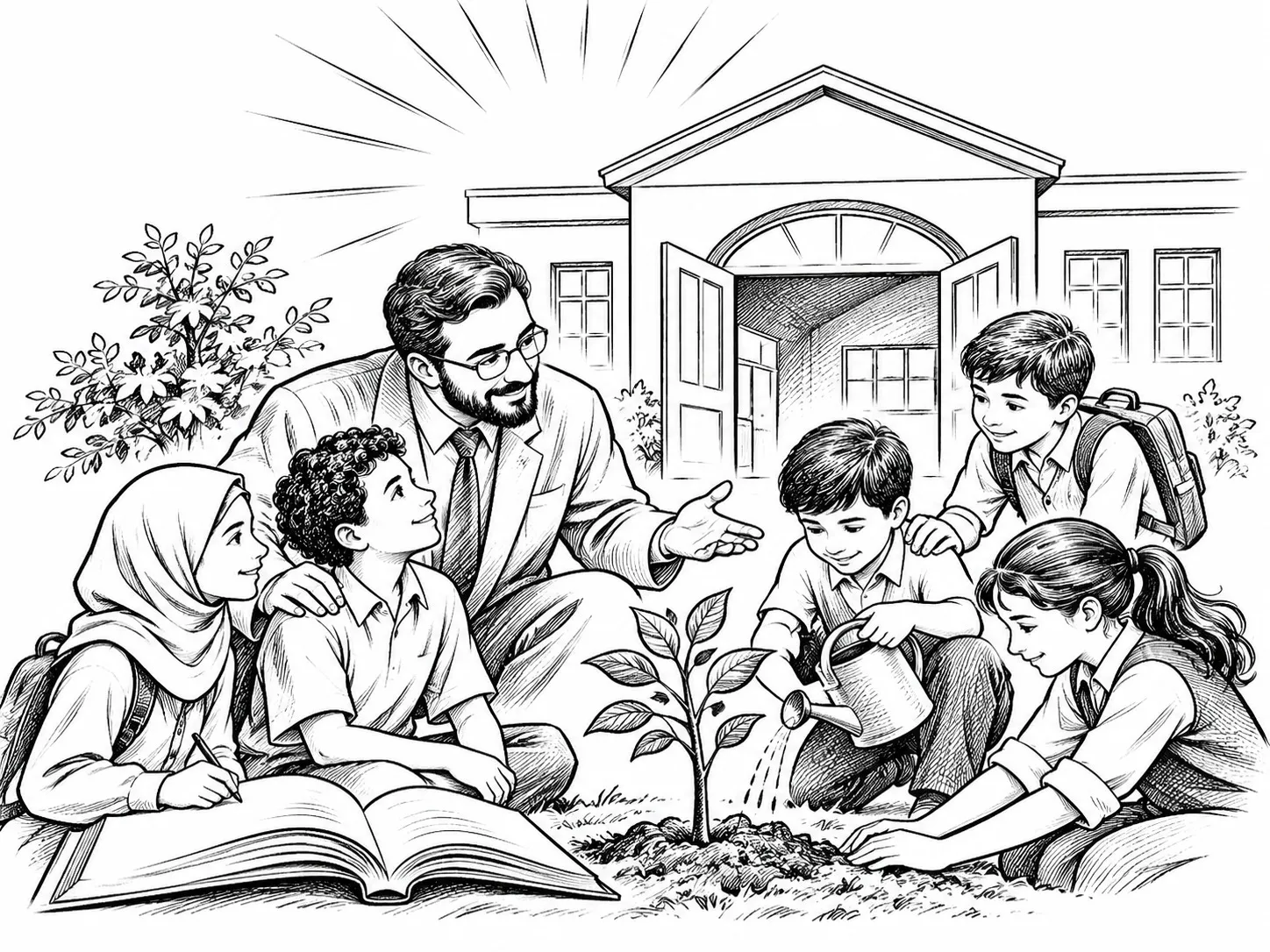
Values are not built by how much we say about them, but by how much we allow the student to live them until they become part of him.
[1] Ahmad ibn Muhammad Ibn Miskawayh, Tahdhib al-Akhlaq wa Tathir al-A'raq [The Refinement of Character and the Purification of Dispositions], in his discussion of character as a state of the soul from which its actions proceed without needing, each time, deliberation and reflection.
[2] Abu Hamid al-Ghazali, Ihya' 'Ulum al-Din [The Revival of the Religious Sciences], the book on training the soul, refining character and treating the diseases of the heart, in his definition of character and his explanation of how it is acquired through discipline and striving.
Related service: Parenting and education counselling
Questions people hesitate to ask
How can a school teach values to students effectively?
By giving them real chances to practise values rather than only defining them on the walls: a teacher who honours a student's honesty about extra marks, a student who helps repair the harm of his negligence, an apology that grasps its effect on others. Repeated across situations, the value moves from information to habit.
Are rewards enough to build good behaviour in students?
Rewards may encourage behaviour, but we need to move gradually from the question what will I get if I do this to why should I do it at all. The aim of upbringing is a person with an inner compass that guides their choices when no one is watching.
Share your thoughts
Have you been through something like this, or has a question come to mind? Write it here. Your words may help another reader.
اجمل ماقيل